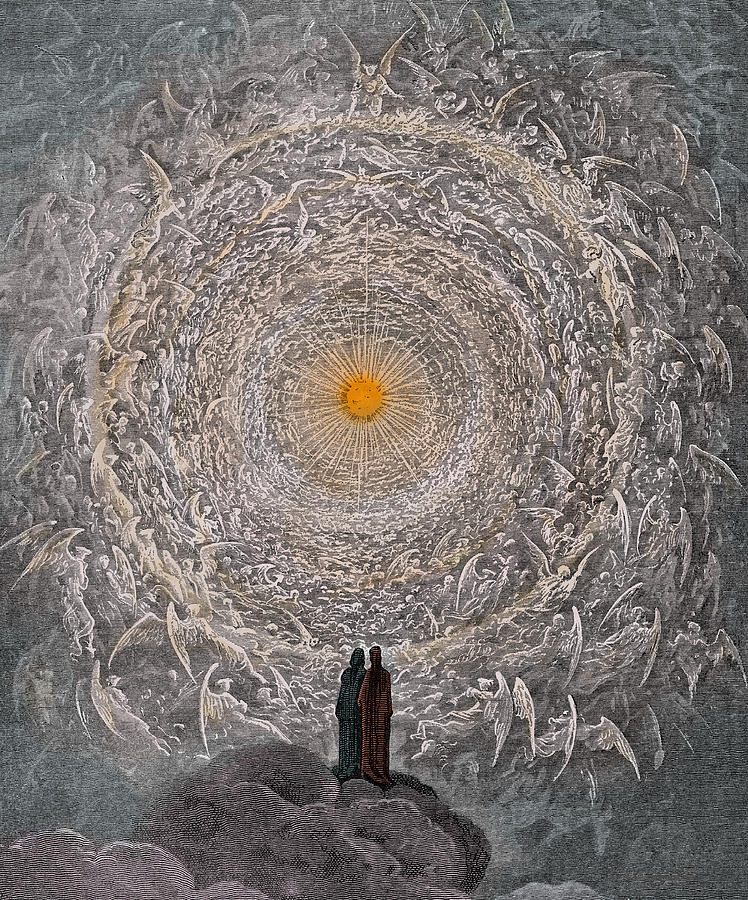
Dante and his true love, the late Beatrice, standing in the Empyrean (the highest heaven) gazing into the celestial rose — the throng of angels and the saints from all periods of history. God lies beyond the rose in the emanating point of light at the center.
“
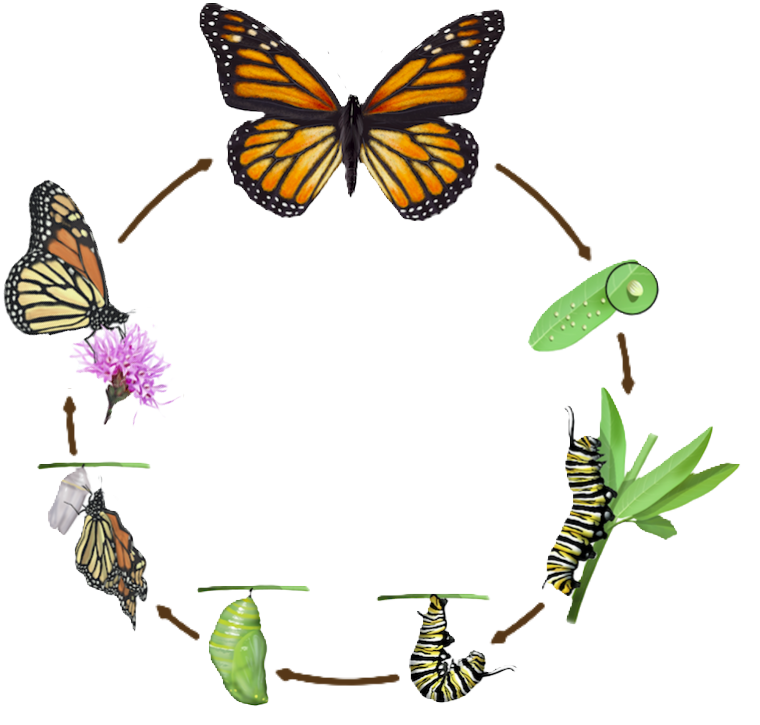
Death is something that occurs only on the earth. In the higher worlds there is transformation, metamorphosis—no death.
”
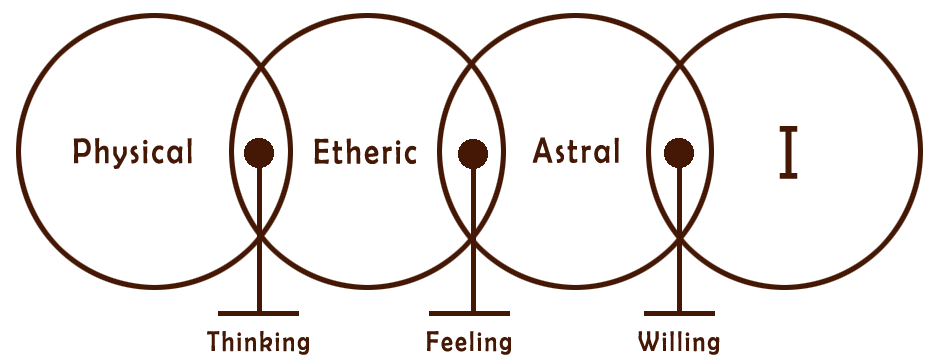
The human being is composed of four bodies with different basic functions. First is the physical body – that is, the outward physical form of the body – which is built up out of mineral substances and which is for that reason visible to us. Second is the invisible etheric body which enables our life processes and functions. The next invisible body is the astral body which enables us to have feelings and perceptions. The highest supersensible body is the 'I' or Ego, our essential self, which enables us to be conscious of ourselves as individual beings among other beings.
—New Food Culture
The physical body shapes your personality in the physical-sensual world in which you are placed.
The etheric body glows with a reddish-blue light like a phantom, but with radiance a little darker than young peach blossom.
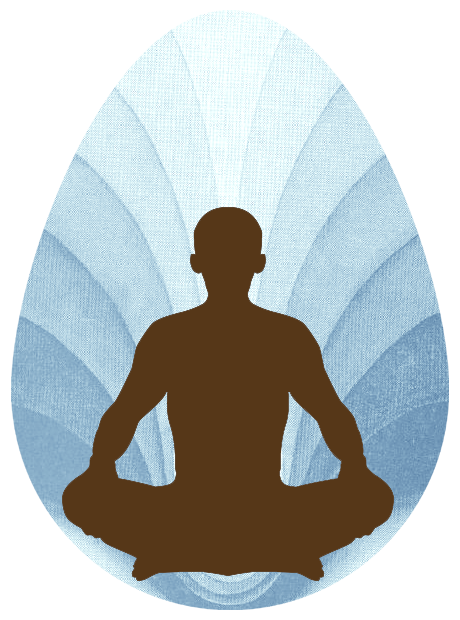
The astral body is an egg-shaped, delicate cloud of light, inwardly full of movement which not only surrounds the body, but permeates it.
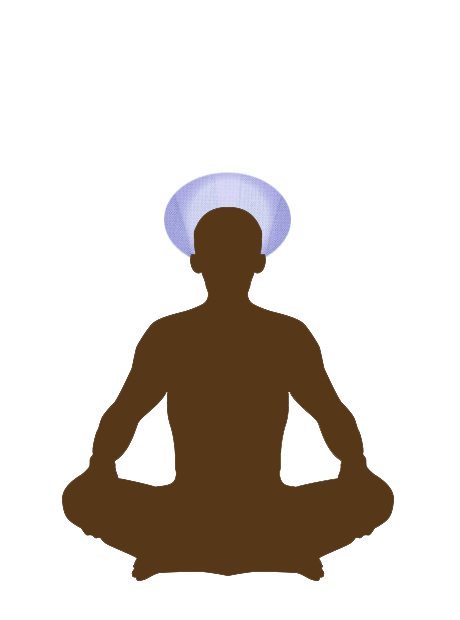
The 'I/Ego' is shaped like a somewhat elongated blue oval, situated at the base of the nose, behind the brow.
For more detailed descriptions of the Fourfold Body, see the notes section.
The Soul
The development of the 'I/Ego' shows how Man received the fourth bodily principle of the human 'I/Ego' through the sacrifice of the Spirits of Form (SoF) that let their substance ripple in and take hold of Man's astral, etheric and physical bodies. These faculties are called respectively the sentient (feeling), intellectual (thinking) and consciousness soul (willing), together making up the threefold soul.
The natural development of the 'I/Ego' is one of growth from the sentient soul experience growing into intellectual and later consciousness soul. Thereby the human 'I/Ego' always uses a larger part of Man's lower structure as a means to function and express itself. The consciousness soul is pivotal as it brings fructification from the spiritual world and moral impulses that are brought down also to the intellectual and sentient souls. As a result, Man's human character is undergoing transformation as the I matures in the mastery and use of the threefold soul.
It is important to realize Man does not leave behind the one aspect for the other, but gains in spiritual maturity: the mastery of having grown into the intellectual soul changes the sentient soul, and similarly the consciousness soul fructifies and changes the intellectual and sentient souls.
The threefold soul consists of three modifications, three parts within the astral body. These three members of the astral body prepare the transformation of the astral body itself, of the etheric body and of the physical body. But these transformations are still not what meets us as the actual human inner being or soul. The soul, the inner part of Man, the three modifications of the astral body must make use of certain instruments, and these express themselves in such a way, that in the astral body the sentient soul is a sort of instrument, in the etheric body the intellectual soul, and in the physical body the consciousness soul. [GA121]
—Free Man Creator
Soul Elements of the Fourfold Human Beings
Beinsa Douno talk: 'The Four Rules' (1937-08-13) [and the Soul]
[the principle of] freedom refers to the soul,
[the principle of] strength to the spirit,
the principle of light to the mind, and the principle of goodness to the heart.
Without having a soul, the human being cannot be free; without having a spirit, he cannot be strong; without having a mind, there can be no light [for him], and without having a heart, he cannot be a good [person].
This very morning, you should examine your condition, see if you have freedom for your soul, strength in your spirit, light in your mind, and goodness in your heart. As you can see, the number four plays an important role in human life.
For this reason, Pythagoras taught his students the properties of the numbers: one, two, three, and four.
In the concept of one, Pythagoras introduced hardness. By this, he wanted to say that one should be so hard that he is unmovable; that is, if he takes something in his hand -- even if the whole world begins to fight with him -- no one should be able to take it away from him. Hardness is a quality of the earth, of the solid matter.
In the concept of the number two, Pythagoras introduced the quality of movement inherent in water. At the slightest slope, the water begins to descend and [passing through] this new environment, it begins to become acquainted with it. The human being must be mobile like water, to be willing to get to know the people he meets on his way and to study them. This is what it means, "a living human being", [namely] the one who can move on his own and be the master of himself.
In the number three Pythagoras inserted the concept of expansion, which is characteristic of air.
In the number four Pythagoras introduced the concept of penetration, which is a property of light.
Thus,
the solid matter has one direction of movement [and tension]: downward, which is its weight.
The liquid matter has two directions of movement [and tension]: downward and sideways.
Air-like matter has three directions of movement [and tension]: downward, upward and sideways.
Light, or fiery matter, has four directions of movement, four directions of tension.
Therefore, one cannot understand life, if he is not durable as the solid matter is, if he is not mobile like the water is, if he does not expand like air does, and if he does not penetrate like the light/fire/ does. To penetrate an object, it means to illuminate it.
—Free Man Creator
Introduction
Life Between Death and Rebirth
If we are to undertake a journey, it is usual and reasonable to make some sort of preparation. If we are to travel into a strange land, it would seem advisable to gather such information as is available. If we are to sojourn in some particularly interesting place, it would be advantageous to learn about conditions there. In particular our stay would be much more fruitful if we had studied the country. If this is true of journeys in this world, then how much more significant must it be in the great adventure that awaits us beyond the grave.
Those who feel the urge to seek may find some of their requirements met by reference to history or literature since survival after death has been accepted as a fact since time immemorial. All the great religions testify to it and many of them to the idea of a rebirth of the human being on Earth, or what is termed reincarnation. Christianity does not proclaim this idea but at least it points to a spiritual world (Heaven) where human beings continue to exist and where they are united with friends and loved ones.
Philosophical thought, too, supports the idea. When Goethe, speaking of nature, says, 'Life is her fairest invention, death her means to create more life,' he is expressing nothing more than a fact of existence. Although the materialistic age produces a feeling of scepticism, it also stimulates the search for new ideas and many great minds of recent and modern times have expressed belief in a continued existence. There are, however, outstanding personalities who know and who can give knowledge from their own experience. Such individualities are endowed with exceptional powers. They possess the ability to penetrate the veil of physical existence and have direct access to the spiritual world. Rudolf Steiner had such a faculty. What he had to reveal is perfectly understandable and satisfying to an unprejudiced mind. But Rudolf Steiner goes beyond the mere answering of specific questions. He puts the answers in a world context showing how knowledge gained by the seeker is not only of significance for himself but for the whole Earth and evolution of mankind.
The Continuity of Life
In day-to-day existence we do not start new projects every day but continue where we left off the day before. In the course of life different faculties develop and understanding matures. It is obvious that today's capabilities and capacities are dependent on yesterday's efforts and experiences, today's comprehension on yesterday's lessons. We may have forgotten the reading lesson but we have acquired the ability to read. We may have suffered some setback but it gives us an ability to sympathise with others. We may have exerted ourselves to learn a language; now we can understand and speak it.
In some way or other we are active in the world. We do something and our deeds have consequences. We do a kindness or the opposite; we do something creative or destructive. Everything has an effect. It is a sobering thought that in some measure, whatever we do, we leave our mark on the world. We might go so far as to say that everything we do, positive or negative, has an effect on the whole course of human evolution and should be judged in this light.
In the spiritual world there are corresponding factors and conditions.
As in early infancy the child learns things which last its whole life through and affect the life beyond, so after death (which is birth into the spiritual world) the individuality will learn things to last the whole of the period between death and rebirth and which will affect the new life on Earth.
As life here progresses in some logical sequence so does life there.
On Earth we enjoy sociability. We grow and develop in and by companionship. Here we are together with those who belong to us and the relationships continue. Here we meet people of dubious character, geniuses, men of high moral standing, and there, too, is variety. As we mutually influence one another here, so do we in the spiritual world.
When the human being dies, he casts off his material body and his eternal spiritual entity enters a spiritual world where his experiences and activities are a continuation of what went on before and where a new, wonderful and tremendously interesting phase of life begins.
After he has learned his lessons and reformed his nature, he is ready to embark on a new earthly existence.
Through the alternating experiences on Earth and in the spiritual world, that which lies at the centre of the human being—commonly referred to as the ego or spirit—is enriched. What has been experienced through existence in a physical body is developed in spiritland. There the spirit is refreshed, perhaps one could say recharged, with what is necessary for earthly life.
In considering the riddles of existence there comes a point when a question arises which cannot be answered—as yet. It concerns the goal of human existence.
It is difficult to visualize an ultimate goal and one is led to think that it must be beyond this evolution, beyond our comprehension and imagination at this stage. What can perhaps be said is that the fruits of all experience are incorporated in the ever-evolving human spirit on its path to become 'ideal' man. Greater revelation will come with greater capacity to understand.
—Wilkinson
1 Interpenetration of Astral and Spirit Worlds
Dr. Steiner continually points out [in his lectures and books] the difficulties of explaining, in earthly language, matters appertaining to the spirit. What is said can only be taken as an approximation or as an equivalent. It is necessary to try to form new concepts. In fact even when one uses the expression 'spiritual world' there is something of a contradiction. 'World' infers something solid. Instead of spiritual world one might equally say a state of mind [or consciousness].
Man does not exist for himself alone. He is related in various ways to all the kingdoms of nature and to the universe itself. Everything is in some way related to everything else. In other words, we must think of the whole of the universe as a unity and man as a part of that unity, subject to the same laws. His continuous existence fits in with the whole idea of creation.
All nature works together and all parts of nature are interdependent. Throughout nature there are cycles of life and within the cycle death is a staging post. The plant grows, blossoms, forms seeds, dies, and a similar plant grows from the seed. Water is revitalized in the rain cycle; air is purified by vegetation; the torpor of winter is followed by the vitality of spring. Death and resurrection.
In nature there is order but it exists not only in nature. It is inbuilt in the universe. By day we observe the regular passage of the Sun across the heavens, by night the procession of stars and planets. We note the established rhythm of day and night.
Man is a part of nature and a part of the cosmos. He is one with nature and one with the cosmos although he has a certain independence. He takes part in the rhythms of nature and of the cosmos. In fact cosmic rhythms are reflected in his own. Actual numbers demonstrate the relationship between the Sun's movement and man's breathing and life-span, but the great rhythm of life is that of expansion and contraction. The plant grows on this principle. Day and night, summer and winter illustrate it. It is reflected in man's alternation of waking and sleeping, or, in a wider context, of birth and death. In the state of wakefulness there is continual wear taking place, evidenced by the feeling of tiredness. In sleep there is a restoring process although man is not conscious of this. During sleep the spiritual part of man has sojourned in its own home, the spiritual world, and it has brought back fresh forces for physical existence. Activity between death and rebirth is similar, but it is directed not to restoring the present body but to building up a new one from the forces of the universe.
Man, Earth, nature, cosmos, spiritual beings are all parts of a unity, parts of a spirit-filled, self-sustaining universe. Life and movement are in continuous harmony. There are no sudden endings. Life persists.
We are inclined to think of the spiritual world, if indeed we think of it at all, as something remote, separate and different. Different it is but neither remote nor separate, for physical world and spiritual world are really one.
A simple example will illustrate the point. A plant needs soil, light, air, warmth for its growth but there is a strange power inherent in the plant which gives it the possibility to grow, and to grow into its own particular form. This has nothing to do with physical forces. It is something non-perceptible to ordinary vision and might be termed—in a general sense—spiritual. Thus the plant is a manifestation of a spiritual force and since this force must exist somewhere we can say that it is centred in the spiritual world.
The plant dies and its spiritual force is dissipated, but that is not to say that it is lost. New plants grow, imbued with the same force and hence we could look upon the spiritual as having an enduring quality.
We can look upon the human being in a similar way. On the one hand he has a physical body and, on the other, something less tangible to which we refer—again in a general sense—as the spirit. Normally we consider that the spirit dwells within the body during earthly existence but that its home is in another realm into which it is released at death.
It is interesting to note that in the process of ageing the body changes its substance every seven years so that the adult cannot be the same as the child. Yet the personality remains. Obviously there is something present of lasting character, something which we also term the spirit.
Following the same line of thought we can consider the whole of creation in the same light. In fact we have good authority for it. The Bible tells us that God created Heaven and the Earth, and man in His own image.
Thus the heavenly bodies which appear to us as physical orbs also have a spiritual background. They, too, are manifestations of the spiritual, in this case of higher beings. They represent the spheres through which the human spirit travels.
Nevertheless, our modern minds think in terms of two worlds. Usually we are aware of the physical only but, if the faculty of perception were sufficiently developed, we could be aware of the spiritual world while still living in the flesh. Death would then become a minor experience. In present circumstances death marks the end of one sort of consciousness and the beginning of another.
—Wilkinson
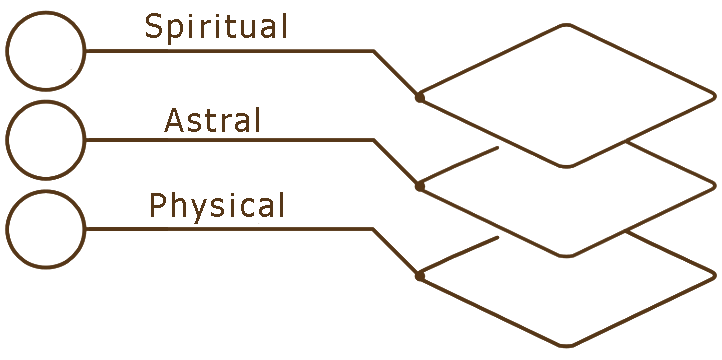
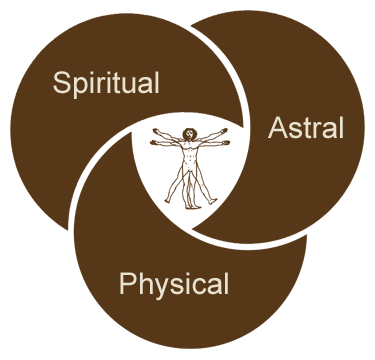
Humanity exists within three worlds — physical, astral, and spiritual. The three worlds should not be regarded as different environments. In reality they interpenetrate, and Man lives in all three worlds at the same time. The astral world overlaps with the physical plane, and also the astral world and the spirit world overlap. These worlds, though they are also called 'planes', should not be thought of as physical in time and space, different, or stacked: they interpenetrate as part of the same single cosmos and the human being functions in all worlds concurrently.[2]
Not ThisMore Like This
2 Earthly Deeds and Attitudes: Their Consequences
As mortals we have strengths and weaknesses of character and what we have made of ourselves is reflected in the spiritual world.
Let us consider the case of a person who has lived an immoral, dissolute life on Earth. In the spiritual world such a person will not be in a position to partake fully of the life there. His experiences will be limited. He will have only a dim, twilight consciousness and will not be able to attract to himself the whole of the normally required forces for a new incarnation. Hence when he next appears on the physical plane he will have a weakness of some sort. On the other hand, a morally disposed person will have greater contacts with the helping higher beings, the Hierarchies, and will attract the right assistance for future health and balance.
Or take the case of an out-and-out materialist, one who on Earth has rejected all knowledge of spiritual matters. In his new surroundings he will be like one lost in the wilderness without chart or compass. By contrast, one who has busied himself on Earth with ideas of a spiritual nature will be better orientated and will achieve greater harmony in his next life on Earth.
It is a fact of life that not all people live to a ripe old age. Parting is always a matter of sorrow, and when a young person dies the feeling of loss is all the greater. Though suffering may be caused, it may be a consoling thought that dying young has another aspect. There is a compensating effect in that the person concerned will achieve a strong position in a future life, or that he will be endowed with a strong will, a strong character or strength to fulfil a special mission. The fact of leaving the Earth in early years also has an effect in the spiritual world. Here such individuals are 'idealists', bringing to the dead the unfinished impulses from their lives and showing that there is something spiritual on the Earth. They act as a counter to materialism. Dying young also releases forces that can be used by the higher beings to help souls who are faltering in their progress.
By contrast, the result of living to an old age results in greater inner activity in the next incarnation and a less defined vocation.
Those who have failed to meet life's difficulties and have taken their own lives face particular problems. For them not only are the normal desires appertaining to the body still present, without the means of gratification, but the sudden and violent separation from the body is felt as a greater deprivation than if death had taken place naturally.
(It might be mentioned here that those in difficulty in the beyond can be helped by those still on Earth.)
Those human beings who have worked on Earth with enthusiasm and devotion, and not merely out of a sense of duty, are in an advantageous position. They can become co-workers and helpers of the higher powers, receiving advancement through the fact of close association. This also applies to those who learn to adapt themselves properly to their environment, that is to say, those who cope with life, however it presents itself. Since a man is on Earth not only to gather for himself the fruits of experience but also to bring impulses into the spiritual world, such beings are strengthened by positive attitudes and in turn they can radiate health-giving forces to the Earth.
It might be said that many people on Earth find themselves in dull routine work where enthusiasm and devotion are difficult to generate. This objection is perfectly valid but it is equally valid that man possesses an inner moral strength and if he can develop this sufficiently he can carry out whatever tasks life imposes. If his work does not inspire enthusiasm, then he can take the opportunity to be creative in some other field.
Moreover the Hierarchies have gifts to bestow on those who are worthy to receive them. Negative attitudes on Earth, no thoughts on the supersensible, result in no awareness of what the spiritual world can offer. It means a lack of some good quality in a future life.
This is particularly the case with those who, rejecting all ideas of a spiritual nature, devote their energies to making for themselves a material paradise of ease and comfort.
A lack of conscience on Earth can also result in a human being coming under the influence of evil spirits in the spiritual world—again with repercussions in a future life.
There is, however, another aspect of these matters which goes beyond the personal. As on Earth we affect our environment so do we in the beyond, although it must be appreciated that environment there is a vastly different matter. It is also possible to take harmful impulses into the spiritual world and these also affect the Hierarchies. These lofty beings are the spiritual background of the terrestrial kingdoms of nature and they are influenced by their association with man. Evil thoughts, evil feelings bring about changes in their character, and, as they change, so do conditions on Earth. This means that man is ultimately responsible for such things as earthquakes and volcanic eruptions, even the destruction of continents. As an example one might recall the destruction of Atlantis through the wickedness of men (Noah and the story of the Flood). Evolution is bound up with changes in the Earth.
In spite of appearances we inhabit an orderly world in which there must be balance. Balance is achieved by compensating. In biblical terms it is reaping as one sows. Should we meet difficulties in this life or the next, we should not complain since they are probably of our own making. We may even bring illnesses on ourselves through our failures.
This law of compensation, in particular the idea of carrying over debts or credits into another incarnation, is what is usually understood by the oriental word 'karma'. In older times, a man knew that if he suffered some inability on Earth it was because he had not acquired the right forces on his previous journey through the spheres, and he would resolve to make good the next time round. The physicians, too, who were initiates, could offer guidance.
—Wilkinson
3 The Nature of the Spiritual World and the Path through the Spheres
Dr. Steiner continually points out the difficulties of explaining, in earthly language, matters appertaining to the spirit. What is said can only be taken as an approximation or as an equivalent. It is necessary to try to form new concepts. In fact even when one uses the expression 'spiritual world' there is something of a contradiction. 'World' infers something solid. Instead of spiritual world one might equally say a state of mind.
Using the language of approximation we can say that at death the human being enters an environment where he no longer perceives the solid objects of the physical world. Instead of stones, plants, animals, stars, he is aware of spiritual beings which are the counterpart of physical existence. Even his own thoughts and those of friends left behind manifest as beings. Time and space do not exist.
We have to try to form a different idea of the being of man and of his relationships with fellow humans. On Earth we are bounded by our skin and separated physically. In the spiritual world there is an intermingling and an interpenetration. Relationships are a matter of consciousness. In a crude sort of way we might think of souls occupying the same place but they are unaware of one another unless the requisite consciousness has been developed. This is enkindled by inward feeling. The ability to perceive has to come from within. Only individuals already acquainted with one another can perceive each other in the spiritual world. Acquaintance can only be acquired on Earth.
There are also higher beings present but no human being is conscious of them unless he has acquired the necessary inner powers. The greater his effort to obtain knowledge of spiritual realities while still on Earth, the greater his consciousness between death and rebirth.
A different experience from that on Earth is for man to feel himself united with the cosmos. At one stage of his progress he feels that the planetary and other heavenly forces are not only outside but also within him, just as, on Earth, he feels that the organs of the heart, lungs, etc, are within him. He feels as if he is spread over the cosmos and looks, so to speak, from the circumference to the centre. It is as if he is duplicated, gathering forces from the different points of the heavens to form his being. A person on Earth with the necessary spiritual development would feel, like the rest of us, that his heart and other organs were within him, but he would also feel that the planetary forces are within these since the body is built up from the forces of the cosmos.
In this connection it is interesting to note that the alchemists of old referred to bodily organs by the names of the planets.
Theology speaks of Heaven and Hell, evoking the concept of regions. The one is a place of eternal bliss and the other of eternal torment. Both must be extremely boring.
Nevertheless the ideas have some justification except that it is more reasonable to think of a series of regions, some of which may be pleasant and some unpleasant, but where there is continual activity as the human being passes through them.
Although one speaks of regions in this context, they must not be thought of as spatially side by side since, in the spiritual sense, they interpenetrate one another. Regions in our case can be equated with spheres but these spheres are not the physical orbs we see in the heavens. They are their spiritual environment, the homes of the Hierarchies.
To speak of a journey is also not quite correct and such an expression in this context must be understood figuratively or imaginatively.
The experience between between death and rebirth is a 'journey' of the human spirit through the planetary spheres to the realm of the fixed stars and back again. As an approximate outline description, we could think that on the outward path we experience the events of our past life, all that we have done on Earth. Now detached from the body we relive them almost as memories but these memories are real, inner experiences. On Earth we know only rudiments of such as, for instance, when pangs of conscience trouble us, or when we rejoice over a good deed.
We meet and accept the judgement of our actions and learn eagerly how they must be compensated. We cannot make amends at this stage. Knowledge and insight will be obtained but only on Earth can things be rectified. What is acquired is a guiding light for a new incarnation.
On our journey we inscribe, as it were, a spiritual record in the planetary spheres. We meet those with whom we have been connected on Earth and also heavenly beings who help us on our way. We reach the highest sphere and turn again towards the Earth, collecting what is our own, the results of our former deeds.
These are woven into the pattern of our future life so that we shall be led subconsciously to situations where we can make good past errors or receive due rewards for work well done. According to what has been deposited on the way up and the measure of sympathy with which we have passed through each sphere, so will forces be given to us by higher beings. They will help in transforming what was learnt on Earth into ability for the next incarnation. With their help we build the prototype of a body to accord with our nature and needs. We must choose the right time to be born, the right place and the right parents, guided by the Hierarchies. All this must be arranged from the spiritual world even to the extent of influencing the coming together of our ancestors many years in advance. The human being is certainly active in all this but not independently active as on Earth, where individual independence is conditioned by bodily existence. Yet we are not passive. Between death and rebirth we co-operate with the higher beings.
—Wilkinson
4 Physical Death & Expansion
When we go through the portal of death, the first phenomenon, the first fact, to appear is the laying aside of the physical body. The physical body undergoes dissolution into earthly elements, regardless of the form of funerary chosen (disintegrated quickly by cremation or more slowly through burial & decomposition — the two processes are exactly the same and only differ in rapidity). In either case, we can refer to it simply as dissolution. The observable fact is that the physical body disintegrates into its smallest particles, which are then incorporated into earthly matter. That is the physical situation, and we can speak of dissolution of this body into earthly matter if we take into account everything we know about matter and substance. We know too that this dissolution process is a spiritual one as well.
The dead man enters a world of reality. This reality consists of what to us are merely thoughts. Whereas in physical life we perceive the external, mineral, vegetable and animal worlds, and have our physical world besides, that of which we only experience the shadowy reflection in our thoughts is immediately present to the dead man when he has passed through the gate of death. The world he then enters really bears the same relation to the physical world as do objects to their shadows here. In our thoughts we have only the shadow of what the dead experience; but they experience it differently from the way we experience our thoughts. They learn something more concerning thoughts from what man on earth does, at least in our present-day epoch. For we usually dream in respects to our thoughts. But the dead man experiences that while he thinks, he lives in his thoughts as in realities; he grows, he expands, he flourishes; but to the extent to which she ceases to think and no longer lives in thought, he declines, becomes thinner and sparer.
Expansion
The first experience, after the death of the physical body, is the feeling that we are growing larger or that we are growing out of our skin. This has the effect of the human being attaining another perception of things than was the case earlier in physical life. Everything in the physical world has its definite place — either here or there — outside the observer, but that is not so in this new world. There, it is as if the human being were inside the objects, extended with or within them, whereas earlier he or she was only a separate object in its own place.
The [next] experience after death consists of a human being's attaining a "memory tableau" (or Panorama) of the life just completed, so that all events in it recur in comprehensive memory. This occurs juxtaposed to the experience described above in the first stage. This process lasts a definite amount of time. For reasons that cannot be stated here today, the duration of this memory is shorter or longer, depending on the individual. In general, the duration of this state can be determined from the length of time each human being was able to stay awake during the past life, continuously and without once succumbing to the forces of sleep. For example, supposing that the outer limit for a person's staying awake continuously had been forty-eight hours, then the memory tableau after death will also be forty-eight hours. And thus, this stage is like an overview of the past [waking] life (hence, 2/3 of a person's life).
The above makes sense i.e. that the duration is comparable to, or as indicated, equivalent to, that part of the just-ended life we spent awake, not including the sum of our life spent physically sleeping — for we understand that when we sleep, our astral body and Ego [ 'I' ] separate from our physical and etheric bodies and 'travel' into spiritual spaces. While in those 'spiritual spaces', we are in contact with Hierarchies that reside there, exchanging what we have learned/experienced during the (waking) day. Such sharing thereby either benefits the Hierarchies (and ultimately all of humanity) or it causes disruption. —Anthony
These pictures [of the memory tableau] are suddenly there: the events of years long past and of the last few days are there simultaneously. As the spatial exists side by side and only possesses spatial perspective, so the temporal events of our earthly life are now seen side by side and possess 'time-perspective'. This tableau appears suddenly, but, during the short time it is there, it becomes more and more shadowy, weaker and weaker. Whereas in earthly life we look into ourselves and feel that we have our memory-pictures 'rolled up' within us, these pictures now become greater and greater. We feel as if they were being received by the universe. What is at first comprised within the memory tableau as in a narrow space, becomes greater and greater, more and more shadowy, until we find it has expanded to a universe, becoming so faint that we can scarcely decipher what we first saw plainly. We can still divine it; then it vanishes in the far spaces and is no longer there.
This is the phase which we can describe as the flight of our memories out into the cosmos. And all that we have bound so closely to our life between birth and death, composing our memory, expands and becomes more and more shadowy, to be finally lost in the wide spaces of the cosmos. Between birth and death we feel ourselves within our memories; and now we actually feel ourselves within these rapidly retreating memories and being received into the wide spaces of the universe.
Etheric Corpse
Then the etheric body leaves the astral body, in which the ego is living. All three had been connected from the time they left the physical corpse, but now the etheric body separates itself from the other two and becomes an etheric corpse. However, today's human beings do not lose their etheric body completely but take an extract or excerpt along with them for all the times to follow. So in this sense the etheric corpse is cast off, but the fruit of the last life is carried along by the astral body and by the ego. If we want to be quite precise, we will have to say that something is taken along from the physical body as well: a kind of spiritual abstract of this body — the tincture medieval mystics spoke about. However, this abstract of the physical being is the same in all lives; it merely represents the fact that the ego had been embodied. On the other hand, the essence of the etheric body is different in all lives, depending on what one has experienced in a life and on the degree of one's progress in it.
—Steiner
6 The Region of Purification (Purgatory, Kamaloka)
In order to understand what is next experienced, we must again consider man's nature. On Earth the human being has many desires and passions which belong to the sense world and which can only be gratified through the physical body. He also has subconscious longings. These feelings belong to the soul and they do not immediately disperse at death. They continue to be felt but now there is no body through which satisfaction can be obtained. The pure spirit in man cannot advance further while connected with and hampered by a soul with bodily desires. The urges must therefore be purged. They cannot now be satisfied and they are experienced as a burning thirst or a consuming fire. This is the explanation of what is usually called purgatory or, in Eastern terminology, Kama-loka. The soul has to learn not to long for those things which can only be satisfied through the body, and through such non-gratification the desires are extinguished. If this appears to be a torment, then it must be remembered that it is a torment which is desired by the human being concerned in order that further progress may be made. It is a process of purification.
In a similar way, thoughts, wishes, remembrances dependent on physical existence must be cast off.
It is obvious that the intensity of experience here will depend on the character of the person. Those with the most earthly desires will have the most to purify.
But this is not the only thing the human being has to endure in this region. Again a little diversion must be made in order that matters may be clear. We must consider what happens during sleep.
In normal day-to-day existence the human being alternates between sleeping and waking. In sleep he is normally unconscious of what is going on around him but this does not mean that he is inactive. It is true that the body rests in bed but the spiritual part of his being leaves it and soars into another realm where the events of the day are recollected. All that a man has done, felt or thought is reviewed and the angelic hosts who dwell in this world pass judgement on events.
After death the human being relives, so-to-speak, his sleep life and he does this in reverse order. He first experiences events immediately preceding his death and goes back to the moment of birth. It is a life of memories but of memories which evoke a reaction, for now he feels the pain, the suffering, joy, etc., which he caused others. In these recapitulations, therefore, he is at the receiving end of his own deeds. What he gave, he now receives. Any distress he has caused others, including the animal world, he will now experience himself. It is a salutary reversal but at this stage nothing can be done by way of compensation. Nevertheless, insight is given. Man realizes that everyone of his acts has consequences. He realizes the significance of his deeds for the whole of the rest of the world. An impulse is given to make good where necessary, but this, however, can only be done on Earth in a future incarnation. Thus man begins to form ideas of future destiny.
Encountering Other Beings
There is a meeting together here of those who were connected with one another in life and the significance of common destiny begins to unfold. In meeting, however, another sort of lesson is learned. The human being has no way of disguising his moral nature. Whereas on Earth the physical appearance of a man may tell nothing of his moral character, in this region, in his spiritual appearance, this is exposed and cannot be cast off. He is thus recognized by others for what he is and, in turn, he recognizes others. What on Earth was hidden, perhaps in the deep recesses of conscience, now becomes manifest. His own feelings of aversion or affection call forth a reaction in the other person so that he sees himself reflected in others as if in a mirror.
These things are also an objective judgement and give further impulse to correction, improvement or compensation. Another point to note is that perception, and hence progress, depend on a willingness to see. The individual has to become conscious of others in this spiritual world by means of his own individual effort.
Besides fellow humans, there are other beings in this region. On the one hand there are evil creations who derive nourishment from man's passions. The excarnated human being is faced with horrible forms which instil fear into him but in actual fact they are manifestations of his own lower urges. On the other hand, there are also higher beings and man is conscious of their joy or sorrow at what he brings with him from earthly life. This is felt as a judgement. Forces of sympathy or antipathy stream from them according to what is brought and these provide guidance.
As here on Earth there are some people who find life easy and some otherwise, so also in the spiritual world there are those who have a relatively easy passage and others who meet difficulties. There is, however, one great difference. In physical life it is quite possible that the honest and the just may suffer hardships and the rogues and villains have a life of ease and comfort. But the manner of life after death is determined by justice. There is compensation but it must not be thought that justice is something imposed by an outside agency. It is something sought by the individual for it is his means of progress.
With regard to the time-aspect, time can only be reckoned in relation to the Earth but, since we reckon time between incarnations, we can think of periods spent in various regions. In this respect and in earthly terms, the sojourn in this region of purification lasts for about a third of the lifetime, i.e. the same period as has been spent asleep. Those who have lived for a long time are likely to have more to shed than those who die early, while any one who dies very young would have attracted few burdens and passes through quickly.
The Astral Corpse
At the end of the Kamaloka period, i.e. when the grossest physical urges have been overcome, the spirit is able to cast off an astral substance, an astral corpse, which falls away like the physical body at death.
Preparing for Kamaloka
It is not a question of whether our wishes, desires, passions and so on are in the superconscious, in the ego-consciousness, but whether they are also in the astral, in the subconscious. Both have the same burning effect after death, and the wishes and desires that we have concealed here in life actually have an even more intense effect after death. [GA 140] Of course, this state is not only an agonizing one; it is only agonizing until this astral body has weaned itself from the desire for pleasure. So the more the astral body had needs here in physical life, the longer this state lasts. But from this you can already see that, depending on the quality of the needs that the human being has had in the past life, the astral body in Kamaloka can encounter not only agony, but also under certain circumstances something very good and pleasant. For example, he then experiences pleasantly every joy he has had in beautiful nature. In order to enjoy this pleasure in beautiful nature, we must have eyes to see, but beauty is something that transcends the physical, and therefore this state is also the source of heightened pleasure in Kamaloka life. Such things are the causes of the greatest joys and wonderful experiences, even during the Kamaloka period. A person can make this time more beautiful if he frees himself from attachment to purely physical pleasures. [GA 100] We also live through all the spiritual things we have already experienced between birth and death, we also live through the good events of life in such a way that we have them before us again, as it were, in a mirror image. [GA 119]
This Kamaloka time is therefore not always a horrible or unpleasant one. In any case, man becomes more independent of physical desires, and the more he has already made himself independent in life and acquired interests in looking at spiritual things, the easier this Kamaloka time will be for him. He becomes freer through it, so that man becomes grateful for this Kamaloka time. The feeling of deprivation in the physical life becomes bliss in the kamaloka time. Thus the opposite feelings occur, for all that one has learned in life to be gladly deprived becomes pleasure in the kamaloka time. [GA 108]
7 The Period of 'Education' (or, Kamaloka 2.0)
Now the individual spirit traverses various soul regions in each of which he has some specific experience. He is 'educated' by beings of a higher order. It is almost like progressing through different classes in school and being taught by different teachers. But his capacity to understand and to receive benefit is conditioned throughout by his previous attitude on Earth. A mind which was orientated towards the spirit will have provided a better basis for understanding than that of a materialist. Earlier feelings of love and sympathy also play a part as well as morality and religious conviction.
Up to now his experience has been one of beholding, of vision, but now he comes into a region where he is made more conscious of the far-reaching consequences of his deeds and how they may influence the future. Angelic beings remind him of his actions on Earth and that he has to reckon with these. He becomes more aware of wrongs committed against others but at this stage he can still do nothing to compensate. It is a further painful experience.
In Kamaloka the human being knew only the reactions of the spiritual beings who showed pleasure or displeasure at what was brought to them. Now he is permeated by their forces which give him a sort of moral consciousness or what one might call a cosmic conscience.
The conditions under which he lives in this region are dependent on morality in the previous Earth existence. A moral person enjoys sociability with others and with higher beings. This, of course, means advancement, but an immoral person lives in isolation, excluded from the community, and leads a restricted and solitary existence. This is felt as a torment for the individual but it also has a negative effect on the world generally.
In the next region the 'teachers' add description and explanation of the former earthly existence. What is decisive for man's understanding of these matters and for his social life is his former religious disposition ('religious' is to be understood in the broadest sense as having some understanding that the physical is transitory, that a spiritual essence permeates the physical, that man is of divine creation and immortal, whatever the creed). Human contacts here are like with like. For example, Hindus will find fellow-Hindus; Christians, fellow-Christians.
In his upward progress man continues to receive instruction from the higher beings at a higher level. He acquires a great knowledge of destiny. He learns more about his relationships with other humans and how these will affect the future. But more than this, he is now expanding so far into the cosmos that he begins to feel at one with it. Whereas in physical life he had felt Earth to be his home, he now feels that he is a creature born out of the spiritual world. He comprehends more of the spiritual realms and their connection with the Earth. He becomes aware of the interworking of the planetary spheres and this awareness becomes auditory. He 'hears' what the old Pythagoreans used to call the 'Music of the Spheres'.
The conditions for full participation and receipt of benefits here are a previous appreciation on Earth for all religions, including what was Christlike in another person even if his faith was not Christianity.
8 Fulfillment and Transformation: Building the Next Incarnation in Devachan[4]
The human being now enters Devachan (or spirit world) where he or she prepares in the spiritual world for a new life in the future. Here human beings live with spiritual events and beings until they are again called into the physical world, be it because the karma of a person demands it or because an individual is needed on the physical earth.
But now it is not only a question of education. Together with the Hierarchies the individuality begins to work on the spiritual pattern of his new physical body. This has a certain relationship with the old one. The previous physical body will be transformed—spiritually speaking—into the prototype of the new head. With a little imagination it is not difficult to observe a threefoldness in the head which corresponds to the whole physical organism. The dome is the head part, cheek bones are like arms and the lower jaw, legs. There are also corresponding functions. Sense impressions belong to the head; nose and lungs are related, and so are the jaws and digestion.
The way is taken into still loftier spiritual realms. As in previous regions, consciousness depends on the attention the individual has given to spiritual values while on Earth. If sufficiently awake, he now finds himself in a world of pure spirit and feels himself as a spirit among spirits. He realizes that thoughts are living realities and that in this world they are beings. He appreciates how the spiritual permeates everything physical and he recognizes the spiritual background of all material things.
If he is sufficiently advanced he has a remembrance of earlier lives and a preview of future ones. He has a survey of all his human connections. Earthly life is seen from a cosmic viewpoint. He recognizes what has been of spiritual value. He has reached the furthest limit of his journey and the point of return.
He comes into closer relationship with mighty divine creative beings who guide, help and influence his future to be in harmony with what is true and spiritual. It is a sublime experience to be among the Hierarchies.
Consciously or unconsciously the human being works with the higher powers, continuing the task already started, transforming the spiritual substance he has brought with him into capacities. The spiritual pattern of the body needs more shaping. Account must be taken of deserts and merits and whatever is required to fulfil the new destiny. This body is built from the ingredients of the whole spiritual universe, by forces streaming in from the cosmos. As a magnet takes its direction from forces outside itself so does the body take shape under the influence of outside forces that are spiritual. Its final appearance on Earth is a manifestation of this spirituality but the finished form must fit the individuality. Time and place of birth as well as ancestry must be determined in accordance with karmic needs.
The forces of the cosmic powers now stream into man, giving him the feeling that they are more and more active within him. He is inspired to work towards their goal of ideal man. He experiences himself far more intensively as an individual, and as this feeling grows richer the vision of the spiritual environment begins to fade. A longing for the physical world develops.
9 Descent to a New Incarnation
In the outer spheres the spiritual pattern of the new body has been formed in accordance with the individuality's new requirements. Experiences have been changed into capacities, the spirit enriched.
During the upward journey a record of perfections and imperfections has been left in the various regions. Now on the journey to Earth again these records, or rather the compensating aspects, become part of a person's karma, that is, the pattern of life. They are woven into his being.
As the individuality descends into the soul world, he gathers substance or forces from the astral world to form his own astral body. This will contain directives in accordance with former deeds, directives that will influence his future.
The spiritual Hierarchies take part in the weaving of the path of destiny.
Coming into lower regions there is now a feeling of separation and a loss of consciousness of the upper realms. The individual seeks the right basis for a new incarnation.
From the world ether the individuality gathers etheric forces for his new body. The strength or otherwise of these is also determined by previous deeds and character.
There is a right time and a right place to be born to accord with requirements. Birth takes place in both an earthly and a cosmic setting. The personal constellation is a moral inheritance.
The parents provide the physical basis for life on Earth. As the individuality descends and connects himself more closely with her who is to be his mother, he has the longing to be on Earth to fulfil his karma. Immediately before incarnation he has a preview of earthly life in general outline. During the embryo period his consciousness is dimmed to dream consciousness with which he lives at the beginning of earthly existence.
Appendix
The Moment of Death and the Period Thereafter, GA 168
22 February 1916, Leipzig
The time in which we live reminds us daily and hourly of death, this significant event in human life; it reminds us of man's passage through the portal of death. For only in the light of spiritual science does death become a real event in the true meaning of the word, because spiritual science shows us the eternal forces that are active within us, that pass through births and deaths and take on a special form of existence between birth and death, in order to assume another form of existence after their passage through the portal of death. In the light of spiritual science, death becomes an event, instead of being merely the abstract end of life (only a materialistic world-conception can look upon death as the end of life); it becomes a deep and serious event within the whole compass of human life. Even from our own ranks, dear friends of ours have left us in order to pass through the portal of death, chiefly as a result of the present historical events, but also for other reasons, and so it may perhaps be particularly appropriate just now to say a few things on death, on this great event, and on the facts of human life that are connected with it.
Explanations have often been given in our spiritual-scientific lectures on the life between death and a new birth, so that we were able to gain many essential facts, particularly in regard to this subject. The course which spiritual science has followed up to now will have shown you that in every single case it can only speak of things from one definite standpoint, so that a more accurate knowledge can gradually be acquired by speaking of things repeatedly and throwing light upon them from many points of view. Today I shall therefore add to the facts that you already know in connection with this subject a few things that may be useful to our comprehension of the world as a whole.
Through spiritual science, we consider, to begin with
(and that is a good thing), the human being such as he stands before
us, here in the physical world, as an expression of his whole being.
We must depart first of all from the manner in which the human being
presents himself to us in the physical world; and for this reason, I
have frequently pointed out that we obtain, as it were, a general
view of man's whole being if we contemplate him so that we first
take, as a foundation, his physical body which we learn to know
externally in the physical world through our senses and the
scientific dissection of what we perceive through the senses. We then
proceed by studying that form of organization which we designate as
our etheric body: this already possesses a super-sensible character
and cannot, therefore, be contemplated with the aid of the ordinary
intellect, which is bound to the brain, and is consequently also
inaccessible to our ordinary science. The etheric body is an organism
having a super-sensible character, concerning which we may say that it
was already known to men such as Immanuel Hermann Fichte, son of the
great thinker Johann Gottlieb Fichte, to Troxler and others. Indeed,
man's etheric body can only be grasped through imaginative knowledge
owing to its super-sensible character; but as far as imaginative
knowledge is concerned, it can be contemplated externally,
just as the physical-sensory body can be contemplated externally
through our ordinary sensory knowledge.
We then ascend in our contemplation to the astral body.
The astral body in man cannot be contemplated in an external-sensory
manner in the same way in which we contemplate the physical body
through our external senses, or in the same way in which we
contemplate our etheric body through our inner sense; the astral body
is something that can only be experienced inwardly. We must
experience it inwardly, and in order to experience it we must be
within it. The same thing applies to the fourth member which must be
grasped in the physical world, to the ego. With these four members of
human nature we build up our whole being.
Past lectures showed us that what we designate as man's
physical body is a very complicated structure, formed during long
periods of development, that passed through the stages of Saturn, the
Sun and the Moon; also the evolution of the Earth
contributed to this development of the physical body, from the very
beginning of earthly existence up to our time. A complicated process
of development therefore built up our physical body.
That form of contemplation which is, to begin with,
accessible to us in the physical world merely sees the external
aspect of everything that lives within the physical body. Even
ordinary science merely sees this external aspect. We might say: our
ordinary physical contemplation and ordinary science, in the form in
which it now lives in the world, merely know of the physical body as
much as we would know of a house if we would only go round it
outside, without ever going inside, so that we would never learn to
know what it is like inside, nor what people live in it.
Of course, those who stand upon the foundation of
ordinary science, in the usual materialistic meaning, will
argue: 'We are thoroughly acquainted with the interior of the
physical body! We know what it is like, because we have frequently
studied the brain inside the skull when dissecting corpses; we have
frequently studied the stomach and the heart.' This interior,
however, that can thus be studied from outside, this spatial
interior, is not what I mean when I speak of man's inner being. Even
this spatial interior is nothing but an external thing. Indeed, in
the case of the physical body, this spatial interior is far more
external than the real spatial interior.
This must sound strange. But our sense-organs —
you know this from other descriptions contained in our spiritual
science were formed already during the Saturn period and we carry
them on the surface of our body. Spatially speaking, they are
outside. Nevertheless, they were built by forces that are far more
spiritual than those that formed our stomach or everything that
exists, spatially speaking, inside our body. What is inside our body
is built up by the least spiritual of forces. Strange though it may
sound, I must nevertheless point out that we really speak of
ourselves in an entirely mistaken manner upside down, we might say.
Since we live on the physical plane, it is natural to speak in that
way; nevertheless the way in which we speak of ourselves is quite
wrong. We should really designate the skin of our face as our
interior, and the stomach as our exterior. This would lead us far
closer to the truth! It would lead us closer to the real truth if we
were to say: we eat in such a way that we send the food out of us;
when we send food into our stomach, we really send it out, we do not
send it into our body, as we generally say at the present time. The
more our organs lie on the surface, the more spiritual are the forces
from which they come; and the more they lie inside our body, the less
spiritual are the forces that gave rise to them.
The descriptions that were given so far in our spiritual
science enable you to grasp this with a certain ease. If you
carefully remember the descriptions of spiritual science, you will no
doubt remember what it says in regard to the Moon stage of
development, namely, that something split off during the Moon stage
of development, and that something also split off during the
Earth-development; it went out into the world's spaces from the
Saturn, Sun and Moon stages of development. A very strange thing
is connected with this splitting-off process, namely, we were turned
inside out! Our inside became, our outside and our outside became our
inside. During the Saturn and Sun periods, our human countenance,
which is now turned towards the outer world, was really turned
towards our inner being. Of course, this was only the case during the
early stages of development; but even during a part of the Moon
period, during the Moon existence, the foundation of the inner organs
which we now possess was still formed from outside. Since that time,
we have really been turned inside out, like an overcoat that can be
turned. We should bear in mind that many super-sensible facts are
connected with our physical body. Its whole structure is
super-sensible; the super-sensible world has formed it, and when we
look upon the physical body as a whole, it merely shows us its
external aspect.
If we now come to the etheric body, we shall find that
it is neither visible nor accessible to the physical-sensory
contemplation. But when the human being passes through the
portal of death, it becomes all the more important. The time through
which the human being now passes, the first days after his death, are
particularly important as far as the etheric body is concerned. But
we must learn to think differently, even in regard to the physical
body, if we wish to grasp in the right way all that we encounter
after our passage through the portal of death.
You already know (for you can observe this even in the
physical world) that when we pass through the portal of death we lay
aside our physical body, as we generally say. We lay aside our
physical body. Through decomposition or cremation (the only
difference between these two processes lies in the length of time
that they take up) the physical body is handed over to the elements
of the earth. Now we might think that the physical body simply ceases
to exist for those who have passed through the portal of death. But
this is not the case, in this meaning. For we can hand over to the
earth only those parts of our physical body that come from the earth
itself. We cannot, however, hand over to the earth that part of our
physical body that comes from the Old Moon existence, nor that
part which comes from the Old Sun existence or from the Old Saturn
existence. For those parts that come from the Old Saturn existence,
from the Sun existence, from the Moon existence, and even from a
great portion of the Earth existence, are super-sensible forces. These
super-sensible forces contained in our physical body, of which only
the external part is accessible to our sensory contemplation, as
explained just now — where do these super-sensible forces go to
after we have passed through the portal of death? As stated, we hand
over to the earth, we return to the earth, only that part of our
physical body — of that most wonderful structure which exists
in the world, to begin with, as a form — we return to the earth
only what the earth has given to the physical body. And where is the
other part when we have passed through the portal of death? The other
part withdraws from the one that sinks down into the earth, as it
were, through the process or decomposition or cremation; the other
part is taken up by the whole universe.
If you now think of everything you can at all imagine in
the environment of the earth, including the planets and the fixed
stars, if you imagine this in the most spiritual form, this
spiritually conceived idea would give you the place where the
spiritual part of our physical body abides after death. Only a
portion of this spiritual part, a portion contained in the element of
warmth, separates and remains with the earth. But every other
spiritual part of our physical body is borne out into the spaces of
the universe, into the whole cosmos.
Where do we go to when we abandon our physical body?
Where do we dive down? Through our death, we go out with lightning
speed into that which forms our physical body from out of all the
super-sensible forces. Imagine that all the constructive forces that
have worked upon your physical body, ever since the time of Old
Saturn, were to stretch themselves into infinity in order to prepare
the place in which you live between death and a new birth. Between
birth and death, all this is drawn together, I might say, within the
space enclosed by your skin; it is merely drawn together.
When we are outside our physical body, we experience
something that is of the utmost importance for the whole subsequent
life between death and a new birth. I have often mentioned this. This
experience is of opposite character to the corresponding experience
during our life here, upon the physical plane. During our life upon
the physical plane we cannot look back as far as the hour of our
birth; we cannot look back upon it with the aid of our ordinary
cognitive power. There is not one person who can remember his own
birth, nor look back upon it. The only thing we know is that we were
born, in the first place, because we have been told so by others, and
in the second place, because all the other human beings that came to
the earth after us were also born, so that we infer from this that
we, too, were born. But we cannot pass through the real experience of
our own birth.
Exactly the opposite is the case with the corresponding
experience after death. Whereas, during our physical life, the
immediate contemplation of our birth can never rise up before our
soul, the moment of death stands before our soul throughout our life
between death and a new birth, if we only look upon it spiritually.
We must realize that we then look upon the moment of death from the
other side. Here, on earth, death has a terrifying aspect only
because we look upon it as a kind of dissolution, as an end. But when
we look back upon the moment of death from the other side, from the
spiritual side, then death continually appears to us as a victory of
the spirit, as the Spirit that is extricating itself from the
physical. It then appears as the greatest, most beautiful and
significant event. Moreover, this experience kindles that which
constitutes our ego-consciousness after death. Throughout the
time between death and a new birth we have an ego-consciousness that
not only resembles but far exceeds that which we have here during our
physical life. We would not have this ego-consciousness if we could
not look back incessantly, if we would not always see — but
from the other side, from the spiritual side — that moment in
which our spiritual part extricated itself from the physical. We know
that we are an ego only because we know that we have died, that our
spiritual has freed itself from our physical part. When we cannot
contemplate the moment of death, beyond the portal of death, then our
ego-consciousness after death is in the same case as our physical
ego-consciousness here upon the earth when we are asleep. Just as we
know nothing of our physical ego-consciousness when we are asleep, so
we know nothing concerning ourselves after death if we do not
constantly have before us the moment of death. It stands before
us as one of the most beautiful and loftiest moments.
You see, even in this case we must set about thinking in
an entirely different way of the spiritual world than of the
sensory-physical world. If we indolently remain with the thoughts
which we have in connection with the physical-sensory world, it will
be impossible for us to grasp the spiritual in any way more
precisely. For the most important thing after death is that the
moment of death is viewed from the other side. This kindles our
ego-consciousness on the other side. Here, in the physical world, we
have, as it were, one side of ego-consciousness; after death, we have
the other side of ego-consciousness. I explained just now where we
should look for the super-sensible part of our physical body after
death. We should seek this physical body in the shape of a relation
of forces, of an organism of forces, as a cosmos of forces, within
the whole world. This physical essence prepares the place through
which we must pass between death and a new birth.
Within our physical body, which is so small in
comparison with the whole world, our skin really encloses a
microcosm, something that is, in reality, a whole world. Trivially
speaking, I might say that this world is merely rolled together and
that afterwards it unrolls again and fills out the universe, with the
exception of one tiny space that always remains empty.
Between death and a new birth we really exist everywhere
in the world; we live in it with that part which, here on earth, lies
at the foundation of our physical body in the form of super-sensible
forces. We are everywhere, except in that one place. This remains
empty. It is the space enclosed by our skin, the space which we take
up in the physical world. This remains empty.
Yet we constantly look upon this empty space. That is
to say, we look upon our own self, from outside; we look into a
concavity. This remains empty. It remains empty to such an extent
that a fundamental feeling rises up in connection with it. Namely,
we do not contemplate things in an abstract manner, we do not simply
stare at them, but our contemplation is connected with a
powerful inner life-experience, with a mighty experience. It is
connected with the fact that when we contemplate this emptiness, a
feeling rises up in us, a feeling that accompanies us throughout our
life between death and a new birth and constitutes a great deal of
what we generally designate as our life beyond. It is the feeling
that there is something in the world which must again and again be
filled out by us. And then we acquire the feeling: 'I exist in
the world for a definite purpose, which I, alone, can fulfil.'
Thus we learn to know our place within the world. We feel that we
are building stones, without which the world could not exist. This
is what arises through the contemplation of that empty space. When
we gaze at it, we are overcome by a feeling telling us that we stand
within the world as something that forms part of it.
All this is connected with the further development of
our physical body. The more elementary forms of description only
enable us to explain schematically, as it were, a reality of the
spiritual world that really requires to be explained in the form of
images. In order to rise gradually to those concepts which penetrate
more deeply into the reality of the spiritual world, we must first
have those images.
We know that our next experience is a kind of
retrospective memory that lasts for days. But this retrospective
memory is inappropriately designated (but nevertheless with a
certain right) as a retrospective memory, for we have before us now,
for a few days, something that resembles a tableau, or a panorama,
woven out of all we have experienced during our past life. It does
not, however, rise up in the same way in which an ordinary memory
rises up in our physical body. You see, the memories that live in
our physical body are of such a kind that we draw them out of our
memory. Memory is a force that is connected with our physical body.
Our recollections rise up in the form of thoughts; through the power
of memory we draw them out successively within the stream of time.
But the retrospective memory after death is of such a kind that
everything that occurred during our early life now surrounds us
simultaneously, as if it were a panorama. Our life-experiences
now rise up in the form of imaginations. We can only say that we now
live, for whole days, within these experiences. What we experienced
just before death and what we experienced during our childhood
stand before us simultaneously in powerful pictures. A panorama of
our life, a life-picture, stands before us and it reveals,
simultaneously, in a woof woven out of the ether, what normally
occurs successively within the stream of time. Everything that we
now see before us lives in the ether.
We feel, above all, that we are now surrounded by
something that is alive. Everything within it lives and weaves.
And then we experience that it resounds spiritually, that it shines
forth spiritually and gives warmth spiritually.
We know that this life-tableau disappears after a few
days. What makes it cease and what is the essence of this
life-tableau?
If we study the true essence of this life-tableau, we
must really say: everything that we have experienced during our life
is woven into it. How did we experience these things? In the form of
thoughts connected with our experiences. Everything that we
experienced in the form of thoughts and concepts is contained in
this picture of our life.
In order to grasp this concretely, let us now say:
during our earthly life we lived together with another human being,
we spoke with him and, in speaking with him, his thoughts
communicated with our thoughts. We received love from him, we
allowed his soul to influence us and experienced all this inwardly.
In this manner we shared the experiences of the person we lived
with. He lived and we lived, and through him we experienced
something. What we experienced through him now appears to us woven
into this etheric life-tableau. It is the same thing that
constitutes our memories. Think, for instance, of the moment, ten or
twenty years ago, when you first met him and experienced something
through him. Imagine that this memory now rises up before you, but
that you do not remember it in the same way in which you would
remember things during your ordinary life. The ordinary memories are
grey and faded, but now you remember things in such a way that they
rise up within you as LIVING memories; you see your friend standing
before you in exactly the same way in which he stood before you
during the real experience.
Here, on earth, we are often very dreamy and what we
experience upon the physical plane in a living and hearty manner
becomes dulled and loses its vitality. But when we pass through the
portal of death, when our experiences rise up before us in the
life-tableau, they are no longer dull and lifeless but exist there
in the original freshness and vitality which they possessed when we
passed through them during our earthly life. In this form they
become interwoven with our life-tableau; in this form we experience
them after death for whole days.
In regard to the physical world, we have the impression
that our physical body falls away from us when we die; in a similar
way we now have the impression that our etheric body too falls away
from us after a certain number of days, but it does not fall away
from us in the same way in which our physical body falls away, for
it becomes interwoven with the whole universe, with the whole world.
It lives in the world and stamps its impressions upon the whole
world while we are experiencing our life-tableau. What we thus have
before us in the form of a life-tableau has now been handed over to
the external world: it lives in our surroundings and has been taken
over by the world.
During those days we have an important and impressive
experience in this connection. For, after death, our experiences
do not merely resemble the memories which we have during our earthly
life but they are in every way substance for new experiences. Even
the manner in which we grasp our ego, through the fact that we
constantly look back upon our death, is a new experience, for our
earthly senses do not enable us to experience anything similar. This
can only be grasped through the knowledge of initiation. But even
what we experience during the days in which we are surrounded by
this life-tableau, by this etheric life that frees itself from us
and becomes interwoven with the universe, even what we experience
in this manner is impressive and lofty, it is an overwhelming and
powerful experience for the human soul.
You see, during our physical life on earth, we face the
world: we face the mineral, vegetable, animal and human kingdoms.
They enable us to experience what our senses are able to experience,
what our intellect, that is bound to the brain, obtains through the
sense-experiences, what our feelings, that are connected with
our vascular system, experience: we experience all these things here
on earth.
But in reality, and from a loftier standpoint, we human
beings are extremely great dunces (excuse this expression!),
gigantic dunces, between birth and death. In regard to the wisdom of
the great world, we are fearfully stupid if we believe that here on
earth, when we experience something in the manner described and bear
it along in the form of memories, everything is finished; we are
fearfully stupid if we think that our experiences are finished when
we take them up in this manner as human beings. For while we
experience things, while we form concepts and feelings rise up in
our experiences, the whole world of the Hierarchies is active within
this process through which we acquire our experiences; the
Hierarchies live and weave in it.
When we face a human being and look into his eyes, then
the spirits of the Hierarchies, the Hierarchies themselves, the work
of the Hierarchies, live in our gaze and in what is sent towards us
through the gaze of the other human being. Our experience merely
shows us the external aspect of things for, in reality, the Gods
work within our experiences. We think that we only live for our own
sake; yet the Gods work out something through our experiences; they
obtain from them something that they can weave into the world. We
form ideas, we have feeling experiences; the Gods take them up and
communicate them to their world. And when we die, we know that the
purpose of our life is to give the Gods the opportunity to spin out
of our life this woof coming from our etheric body and to hand it
over to the whole universe. The Gods gave us the chance to live in
order that they might spin out something for themselves, thus
enriching the world.
This is an overwhelming thought. Every one of our
strides is the external expression of an event connected with the
Gods; it forms part of that woof which the Gods use for their plan
of the world and which they leave to us only until we pass through
the portal of death. After our death they take it away from us and
incorporate with the universe these, our human, destinies. Our human
destinies are, at the same time, the deeds of Gods, and the form in
which they appear to us human beings is merely their outward aspect.
This is the significant, important and essential fact which we
should bear in mind.
What we acquire inwardly, during our earthly life,
through the fact that we can think and have feelings, whom does this
belong to after our death? Whom does it now belong to? After our
death it belongs to the universe. We look back upon our death, and
in the same way we now look back with that part which remains to us,
namely, with our astral body and our ego, upon that which has become
interwoven with the universe, with the world. During our
earthly life we bear within us what thus becomes interwoven with the
universe after our death; we bear it within us as our etheric body.
But now it is spun up and becomes interwoven with the world. And we
now look upon it, we contemplate it. After our death, we look upon
it in the same way in which we experience it inwardly here on earth.
It now lives in the world outside. Just as here on earth we see
stars, mountains, rivers, so after our death we see, in addition to
what our physical body has become with lightning speed, also that
part of our own experiences which has become interwoven with the
universe. That part of our own experiences which now incorporates
with the whole world-structure is reflected in those members which
we still possess, in our astral body and in our ego; it is reflected
in the same way in which the external world is reflected here on
earth in our physical organs and through our physical being.
While this is reflected in us we acquire something that
we cannot acquire during our earthly life, something that we shall
only acquire later on, during the Jupiter period, in the form of a
more external, physical impression. Now we acquire it spiritually,
through the fact that our etheric being outside makes an impression
upon us. This impression which is thus made upon us is, to begin
with, a spiritual one; it is made in the form of images; in its
image-character it is, however, the prototype of what we shall one
day possess upon Jupiter: namely, the Spirit-Self.
A Spirit-Self is therefore born to us through the fact
that our etheric part becomes interwoven with the universe; this
Spirit-Self comes to birth spiritually, not in the form in which we
shall have it later on, upon Jupiter.
The etheric body has now detached itself, so that we
now have the astral body, the ego and the Spirit-Self.
The astral body and the ego therefore remain to us from
our earthly life.
You already know that our astral body, in the earthly
form in which it was subjected to us, remains with us for a long
time after death. The astral body remains with us because it is
permeated with all those things that only pertain to the
earthly-human life, and because it cannot immediately expel this. We
now pass through a time during which we can only cast off little by
little what has become of our astral body as a result of our earthly
life.
You see, here on earth we can only experience, in
regard to the astral body, one half at the most of everything
through which we pass. We really experience only half of what takes
place in every one of our experiences. Let us take an example.
Imagine — this applies both to good and to evil thoughts and
actions — but let us take as an example an evil action.
Imagine that you say something bad to another person and that your
words hurt him. When we say something unkind we only experience that
part which concerns us personally; we only experience the feelings
that prompted us to say those evil words. This is the
soul-impression which we gather when we say bad and unkind things.
But the other person to whom we addressed our unkind words has an
entirely different impression; he has, as it were, the other
half of the impression and feels hurt. The second half of the
impression lives in him. What we ourselves experience during our
physical life on earth is one thing, and what the other person
experiences is another thing.
Now imagine the following. After our death, when we
pass backwards through our life, we must once more live through
everything that other people, outside, have experienced through us.
As we go backwards through our life, we experience the effects
of our thoughts and actions. Between death and a new birth we
therefore pass through our life by going through it backwards. And
when we have gone back as far as our birth, we are ripe for the
moment when also that part of our astral body may be cast off which
is permeated with earthly things. It abandons us, and a new state of
existence begins for us when we have cast off our astral body.
The astral body always kept us connected, I might say,
with the earth; it maintained this connection in all our
experiences. When we pass through our astral body — not in a
dreamy condition, but by living through our earthly experiences
backwards — we are still connected with our earthly life; we
still stand within our earthly existence. Now that we have cast off
— but this is not the right expression; it is, however,
impossible to use another one — now that we have cast off our
astral body, we are quite free of all that pertains to the earth and
we live in the real spiritual world.
A new experience now sets in. This casting-off of the
astral body is, again, merely one aspect of the whole experience;
the other aspect is an entirely different one. When we have passed
through our earthly experiences and no longer have our astral body,
we feel, as it were, inwardly filled and permeated with — we
cannot say with material — but with spirit; then we really
feel that we are in the spiritual world and the spiritual world
rises up within us. In former times it rose up before us in the
outer world when we contemplated the universe and saw our own
etheric body interwoven with the universe. But now it rises up
within us; we now experience it inwardly. And our ego rises up
within us as a prototype of what we shall possess physically only
upon Venus; our ego rises up as a prototype of the Life-Spirit.
We now consist of Spirit-Self, Life-Spirit and ego.
Just as here on earth we live in a rather dreamy state
from our birth until that moment of our childhood in which we
acquire self-consciousness, which is the earliest moment of life
that we can recall, so we now lead a form of life that is fully
conscious, indeed more conscious and higher than our earthly life.
However, we experience a purely spiritual life, only when we have
detached ourselves from our astral body, from our astral life,
retaining only that part of our astral which permeates us
inwardly. Consequently, we are, from that time onwards, spirits
among spirits.
Now another important and essential experience rises
up. During our life in the physical world we carry on our work, do
this or that thing and have experiences in connection with all these
things. Our experiences are, however, not limited to the physical
world; simultaneously and in connection with them, we also
experience something else. Although the expression which I shall now
use for these simultaneous experiences is just an ordinary, more
general expression, let me nevertheless use this word; while we
experience these things, we grow tired, we get used up. This is
constantly the case: we grow tired. Although our weariness is
eliminated for our next state of consciousness through the fact that
we sleep, or rather, through the fact that we rest during our sleep,
this elimination, or adjustment, is nevertheless only a partial
one, for we know, of course, that during our life we gradually
become used up, we grow older, and our strength gradually dwindles.
Consequently, we also grow tired in a wider sense. When we grow
older, we know that we cannot adjust everything by sleeping. Thus we
wear out our strength, we grow tired, during our life on earth.
Indeed, we are now able to view this problem from
another aspect. After our preceding explanation, we can now advance
this problem in a different way; we can ask: why do the Gods allow
us to grow weary? The fact that here on earth we get tired and wear
out our strength gives us something that is really most significant
for our whole life. Let us, however, grasp the idea that we get
tired, in a wider sense than the usual one. Let us place it clearly
before our soul.
You will grasp it best of all if you imagine it in the
following way. Ask any one of those present: do you know anything
concerning the interior of your head? Probably only a person who is
suffering from a headache would answer that at the present moment he
does know something concerning the interior of his head. He alone
would feel what the inside of his head is like; all the others would
not feel it.
We can feel our organs only when they are not quite in
order; we are then to some extent aware of their existence through
our feelings. As a rule, we only have a more general feeling of our
physical body, and this feeling increases when anything is out of
order. But when we only have this general feeling, we know very
little concerning the interior of our body. Those who suffer from
bad headaches know a little more concerning the inside of their head
than an anatomist, who is merely acquainted with the head's vessels.
In growing more and more tired, during the course of our life, we
acquire an ever stronger feeling in regard to the body's interior,
its spatial interior.
Consider the fact that the more weary we grow, the more
the infirmities of life arise, for instance the infirmities of old
age. Our life consists in that we gradually begin to feel and to
sense our physical body. We learn to sense this physical part of our
being because it becomes hardened within us and because it pushes
itself, as it were, into our being. Just because it develops so
slowly we regard it, I might say, as an insignificant feeling.
Its real significance could be gauged if we could feel (excuse this
trivial expression, but it conveys what I wish to say) in the pink
of health, like an exuberantly healthy child, and immediately
afterwards, for the sake of comparison, like an old man of 80 or 85,
whose limbs have grown fragile. This would enable us to experience
that feeling more strongly, simply because it develops so slowly.
Yet growing weary is a real process. At first, it does not exist at
all, for a child is full of exuberant vitality. But later on,
fatigue gradually begins to drown the vital forces, and then the
process of getting tired breaks through. We have the possibility of
growing weary, and during this process (even though it only gives
us, let us say, a dim feeling of our body's inner structure), during
this process something takes place within us, something really takes
place within us.
Our life in the physical world only shows us the outer
aspect of deep, significant and lofty mysteries. The fact that this
dim, insignificant feeling of growing weary accompanies us
throughout our life, so that we are able to feel the inner
structure of our body, is merely the outer aspect of something that
becomes interwoven with us; it is wonderfully woven out of pure
wisdom, a complete woof of pure wisdom.
While we thus grow weary during our life and begin to
experience ourselves inwardly, a delicate knowledge becomes
interwoven with us, a knowledge of the wonderful constitution
of our organs, of our inner organs. Our heart grows tired, yet this
weariness means that a knowledge of the heart's structure becomes
interwoven with us, a knowledge of how the heart is built from out
of the universe. Our stomach gets tired — most of all, when we
spoil it by eating too much — yet during this process that
tires the stomach, an image of wisdom from out of the cosmos is
woven into us, and this image shows us how the stomach is built up.
The lofty, wonderful structure of our organism, of this
great work of art, arises within us in the form of an image. But
this image only comes to life when we cast off that part of our
astral body which is bound to the earth. What now lives within us,
what now fills us as Life-Spirit, is the wisdom connected with our
own being, it is the wisdom connected with the wonderful structure
of our inner being and this wisdom now lives in us.
Now begins a time in which we compare, as it were, what
fills us in the form of Life-Spirit from out of the wisdom of our
inner being with the etheric woof that has already been woven into
the universe. Our task is now to compare how one thing fits in with
the other, and we then build up, in the form of an image, our inner
being, we give it the shape which it should have during our next
incarnation.
This is how we begin, but little by little our life
approaches the Midnight, which you will find described in one of the
Mystery Plays, in The Soul's Awakening. Particularly after
the World-Midnight we are engaged in a work that consists in that we
now participate in the world's creative work; we call into life what
we afterwards enjoy here. During our life between death and a new
birth we share in the work, we participate in the weaving of the
Gods' images. We have the privilege of sharing in a divine task, in
what the Gods aimed at when they placed man into the world. We are
allowed to prepare our next incarnation.
Of course, this is not only connected with processes
that exclusively and egoistically concern our own being, for all
manner of other processes take place as well. This may be evident
particularly from the following:
If we gradually succeed in experiencing, in spiritual
contemplation, this wonderful process — which is, above
all, far higher than the one which takes place on earth, when summer
and winter alternate, or when the sun rises and sets and when all
that takes place which occurs in the form of earthly work —
then something occurs in the spiritual world finally leading to our
earthly incarnation, to human existence. This is a lofty, heavenly
process, which has not only an external significance but a deep
significance for the whole world.
We also encounter something else when we contemplate
this process. It may sound strange to say this but, you see, the
higher mysteries at first necessarily appear strange in the light of
a physical-sensory contemplation. What rises up before our soul in
connection with these mysteries must move us. The more it moves us,
the better it is, for these things, the very nature of these things,
should not approach our soul so that we remain dry and indifferent.
They should not be taken up in such a way that we remain
indifferent, dry and cool; but they should, instead, give us a
soul-impression of the loftiness and greatness of the
divine-spiritual world.
We can say: if anybody would undertake to present a
spiritual science in such a dry way that it does not take hold of
our whole being, and so that we do not gain an impression of the
loftiness and greatness of the divine-spiritual that pulses and
weaves through the world — if, after all these descriptions,
we would live on indifferently and dryly, then we would be born
without heads, in accordance with the present conditions of the
world and in spite of everything we know! We would be born without
heads! The structure of our head is something that we are unable to
build. In its whole structure the human head is such a lofty image
of the universe that the human being would be unable to form it,
even with the aid of that life-wisdom which is woven into him; he
would be unable to prepare it for the next incarnation. All the
divine Hierarchies must co-operate in this work. Your head, this
slightly irregular and somewhat transformed sphere, is a real
microcosm, a true image of the great world-sphere. Within it lives,
within it is collected, everything that exists outside in the
universe. All the forces that are active in the different
Hierarchies co-operate in order to produce the head. And when we
begin to shape our next incarnation, from out the wisdom which we
collected during the process of growing weary, all the Hierarchies
co-operate and influence this activity in order to embody in us, as
an image of the whole wisdom of the Gods, what afterwards becomes
our head.
While all this occurs, our physical, hereditary stream
is being prepared generations ahead here upon the earth. Just as
after our death we can only hand over to the earth what comes from
the earth, so our parents and grand-parents only give us that part
of our being which pertains to the earth. Our earthly part is merely
our exterior; it is merely the external expression within this
earthly part. Woven into it is, in the first place, everything that
we ourselves are able to weave in the manner described, and what all
the Hierarchies of the Gods weave, before we gain a connection
(through conception) with that which enwraps us and clothes us about
when we enter the physical plane.
I explained to you that the more of this lofty
knowledge we take up in our feelings the better it will be for us.
Just consider the fact: we use our head. In so far as we live in
materialism, we generally have not the slightest idea that whole
Hierarchies of Gods are at work in order to produce our head, in
order to mould that which lies, spiritually, at the foundation of
our head, so that we are able to live. If we grasp this, in the
meaning of a spiritual-scientific knowledge, it will spontaneously
be filled with feelings of gratitude and thankfulness towards the
whole universe.
Consequently, what we acquire through spiritual science
should incessantly continue to increase and raise our feelings. In
the sphere of spiritual science, our sentient life should more and
more hold pace with our cognitive work. It is not good to remain
behind with our feelings. Whenever we learn to know a new and higher
portion of spiritual science, we should be able to unfold, I might
say, more and more reverent feelings towards the world's mysteries,
which finally lead to the mysteries of man. A true progress in
spiritual science really lies in this purifying, spiritual warmth of
our feelings.
Let me mention one more thing, because it completes all
that we have contemplated in this lecture. Here, in the physical
world, we gradually grow accustomed to life by having, to begin
with, the dull consciousness of childhood. At first we only
recognize our mother and, little by little, we learn to know other
people. As we grow accustomed to life in the physical world, we
believe that we are constantly coming across new people. As far as
our physical consciousness is concerned this is, in fact, true. But
when we pass through the portal of death we have a real, true
connection with all the souls that we encountered during our earthly
life. They rise up again before our spiritual eye. The souls with
whom we were connected during our earthly life and that crossed the
portal of death before us, we find these souls, as it were. The
words 'to find' really applies to physical conditions,
but we may use it here to define that living way in which souls
approach other souls. This 'finding' of the souls that
crossed the portal of death before us should, however, be imagined
in such a way that we approach them, as it were, in an opposite
manner from the one in which we approach human beings here on the
physical plane.
On the physical plane we encounter human beings so that
we first approach them physically, and then we gradually become
acquainted with their inner being. Their inner being unfolds only
when we penetrate into their inner life. Hence, what we experience
inwardly in connection with a human being is the result of that
which develops from out of our own inner life. When we ourselves
have crossed the portal of death and encounter the souls that have
passed through the portal of death before us, we know to begin with:
there is that particular soul. We can feel it, we know that it is
there. Now we must, however, surrender our whole inner being to the
first impression that arises, to the first most abstract impression.
Here on earth we should allow other human beings to exercise their
influence upon us; but in the spiritual world we must surrender our
inner being, and we must now build up the image, the imagination,
ourselves. The imaginative element, what we can look upon, this we
must gradually build up. You may have an idea of the soul's
experiences after death if you imagine that you do not see it all,
but that you take hold of it ... and as you gradually encompass it
with your grasp, you form an image, you build up an image for
yourself. You must therefore build up in inner activity the image of
the soul whom you encounter. You realize, as it were: 'I am
now facing a soul — what soul is it? It is the soul ...'
(and this knowledge rises out of your own soul) 'towards whom
I had the feelings of a son towards his mother.' And you begin
to feel: 'I experience myself together with this soul.'
Now you begin to build its spiritual form. You must be active within
it, and then it develops into an image. Through the fact that you
build this image together with the other soul, you are united with
that dead person even before you begin to form its spiritual shape.
In this manner you are united with everything with which you were
united during your earthly life, that is to say, you now experience
these things in their own world. You must discover them by
awakening within you the power of vision, so that you may look upon
them, but this requires activity on your part.
It is not the same with souls that still dwell in their
physical body, with souls that are still alive when we die. Even
here on earth we encounter them in the form of images. After death
we look down upon them on the earth and do not need to build up
their image, for they already face us as images. The souls of those
still on the earth may of course weave into these images something
that can become spiritual warmth and nourishment for the dead,
namely, the image which they are able to form through their thoughts
for the dead, through their lasting love and memory, or — we
know this, as spiritual scientists — by their reading
something to the dead.
You see, all this extends the human gaze so that it
penetrates, really penetrates, into the real world. If this
rises up before our soul, we begin to realize how little we know of
the spiritual world. This was not always the case. Only the
completely materialistic people of modern times boast of the great
extent of their knowledge. But we know that in the past human beings
were clairvoyant and that this ancient, atavistic clairvoyance was
lost only because certain qualities had to be acquired which
disappeared in the midst of an existence connected with a
materialistic world. If a real materialist, a thoroughly
materialistic thinker, approaches us, he will, of course, say: 'It
is nonsense to speak of an ancient clairvoyance, or that people
had a special knowledge in the past.' But if we would only
open our physical eyes a little as we pass through the world, we
would very soon discover the falsity of such an argument! It is not
even so long ago that people used to know more than they do at the
present time.
You know, for we have often considered this matter —
but let me mention it again at the conclusion of this lecture —
that Lucifer and Ahriman have a share in our spiritual existence. We
also know that in the Bible Lucifer is symbolized as a Serpent, as
the Serpent on the Tree. The physical serpent, such as we see it
today, and as modern painters always paint it when they depict the
Paradise Scene, is not a real Lucifer;
it is only his outer image, his physical image. The
real Lucifer is a being that remained behind during the Moon-stage
of evolution. He cannot be seen upon the earth among physical
objects. If a painter wishes to paint Lucifer's real aspect he would
have to paint him so that he can be grasped as an etheric form,
through a kind of inner clairvoyant form of contemplation. He
would then appear in the shape in which he works upon us; he would
show that he is not connected with our head or with our organism in
so far as these are exclusively formed by the earth, but that he is
connected with the continuation of our head, with the spinal cord. A
painter who knows something through spiritual science would
therefore paint Adam and Eve, the Tree, and on the Tree the Serpent,
but this serpent would only be a symbol and it would have a human
head. If we were to come across such a painting today, we would
assume that the painter has, of course, been able to paint this
picture through spiritual science.
Probably such a painting may even be found here in
Leipzig; but people do not go about with open eyes, they go through
the world with bandaged eyes. In the Art Gallery of Hamburg there is
a painting of the Middle Ages by Master Bertram, setting forth the
Paradise Scene. In that painting, the Serpent on the Tree is painted
correctly, as described just now. That picture can be seen there.
But other painters have also painted the Paradise Scene in that way.
What may we gather from this? That in the Middle Ages people still
knew this, they knew it to the extent of being able to paint it. In
other words: it is not so long ago that human beings were pushed
completely on to the physical plane.
The course of man's spiritual history as related by
materialistic thinkers, is, after all, nothing but an outer
deception, because they think that man always had the aspect which
he assumed in the course of the past few centuries, whereas it is
not so long ago that he used to look into the spiritual world with
the aid of his ancient clairvoyance. He had to abandon the spiritual
world because he was not free, and in order to acquire full freedom
and his ego-consciousness it was necessary that he should leave
the spiritual world. Now he must once more find his way into the
spiritual world.
Spiritual science therefore prepares something very
important and essential: namely, that we may once more
penetrate livingly into the spiritual world. Again and again let us
conjure up in our soul the necessity of feeling that this small
number of men that is now living in the very midst of a
materialistic world and is led through its karma to the possibility
of grasping mankind's most important task for the future —
that this small number of human beings is called upon to fulfil
important, most important, tasks through its soul-life. We should
realize without any pride, we should realize modestly and humbly,
the great difference between a soul that is gradually finding its
way into the spiritual world, and all the people outside, who have
not the slightest idea of this, who are, above all, not willing to
have any idea of it. This fact should not merely arouse in us
discouraging and painful feelings, but produce feelings that incite
us to continue our work with increasing energy and to work
faithfully within the stream of spiritual science, to which we were
led through our karma.
When we were together last I also mentioned that when a
human being passes through the portal of death before having lived
through the whole of his life, then that part which is given to him
in the form of an etheric body has not been used up completely. When
a human being passes through the portal of death in his youth, then
his etheric body might still have worked for years upon his physical
body. But these forces do not get lost; they are still there. I also
mentioned that in the present time, through the fact that every day
and every hour death so numerously approaches mankind, many, many
etheric bodies that might still have worked for a long time upon
their physical bodies here on the physical plane are handed over to
the spiritual-etheric world and hover in it. The forces that might,
for decades, have provided for the physical body, become spiritual
forces that co-operate in the spiritual development of humanity.
Thus a time will come when these forces that constitute these
etheric bodies, can be used for the spiritual progress of humanity;
but this time will only come if here on earth there will be human
souls who are able to understand this.
When the terrible events of the present shall have
passed over the earth and there will be peace once more, then the
souls of those who are still living on the earth in human bodies
will have the possibility of grasping something of the fact that all
those who have gone into the spiritual world before their time have
their etheric bodies in that world and that they can ray their
forces into the earth. It will be necessary that this fact be
grasped by these souls. These souls can then co-operate in that
spiritual progress which is rendered possible particularly through
the many deaths of self-sacrifice.
Imagine what it would mean if spiritual science were to
disappear, and if no one were to have any comprehension for all that
is being prepared in the spiritual world through these deaths of
self-sacrifice! Imagine what this would mean! In that case, all
those forces would become the property of Beings who would use them
for other purposes than those for which they should be used, in
accordance with the plan and resolution of the Gods who follow
the right course of development.
This is an admonition that also comes from the events
of our time, an admonition to the effect that we should stand fully
within all that which constitutes the spiritual world. For even
these events of our time have their spiritual aspect. What they
reveal outwardly, in the form of blood, death and sacrifices, is the
external expression of an inner spiritual course of events, which
should, however, be grasped in the right spirit.
Of this I wish to remind you again and again, with the
words that conclude our present considerations:
From the courage of the fighters,
From the blood of battles,
From the sufferings of the abandoned,
From the nation's deeds of sacrifice,
Shall grow out a spiritual fruit,
If souls lead, in spirit-consciousness,
Their hearts and minds into the spirit-realm.
28 August 1923, Penmaenmawr, Conwy County Borough, Wales
If we wish to bring before our souls the nature of our experiences between death and rebirth, we must above all grasp the great difference between them and those of earthly life. Here on Earth we carry out whatever we do in such a way that once done, it separates from us — it no longer belongs to us. For example, we manufacture various things and they become detached from us. Most people get free of them by selling them. Hence we find that anything a man makes on Earth, as the outcome of his will, goes out into the world in such a way that he feels relatively — I say expressly, relatively — little connection with it. And the thoughts out of which he creates something on Earth slip back within him, into his inner being, where they either remain merely passive or become memories, habits, aptitudes.
It is different between death and a new birth. There, everything a man achieves flows back to him, in a certain sense.
Now we must remember that here on Earth we carry out the impulses of our will on things belonging to the kingdoms of nature — on the minerals, plants and animals. We more or less mould them, move them around, and even set other people into motion.
In the spiritual world, between death and rebirth, we are among purely spiritual Beings, partly with those whose whole existence has been in the spiritual world, who have never been incorporated in earthly substance. Among such Beings belong the higher Hierarchies — the Angels, the Exusiai, the Seraphim and Cherubim. Other names may be preferred; but here, too, there is no need to quarrel over terminology. These particular names are old and venerable; they may well be used now for what we are rediscovering in spiritual realms.
Between his death and rebirth, accordingly, a man dwells partly among such Beings, and partly with the souls of men who have cast off their earthly bodies and taken on spiritual ones; or with those souls who are awaiting their coming re-descent to Earth. This co-existence, it is true, depends somewhat on whether we are connected with such souls, whether we have formed a bond with them in earthly life. For those persons with whom we have not been in close contact on Earth have little to do with us in the spiritual world. I shall have more to say about this.
Then, too, a man stands in relation to other beings who have never been so directly incorporated in earthly life as he was himself, for they are at a lower stage and not ready to take on human form. These are the elemental beings who live in the kingdoms of nature, in the plant kingdom, in the kingdom of the rocks, of the minerals, as well as in that of the animals. Thus, between death and rebirth, a man grows together with the whole spirit-populated world.
I must add that these beings are perceptible to Inspired, Intuitive and Imaginative consciousness, for with these forms of consciousness one can see into the world where we live between death and a new birth.
Because a man lives then in a quite different way, his whole mood and condition are changed. When here on Earth, for example — I am coming back to this same important theme — we make a machine, our action, the handling and fitting together of the parts, flow from our will and our thoughts. But all this becomes detached from us. When between death and a new birth we are in the spiritual world — where as souls we are continually active, always doing something — there shines out from our actions something we recognise as thoughts living in light. Here on Earth a thought stays with us; there, it shines out in everything we do, gleaming as a being of light. So that in the spiritual world we can never do anything without a thought springing from it. This thought is not like the thought of an earthly human being which he can often conceal, however harmful it may be, for it is a personal, individual thought. But in the life between death and rebirth the thought which springs out of things is a cosmic thought, expressing the response of the whole spiritual cosmic world to what we are doing.
Now picture this to yourselves vividly. In the life between death and a new birth a man is active. Through his activity, every action by the soul, every grasping, one might say every touch, immediately changes into a cosmic thought, so that in doing anything we imprint it on the spiritual world. Then on all sides an answer rings back from the Cosmos; out of what we do there flashes up what the Cosmos says of it, and this cosmic verdict is final. But that is not all. In this flashing up of the cosmic world of thought, something else glimmers — other thoughts which we cannot say originate in the Cosmos. Thus we find the brilliantly flashing thoughts permeated by all sorts of dark thoughts, glimmering out of our surroundings.
While the brightly gleaming thoughts from the Cosmos fill us with a profound feeling of pleasure, the glimmering ones — very often, though not always — carry something extraordinarily disquieting; for they are thoughts still working on from our life on Earth. If we have cultivated good thoughts during earthly life, they glimmer out, after death, from the radiant cosmic environment. If we have cherished bad thoughts, evil thoughts, they may be said to glimmer out towards us from the shining thoughts of the cosmic verdict.
In this way we behold both what the Cosmos is saying to us and what we ourselves have brought with us to the Cosmos. This is not a world that detaches itself from a person; it remains intimately bound up with him. After death he bears within him his cosmic existence, and, as a memory, his last existence on Earth. His next task is to lay aside this earthly life and to accustom himself to a different way of living, so that he may become a cosmic being in the true sense. As long as we are in that region of spiritual experience which in my book, Theosophy, I called the soul-world, we are pre-occupied with this aftermath of glimmering earthly thoughts, earthly ways of life, earthly aptitudes. Because of this we make what we feel could be beautiful cosmic forms into grotesque ones, and so, under the guidance of these distorted cosmic forms during our passage through the soul-world, we wander on through the Cosmos until we are freed from everything binding us to the Earth. Then we can find our way into the realm called spirit-land in my book, Theosophy. We have then left behind the state of soul habitual to us in physical life on Earth, and we are able to act in perfect accordance with the admonitions of those spiritual Beings whose realm we have to enter as the only one where it is possible for us to be.
You will see that a man does not take with him into the world after death anything that lives in his physical and etheric bodies. That is thrown off and sinks away into the Cosmos. He takes with him only what as Ego and astral body he has experienced within his physical and etheric bodies.
Something of outstanding significance and importance follows from this. While a man is going about on Earth, he regards his physical body and his etheric body — of which he knows little, but at least he feels it in his powers of growth, and so on — as his own body, but he has no right to do so. Only his Ego and his astral body are his. Everything present in his physical body and etheric body — even while he is on Earth — is the property of the divine-spiritual Beings who live and weave within them, and continue their work while the man is absent in sleep. It would go badly with anyone if he had to care for his own etheric and physical bodies in continual wakefulness between birth and death. Time and time again he is obliged to hand over his physical and etheric bodies to the Gods — especially during childhood, for then sleep is the most important thing of all. Later in life sleep works only as a corrective; the really fructifying sleep is the sleep that comes to a child in the first years of its life. Thus the human being has continually to be yielding up both physical and etheric bodies to the care of the Gods.
In past ages of human evolution this was so clearly perceived that the body was called the temple of the Gods, for so was its wonderful structure experienced. And in all architectural work — this can best be seen in oriental buildings, but also in those of Egypt and of Greece — the laws of the physical body and the etheric body were followed. In the very way the Cherubim are set on the temples of the East, in the attitude of a sphinx, or in the placing of pillars — in all this the work of divine-spiritual Beings in the human physical and etheric bodies has been made to live again. In the course of evolution, consciousness of this has been lost; and to-day we refer to the physical body as our own — with no notion of how unjustified this is — whereas as an earthly creation it belongs in reality to the Gods. Hence, when anyone to-day talks of "my body", when he speaks of the healthy functioning of his body as due to himself, it is just an instance of the prodigious arrogance of modern man — a subconscious pride, certainly, expressed with no awareness of it, but none the less deplorable. It shows how in speaking of their bodies as their own, people are really laying claim to the property of the Gods, and this pride is embodied in their very speech.
To all these things attention must be drawn anew by Spiritual Science; it must show how a moral element is already mixed into our ordinary naturalistic life — and truly, as we have seen in the case just referred to, it can take a by no means healthy form. These matters show how, through genuine spiritual knowledge, our whole feeling life can be so transformed that, if Spiritual Science has been really understood, even ways of speaking can become different from the way in which people like to talk under the influence of purely materialistic thinking.
In order to understand the further experience we have between death and rebirth, we must be able to recall what was said yesterday — that, on growing accustomed to the spiritual world, a man loses the physical aspect of the stars and in its stead there arises the spiritual counterpart of the brilliance of their rays which meet the eye physically. Just as the Earth is the dwelling-place of men who, with their Ego and astral body, live upon it as spiritual beings, so certain spiritual Beings dwell in every single star. And during his physical life a man is connected also with elemental beings dwelling in the kingdoms of the minerals, plants and animals. He is also connected through his ordinary bodily life with other human souls. Then, between death and a new birth, he is in connection with the dwellers on other stars, and his life is actually spent in experiencing the world of the stars through its spiritual counterpart, through life in common with the other divine-spiritual Beings dwelling there.
We have already seen how, immediately after earthly life, we pass through existence in the soul-world, and how it is essentially a living backwards through all that we have slept through in unconscious imagery during our nights on Earth. One-third of the duration of a man's earthly life is thus spent in weaning himself from that which his glimmering thoughts carry into the thoughts of the Cosmos. Anyone who has lived to the age of sixty, say, on Earth, will therefore go through the soul-world in twenty years, while he is working his way out of everything connecting him with physical existence. Inwardly, during this time after death, he experiences his coming into relation with the world of the stars, and especially with the Moon. Yesterday I spoke of a man describing a circle, as it were, completing the first half between birth and death, and the return half in a third of that time. I would now add that he feels this circling to take place round the Moon-existence and the spirits belonging to it. As I pointed out yesterday, he is not conscious of returning to his birth, and so his movement is not actually a circle but a spiral, a progressive spiral.
The reason why we do not simply circle round the Moon, but move on to approach another state of existence, is partly the onward driving force of the Mercury beings. These beings are rather stronger than those of Venus. Existence is urged forward by the Mercury beings, whereas through the Venus beings it is brought to a stop, as though completed. Hence the essential course of a man's passage through the soul-world is such that he feels himself taken up into the activity of Moon, Mercury, Venus.
We must make a quite clear picture of this form of existence. Here on Earth we say: "As a man I have a head", activated chiefly by what might be called the middle brain — the pineal gland and so on. "In the middle of my body is my heart, and in my whole kidney system the organism for metabolism and movement." In the soul-world all this would have no meaning; we have laid it all aside. After death we say: "As a man I consist of what comes from the Moon-spirits on the Moon." This corresponds with saying on Earth: "I have a head." And whereas on Earth we say: "I have a heart in my breast" — which covers the whole breathing and circulatory system — in the soul-world we say: "I bear within me the forces of Venus." Again whereas on Earth we say: "I have a metabolic-limb system with all its organs," of which the chief is the kidney system, after death we have to say: "The forces coming from the Mercury beings live in me." Therefore on Earth we must say: "As man I am head, breast, lower body and limbs"; and after death: "As a man I am Moon, Venus, Mercury."
This corresponds entirely with our true inner existence during life. For our whole physical existence here on Earth depends upon how head, heart, and digestive system work together — everything turns on that. The slightest movement of the hand involves the action of head, heart and digestive system, for continuous changes in the relevant substances come into play. Our whole earthly existence takes its course in head, heart, limbs — to put it in a very summary way. So in the soul-world the activity of the Moon, Mercury and Venus forces within us fills our whole existence. And through this we are in fact carried back to a time when human beings were experiencing natural existence in long past epochs of human evolution — epochs to which I have often alluded during these lectures.
In those days people had a kind of instinctive vision, and I have already spoken here of certain types of this which can still be found. Even on Earth a man then had a presentiment of his connection, in life beyond the Earth, with Moon, Mercury and Venus. Why has this consciousness disappeared today? When anyone speaks of these deeply significant things which lie behind the veil of the physical world and can be spoken of only from the realm beyond the threshold, one naturally stirs up ill-feeling, or, to put it more elegantly, one arouses contemporary criticism. For to-day it is particularly difficult to put into words the truths of Initiation. It must either be done in such abstract concepts that people to-day will not realise what is meant, or terms that really belong to such truths must be used — and this makes many people downright angry. One can understand this anger, for they are being told about a world they want to be rid of, a world they fear and hate. But this cannot prevent a start being made in speaking honestly of these matters in civilised circles. Were one to show great consideration — though it would not help us much — towards the people who hate Initiation-knowledge — not of course any of those sitting here but those in the world outside — one would have to say: As a man grows accustomed to life in the soul-world, he finds himself in conditions resembling an earlier condition on Earth, when he had instinctive spiritual knowledge of the truth, and in this knowledge, lived the forces of the Moon. In that way one might perhaps have gone halfway, quite respectably, towards the materialistic concepts of to-day; but it would have been put far too abstractly. If one is not afraid of the criticisms that will of course come from materialistic thinkers, one has to speak differently and say: When people were going through a far-off prehistoric epoch in earthly evolution — of which more is to be said later — even on Earth they were in the company of spiritual beings who were in direct connection with the Cosmos rather than with the Earth itself. We can say that divine Teachers, not earthly ones, directed the Mysteries and instructed human beings then on Earth.
In such remote ages these Teachers did not take on physical bodies of flesh, but worked in their etheric bodies upon men. So that the highest Teachers in the Mysteries, to whom physically incorporated men stood merely as servants, were etheric and divine; but they dwelt among men on Earth. Hence we are expressing something very real when we say: Once, in a long past period of human evolution, divine-spiritual Beings dwelt on Earth together with men. They did not always make their presence known if someone, let us say, was simply going for a walk, but they did reveal themselves if a person was led to them in the right way through the servants of the Mystery-temples. This happened only in the Mysteries, and through the Mysteries these Beings became companions of earthly men. Since then they have withdrawn from the Earth to the Moon, where they now dwell as if in a cosmic citadel, not perceptible from earthly existence, within the Moon's inner being. Thus, when considering this inner existence of the Moon, we have to look upon it as a gathering of those Beings who once, in etheric bodies, were the great Teachers of men upon Earth. And really we should never look at the Moon without saying: Our one-time Teachers on Earth are now assembled there.
Nothing that comes to earthly men from the Moon is inherent in it, but only what is reflected by the Moon from the rest of the Cosmos. For the Moon reflects all cosmic activity in the same way that it reflects the light. Hence when we look at the Moon and see its light most clearly, this is really the least part of it. We are seeing a mirror of cosmic activities, not the inner life of the Moon.
Within the Moon dwell those Beings who once lived on Earth, and it is only during man's life in the soul-world, after death, that he again comes under their influence. It is these Beings who, in accordance with the judgment of the far-distant past, work correctively on what a man has done on Earth. After death, therefore, in our epoch, a man actually comes once more into relation with these Beings who formerly, as divine-spiritual Beings, educated and instructed him and all mankind on Earth.
When the human being has passed through this realm of the Moon, it is then his appointed task in the Cosmos to enter the Sun-existence. Whereas the first circle, the first completed spiral, has existence on the Moon for its central point, this spiral movement now takes a man a further step forward, and on leaving the realm of the Moon, he enters the realm of the Sun.
Any spatial diagram illustrating this process can be no more than illusory, for it all takes its course in the one-dimensional, the super-sensible. However, as we must use earthly words, we can say: When a man has completed the first revolution in the realm of the Moon, he comes to the Sun realm, and the Sun, the spiritual Sun, then stands in the same relation to him as the Moon did previously. The man has now to become a being who — on entering what in my book, Theosophy, I called spirit-land, the spiritual realm of the Sun — must transform his previous Moon-, Venus-, Mercury-, existence. He must in actual fact become a different being. In earthly life he says: I am a being of head, heart, breast; a being of metabolism and limbs. Immediately after death he says: I am a being of Moon, Mercury, Venus. But then he can no longer say this, for it would mean his having come to a standstill in the spiritual world, between the soul-world and the real world of the spirit. He has now to go through a special metamorphosis even of his soul-spirit being and become what I may describe as follows: The Sun must be his skin. Everything around must be Sun. As here on Earth our physical body is wrapped in our skin, so now, on entering the life of the spirit, we have to be clothed in a skin consisting entirely of the Sun's spiritual forces.
Now it is not easy to picture this, for on the Earth you think: There is the Sun, shining down upon us; the Sun is in the centre and sheds its rays all around. On entering the realm of the spiritual Sun we find the Sun to be no longer in a definite place — it is everywhere. A man is then within the Sun; it shines in upon him from the periphery, and is, in truth, the spiritual skin of the entity he has become. Moreover, within the realm of the spiritual Sun, we have what must be described as organs. In the same way that in earthly life we have head, heart, limbs, and, immediately after death, Moon, Mercury, Venus, so, after that, we have organs which we must attribute to Mars, Jupiter, Saturn.
These are then our inner organs, just as heart, pineal gland, kidneys, are on Earth. All this has gone through a metamorphosis into the spiritual and these new organs, not fully formed when first we leave the soul-world and enter the world of spirit, now have to be gradually developed. For this purpose we do not describe one circle only in the Sun-existence, as in our Moon-existence, but three. In the first circle the spiritual Mars organ is developed; in the second, the Jupiter organ, and the Saturn organ in the last circle. If we compare them with earthly periods of time, we find that these three circles are traversed much more slowly, about twelve times more slowly than the relatively fast Moon circle. And during this whole journey, while a man is living in the world of spiritual spheres and participating in its forces, he is continually active. Just as we are active here with the forces of nature, so there we are active with the forces, the Beings, of the higher Hierarchies, whose physical manifestation in the surrounding starry heavens is only an outer reflection, as with the Sun and Moon.
In order to find his way from the realm of the Moon to that of the Sun, however, a man must have the guidance to which I have already referred. We have seen how, in the most ancient epochs of mankind, Beings lived on Earth who have since withdrawn, entrenching themselves, as it were, in the cosmic stronghold of the Moon. They are the Beings with whom a man, after death, first enters into a relationship. But these Beings have had successors who, in the epochs after the ancient Hyperborean period, appeared on Earth from time to time. In the East they have been called Bodhisattvas. Although they have always made their appearance embodied as men, yet they are the successors of the Beings now entrenched on the Moon, and their life is passed in community with these Beings. There lie the springs of their strength, the sources of their thoughts. And they were the Beings who once acted as the guides of mankind. Through the teaching they gave on Earth, men were enabled to have the strength, on coming to the end of their journey through the Moon-sphere, to pass over into the realm of the Sun.
In future lectures we shall see how, in the course of man's earthly evolution, this has become impossible, and how the Christ Being had to descend from the Sun to carry out the Mystery of Golgotha so that mankind, through the teachings of that Mystery, should be given sufficient force to make the crossing from the soul-world to spirit-land, from Moon-sphere to Sun-sphere.
In the ancient days of Earth evolution, the Moon-influence was closely connected with the Earth, and cared for its spiritual element, with the participation, direct or indirect, of the Bodhisattvas. Then, when the time was ripe, after the first third of the fourth post-Atlantean epoch had expired, the effects of the Mystery of Golgotha, the working of the Christ, came in. This work of the Christ was surrounded by the twelve-fold activity of the Bodhisattvas, indicated — though indeed it was a reality — in the twelve Apostles. Thus the Christ, incorporated in the body of Jesus, is the power who, coming from spiritual existence in the Sun, has now united Himself with the Earth.
If we look up to the Moon with the desire to understand it, rather than merely to gaze at it with our soul and spirit clouded by materialism, and if we realise it to be a gathering of beings pointing to the past evolution of the Earth, then we must look up in the same way to the Sun. The Sun is a gathering of those Beings who point to the future of Earth-evolution and now also to the present, and whose great representative is the Christ, who passed through the Mystery of Golgotha. Through as much as human beings absorb on Earth in their relation to that Mystery, so will their entrance into the spiritual land of the Sun be facilitated, so that they are enabled to take up inwardly the Mars organ in the sphere of Mars, the Jupiter organ in the Jupiter-sphere, and in the sphere of Saturn the corresponding Saturn organ. This is accomplished in threefold circles which take their course far more slowly than that of the Moon; yet this also underlies world-evolution. The complete fulfilment of what I have just been describing — the development into Mars man, Jupiter man, Saturn man — will come about only in the future. During our present epoch we can make only the circle of the Mars region after death, through the activity of world-forces; after that we are unable to do more than touch on the Jupiter region. We have to go through many earthly lives before being able — between death and rebirth — to enter fully the Jupiter region and, later still, that of Saturn.
In order that man, though not yet able to enter the Jupiter region, may receive, between death and a new birth, something of the forces of Jupiter and also of Saturn, many planetoids are interspersed between Mars and Jupiter; in their outer aspect they are constantly being discovered by the astronomers. They make up the region which in its spiritual aspect is experienced by a man after death because he cannot yet reach Jupiter. They have the remarkable characteristic of being spiritual colonies, as it were, of beings from Jupiter and Saturn who have withdrawn there. And before a man is ripe for existence on Earth, he can find in this region of the planetoids, which are there for that purpose, a kind of preparatory substitute, before he is able to enter the region of Jupiter and Saturn. At present, therefore, by the time a man has gone through death and rebirth, he has achieved his Mars-organisation, and has absorbed those Jupiter and Saturn forces to be found in the colonised regions of the planetoids. With the after-effects of this — we still have to learn about them — the human being embarks on another earthly life.
Advice After the Death of a Dear Friend
On December 31, 1905, Rudolf Steiner wrote to his esoteric pupil Paula Stryczek, who had turned to him for advice after the death of Anna Wagner (1847-1905):
Dear Miss Stryczek,
Let me say this to you on the occasion of this unhappy event.
When a person dear to us crosses into the other worlds, it is especially important to send our thoughts and feelings without in any way giving the impression that we want her back, which would make life difficult for her in the new spheres she is entering. What we would send into her worlds is not our own sorrow, but our love for her. Don't misunderstand me; I do not mean that we must be hardened or indifferent. But it should be possible for us to look toward the dead person and think, "May my love accompany you and surround you." According to my insights, such feelings give wings to the dead person, whereas the feelings of many mourners (such as, ‘Oh, if you were only still here with us') become obstacles in her path. This is a general suggestion about how we ought to direct our feelings in such cases.
In this particular case, let me advise you to take up some thoughts based on ancient occult traditions, although they are not yet fully accessible to me in good German.
In inner stillness, say them to yourself three times a day, one of which should be immediately before you fall asleep, so you take them with you into the spiritual world. Ideally, you should fall asleep with the thoughts:
May the offering of my love envelop you, cooling all heat, warming all cold.
May my gift of light carry you upward on wings of love.
It is important to have the right feelings when it comes to the words "heat" and "cold". They do not mean physical heat and cold but rather warmth and coolness of feeling, although it is not easy for someone still embedded in the physical heath to get an idea of what these qualities signify to the disembodied. A recently deceased person must first become aware that the astral element is still effective even though it cannot make use of physical tools. Many of our earthly aspirations are fulfilled by physical tools, and now those tools are no longer there. The soul experiences not having physical organs as something similar to – but only similar to – a burning thirst. That is the strong sensation of "heat" upon becoming disembodied. The same applies to what our will wants to do: it is accustomed to using physical organs it no longer has. On the soul level, this "deprivation" is comparable to a sensation of cold.
Intervention by the living can be especially helpful with regard to these feelings, which are not exclusively the results of an individual life but are related to the mysteries of incarnation. That is why it is possible for us to come to the aid of a disembodied friend.
There is still one more thing that I would ask of you: precede the above sentences by directing a few thoughts toward Mr. Wagner. Their content should be something like this:
"her true love surrounded you until now and continues to surround you, unchanged.
May she continue to hold you, in strength of spirit, just as she illumined you through her visible presence."
I wanted to write to you today, but physical work obscures spiritual experience,and at the moment I have so much work to do on the physical plane that I cannot give you anything more specific than this general advice. Of course you should feel free to share these lines with anyone you see fit. I hope that many hearts will turn towards this personality who is dear to us.
Please give my best regards to our dear Doctor and be assured of the same for yourself.
Yours truly, Dr. Rudolf Steiner.
Source (German): Rudolf Steiner – GA 264 – Zur Geschichte und aus den Inhalten der ersten Abteilung der Esoterischen Schule 1904 – 1914 (page 101-103)
The physical body is made up of the physical and chemical processes in Man. These processes take place in the present human being within the human form. But this form itself is something that is altogether spiritual. It ought to fill us with solemn feelings when, on looking at the human form, we realize that with physical senses we are perceiving in the physical world something that is spiritual.
You have to carefully differentiate between physical body and mineral body. A physical body is the one which is dominated by the physical laws that are (however) currently observed in the mineral kingdom. The current physical human body is not only dominated by such physical laws, but is also interspersed with mineral substances. [GA 13]
What is usually called the physical body of man is one Maya, an illusion, and what we call the physical body in the humanities is that lawfulness, that law organism that creates the physical body of man within our mineral world, like the crystallization law of quartz or that of emerald creates quartz or emerald. This human organization, effective in the mineral-physical world, is actually the physical body of man. [GA 124]
—Free Man Creator
The Etheric Body
The human etheric body is one of Man's bodily principles, part of the structural make-up of Man, so closely intertwined with the other bodily principles that it should not be studied or considered as a separate entity. In one's lifetime, Man develops the etheric bodily principle, or life body, approximately between 7 and 14 years up to the age of puberty (when the workings of the human astral body starts, within a seven year rhythm — related to the work of the spiritual hierarchies and corresponding the influences of the planetary spheres).
The human etheric body also acts as a memory bank containing the memory of all our life experiences. The most recent memories are used day-to-day to experience and navigate the outer physical world. After physical death, we first see all our stored memories as a life tableau. After a period of a few days, these are then dispersed and become part of cosmic world ether.
The evolutionary trend in current and future times is that the etheric body is slowly loosening from the physical body. This will have far-reaching consequences for the human reality experience. Currently human reality experience is principally based on experience of the mineral physical world observed through the physical senses. In the future this will naturally evolve into experiences of the spiritual, which humankind will have to know and understand. Without future knowledge and education in spiritual science, future generations will not be able to make sense of certain aspects of human experience.
—Free Man Creator
The Astral Body
The human astral body corresponds to the element 'air' and is one of Man's bodily principles part of the structural make-up of Man, and so closely intertwined with the other bodily principles it should not be studied or considered as a separate entity. In the human life, Man develops the astral body approximately between 14 and 21 years from the age of puberty.
When the astral body is together with the physical body, it has an egg-like shape. In accordance with individual characteristics, it has various radiant colours fluctuating and enclosed in an egg-shaped sheath. The auric egg has an underlying blue colour with a dark violet spot in the middle of the brain. It extends about two-and-a-half times the length of the head beyond the physical body, surrounds it like a cloud and fades away as you go from the head downwards.
Man's astral body is made up of a dual nature:
Although the astral bodily principle was developed on Old Moon, the higher spiritual part only merged with the lower physical part in the Lemurian epoch in the current planetary stage Earth. As a result, Man still contains a lower animal nature. The spiritual beings living in Man withdrew slowly as Man developed his own I-consciousness.
This dual nature is visible clairvoyantly when the human being is asleep, and the astral body appears as two intertwining spirals or 6-figures, one of which from the physical body, the other extending into the cosmos like the trail of a comet, giving the appearance of a whirl like the Orion nebula.
Therefore in ancient legends and art we still find the image of the Centaur, which reflects an actual human form in a certain stage of evolution (Lemuria before Separation of the Moon) and above Man and below animal. Man is to a certain extent a centaur as his humanity is somehow 'mounted upon' his lower, bestial, astral nature. This dual nature is related to how Man moved from four to two legs and assumed an upright position in the Lemurian epoch.
The astral body remains behind in the spiritual world (before conception and birth) and does not come down into the physical, it "throws its beam into life" whereby its activities extend through the whole of your life. The human being is really like a comet stretching its tail far back into the past. Thus the activity in the astral body today has its origin in a time long past, when one was in the spiritual world before descending to Earth, and that time is still active.
—Free Man Creator
The I / Ego
The human I is what makes Man the crown of creation by the Gods, by the spiritual hierarchies. It sets Man apart from all other kingdoms of nature: animals, plants, minerals do not have an I-consciousness.
The Christ impulse that contains the impulse for Man to cleanse his lower bodies and become a spiritual being is characterized by brotherly love and freed from the Luciferic, Ahrimanic and Asuric (i.e. adversarial) influences.
Currently this is still an ongoing process of individuation, whereby Man is moving from the human group souls, in a evolutionary process towards a fully individual and independent I-consciousness.
The unique novel aspect related to the 'I' is that Man is set free from guidance by the higher hierarchies and therefore has the capacity for thinking and free will, as the basis for love. This freedom in self-consciousness is also the key lever for the spiritualization of the lower bodily principles into Man's higher or spiritual self or 'I': it is by conscious work on ourselves that Man will evolve into a spiritual being, which is the purpose of evolution.
The three worlds (or Planes or Worlds of Consciousness) should not be regarded as different environments. In reality they interpenetrate, and Man lives in all three worlds at the same time. The astral world overlaps with the physical plane, and also the astral world and the spirit world overlap.
During death and a new birth, in the process of reincarnation and the journey between death and a new birth, Man first goes through the astral world and then passes through to continue to the spirit world. This transition is represented by the Sun sphere.
In the developmental pathway of humanity, the connection takes place between the astral nature of the threefold soul (sentient and intellectual), and the consciousness soul as the spiritual individualized part, whereby the human being establishes the spirit-self principle as the refined transformed astral body.
Important Aspects
Renunciation is the law of the astral world, sacrifice the law of the spirit world (1908-10-26-GA107)
Man experiences pain in the kamaloka process and the lower astral world, and bliss in the spirit world
The transition in the planetary spheres between Mars and Jupiter is as if orchestral music would change into choral music ... it becomes increasingly tone, filled with meaning, expressive of its actual being. The harmony of the spheres receives content as we ascend into the sphere of Jupiter, and in the Saturn sphere full content is bestowed upon it as the expression of the Cosmic Word out of which everything has been created (1912-11-03-GA140).
The consciousness soul gives birth to the true spiritual human 'I', from the astral world to the spirit world..
Only if the human soul has gone through these different regions after death, his mind .. is enabled to leave behind everything astral that is filled with wishes, desires and passions and which clings to the sensuous.
And only what of the soul belongs to the spirit, what has developed spirit in the soul lives on, after the human being has cast off the tendency and desire for the sensuous.
The soul now enters that region where it has to do nothing more with the forces which go downward. Because the spirit penetrates it completely, it enters the spirit world.
1904-11-10-GA053
—Steiner
Contemporary waking consciousness is related to our physical senses and bodily constitution, and acts as a bandpass filter only showing part of the complete (spiritual) reality.
This results in a limited worldview (of mineral science), and waking consciousness triggers the feeling of separate-ness as we feel our self is enclosed and corresponding to our physical body.
However at the same time Man's structure includes higher components part of the astral world, lower and higher spirit world (see green or blue lines). Although Man is not aware, he is really part of a group soul and monad, and all actions towards another person are therefore in a way to one's self.
When the human being, in normal daily waking consciousness, encounters an external event or object that makes a sensory impression on us, we form an internal mental image of this object using the astral body is the first to be involved. This experience of the soul, what we form as an idea, is also written into the etheric body of the human being (and remains there). When we remember something, our astral body reads what has been written into our etheric body, and the result of this reading is the emergence of an image that we call a memory. Hence, the memory process consists of a kind of reading of our astral body in the etheric body. (1914-12-12-GA156)
The process of incorporating soul experiences such as those from the process of perception with our human senses into our memory takes place through an imprinting of the conscious I-experience that is creating astral images, onto our etheric and physical bodies. This takes place during sleep and typically takes three or four nights for the experience to be incorporated.
The Faculty of Memory in Past Ages
In his ordinary consciousness man does not regard memory as being a real process, but here he is in error. It is as though he were looking at a castle on a mountain just in front of him and seeing it actually there, believes in its reality. Then he moves away a certain distance, sees the castle in greater perspective, and says to himself: Now I have nothing but a picture, there is no longer any reality. And so it is in ordinary life. In the stream of time we imagine that we get further and further away from reality. But the reality of the castle in space does not change because our picture of it changes, any more than does the reality of that which has given rise to our memory-picture. It remains, just as the castle remains. Our explanation of memory is erroneous because we cannot rightly estimate the perspective of time. Consciousness which flows with the stream of time is able to open up a vista of the past in perspective. The past does not disappear; it remains. But our pictures of it arise in the Perspective of time.
Man's relation to the more spiritual processes in his being between birth and death has undergone a fundamental change in the course of earthly existence. If we were to regard man as a being consisting merely of physical body and etheric body, this would be only the part of him which remains lying there in bed when he is asleep at night. By day, the astral body and Ego come down into the physical and etheric bodies. The Ego of those men who lived before the Mystery of Golgotha – and in earlier incarnations we ourselves were they – began to fade in a certain sense as the time of the Mystery of Golgotha drew near. After the Mystery of Golgotha there was something different about the process of waking. The astral body always comes right down into the etheric body and in earlier times the Ego penetrated far down into the etheric body. In our modern age it is not so.
In our age the Ego only comes down into the head-region of the etheric body. In men of olden times the Ego came right down and penetrated into the lower parts of the etheric body as well. Today it only comes down into the head. The outcome of this is man's faculty of intellectual thinking. If the Ego were at any moment to descend lower, instinctive pictures would arise within us. The Ego of modern man is quite definitely outside his physical body. Indeed his intellectual nature is due to the fact that the Ego no longer comes down into the whole of his etheric body. If such were the case he would have instinctive clairvoyance. But instead of this, modern man has a clear-cut vision of the outer world, albeit he perceives it only with his head. In ancient times man saw and perceived with his whole being – nowadays only with his head. And between birth and death the head is the most physical part of his being. That is why in the age of intellectualism man knows only what he perceives with his physical head and the thoughts he can unfold within his etheric head. Even the process of memory eludes his consciousness and, as I said, is interpreted falsely.
In days of old, man saw the physical world and behind it a world of spirit. Objects in the physical world were less clear-cut, far more shadowy than they are to the sight of modern man. Behind the physical world, divine-spiritual beings of a lower and also of a higher order were perceived. To state that ancient descriptions of the Gods in Nature are nothing but the weavings of phantasy is just as childish as to say that a man merely imagines something he has actually seen in waking life. It was no mere phantasy on the part of man in olden days when he spoke of spiritual beings behind the world of sense. He actually saw these beings and against this background of the spiritual world, objects in the physical world were much less clearly defined. Thus the man of antiquity had a very different picture of the world. When he awoke from sleep his Ego penetrated more deeply into his etheric body and divine-spiritual beings were revealed to him.
He gazed into those spiritual worlds which had been the forerunners of his own world. The Gods revealed their destinies to him and he was able to say: 'I know from whence I come, I know the divine world with which I am connected.' This was because he had the starting-point of his perspective within him. He made his etheric body an organ to perceive the world of the Gods. Modern man cannot do so. He has no other starting-point for his perspective than in his head and the head is outside the most spiritual part of the etheric body. The etheric counterpart of the head is somewhat chaotic, not so highly organised as the other parts of the etheric body, and that is why modern man has a more defined vision of the physical world, although he no longer sees the Gods behind it. But the present epoch is one of preparation for what lies in the future. Man is gradually progressing to the stage where the centre of his perspective will be outside his physical being. Nowadays, when he is really only living in his head, he can have nothing but abstract thoughts about the world. It may seem rather extreme to say that man lives in his head, for the head can only make him aware of earthly, physical existence. But it is none the less a fact that as he 'goes out of his head' he will begin to know what he is as a human being. When he lived in his whole being he had knowledge of the destinies of the Gods. As he gradually passes out of himself he can have knowledge of his own destiny in the cosmos. He can look back into his own being. If men would only make more strenuous efforts in this direction, the head would not hinder them so much from seeing their own destinies. The obstacle in the way of this is that everyone is so intent upon living only in the head. It is simply an unwillingness to look beyond what the head produces that makes people loath to admit that the wisdom which Anthroposophy has to offer in regard to the being of man is something that can be understood by ordinary, healthy intelligence.
And so man is on the way to a knowledge of his own being, because he will gradually begin to focus his perspective from a point that lies, not inside, but outside himself. It is the destiny of man to pass out of his etheric body and so, finally, to attain to knowledge of himself as a human being. But obviously there is a certain danger here. It is possible for man to lose connection with his etheric body. This danger was mitigated by the Mystery of Golgotha. Whereas before the Mystery of Golgotha man was able to look out and see the destinies of the Gods, after that Event it became possible for him to see his own world-destiny. In the course of his evolution, man's tendency is more and more to 'go out of himself' in the sense described above. But if, as he does so, he understands the words of Paul: "Not I but Christ in me" in their true meaning, his connection with the Christ will bring him back again into the realm of the human. His link with the Christ sets up a counter¬balance to the process which gradually takes him 'out of himself.' This experience must deepen and intensify. In the course of world-destiny the outer Gods passed into twilight, but just because of this it was possible for a God to work out His destiny on the Earth itself and thus be wholly united with mankind.
Think, then, of the man of olden times. He looked around him, perceived the Gods who arose before him in pictures, and he then embodied these pictures in his myths. Today, man's vision of the Gods has faded. He sees only the physical world around him. But as a compensation he can now be united in his inner life with the destiny of a God, with the death and resurrection of a God. Looking out with their clairvoyant faculties in days of yore, men saw the destinies of Gods in fleeting pictures upon which they then based their myths. The difference in the myths is due to the fact that experience of the spiritual world varied according to men's capabilities of beholding it. Perceived by this instinctive clairvoyance the world of the Gods was dim and shadowy – hence the diversity in the myths of the various peoples. It was a real world that was seen but it arose in a kind of dream-consciousness. The figures of the Gods were sometimes more and sometimes less distinct, but never distinct enough to guarantee absolute uniformity in the different myths.
And then it happened that a God worked out His destiny on the Earth itself. The destinies of the other Gods were more remote from man in his earthly life. He saw them in perspective and for that reason less distinctly. The Christ-Event is quite near to men — too near, indeed, to be seen aright. The old Gods arose before men's vision in the perspective of distance and for this reason somewhat indistinctly. If it had been otherwise, the myths would have been all alike. The Mystery of Golgotha is too near to man, too intimately part of him. He must first find the perspective in which to behold the destiny of a God on Earth and therewith the Mystery of Golgotha.
Those who lived in the time when the Mystery of Golgotha took place could behold with spiritual vision and so understand the Christ. They could readily understand Him for they had seen the world of the Gods. So now they knew: Christ has gone forth from the world of the Gods. He has come to this Earth for His further destiny beginning with the Mystery of Golgotha. As a matter of fact they no longer saw the Mystery of Golgotha itself in clear outline but until this moment they could see the Christ Himself quite well. Therefore they had very much to say of the Christ as a God. They only began to discuss what had become of this God at the moment when he came down into a human being at the Baptism of John in Jordan. Hence in the earliest time of Christianity we have a strongly developed Christology but no 'Jesusology'.
It was because the whole world of the Gods was no longer within man's ken that Christology afterwards became transformed into mere Jesusology — which grew stronger and stronger until the nineteenth century, when Christ was no longer understood even with the intellect and modern Theology was very proud of understanding Jesus in the most human way and letting the Christ go altogether.
The spirit world (or spirit land) — Devachan — is the third world after our physical world, and the astral or soul world.
It consists of:
A lower region – the lower spirit world, that contains the formed mental or spiritual archetypes of everything we find on Earth.
The lowest three regions are called the continental, oceanic and atmospheric regions and contain archetypes for the physical earthly, the etheric life, and the airy astral components we find in the lower planes.
The fourth region, holding the middle with the higher spirit world, is Plato's 'home of the Ideas', or the 'Realm of the Mothers' of which Goethe speaks in Faust.
A higher region – the higher spirit world consisting of unformed mental substance, it is also called 'world of reason' (in the middle ages) or the 'world of ideas' (Plato).
In the fifth, sixth and seventh regions of the spirit world, we find the creative forces of the archetypes. The archetypes are still present here as soul‑inspired germ cells, ready to take on the most diverse forms when they enter the lower realms. Here ideas take on their first forms as divine geniuses and float around together, still penetrating each other as similar spiritual beings.
Spiritual science shows us that we do not live as isolated beings but that our thoughts continually produce forms which cast shadows in the world of Devachan and permeate it with all kinds of substances and essences.
The four regions of Devachan ... the "Continental," the "Oceanic," the "Atmospheric" and the region of original "Inspirations" are influenced all the time by the thoughts, feelings and sensations of human beings.
The higher regions of Devachan, in which the Akasha Chronicle appears, are influenced by deeds.
What happens in the external world plays into the very highest region of Devachan - the "world of Reason."
...
Just like plant seeds, human beings take a multitude of seeds with them to the spirit world, in order to develop them there anew. All the powers that rebuild the body are contained there; the archetypes of the human being are also found there.
Long ago, the physical eyes were formed by the light. The light drew out the eyes, they are products of the light. Before that, man was still blind; the food juices, which otherwise provided the strength to feel, grasp, scratch and so on, were transformed to form organs for seeing. In this way, the ear was formed for sound, the nose for aroma.
The archetype of the etheric body arises out of the watery region of the spirit world.
The archetype of the astral body arises out of the aerial region of the spirit world.
Out of these regions Man creates the foundations for his physical shell.
...
We must now study the devachanic world. It is just as varied as our material world. There, as here, we can speak comparatively of a continental area, an ocean area and an air area (atmosphere or aura), which permeate each other.
The continental area contains the archetypes of the material world, insofar as they are not animated with life, that is, the material forms of minerals, plants, animals and humans.
Imagine a limited space filled with material bodies. Seen with a devachanic gaze, the material forms disappear, but a radiance around the bodies begins, while the space occupied by the material bodies forms an empty space, a negative or shadow image. Animals and humans, seen in this way, appear as negative images: Blood appears green, which is the complementary color of red. The entire material world is present in this way as an archetypal image in the devachanic realm.
The second realm, the oceanic realm, consists not of water but of flowing life that permeates the entire devachanic realm, just as the bloodstream permeates everything in the human body. The unique substance, the "Pran", which flows here [on earth] in separate animal and human bodies, forms an eternally flowing stream of life in the devachan, the color of peach blossoms. This element is the creative force of everything that appears on earth as a living being. In Devachan we see that the life that animates us all is indeed a unity.
The third realm can best be characterized by saying that everything that takes place here [on earth] in the soul in terms of inner feelings of joy or pain, passion or anger, is revealed there as an atmospheric phenomenon. The silent longing of a human soul can be perceived there like a gently whispering wind; an outburst of passions like a storm wind; a battlefield caused by the outbursts of hatred, anger and lust for murder causes a heavy thunderstorm with rolling thunder and bright lightning strikes. Just as the earth is surrounded by its aura, so the devachan has around it, scattered about, all the feelings that are nurtured or expressed here on earth.
The fourth region of devachan has no direct connection with the lower worlds. The archetypes found there are beings that rule over the archetypes of the lower devachanic realms and bring them together. They are therefore more concerned with organizing and grouping the archetypes that are subordinate to them. A greater power emanates from this realm than from the lower three.
In the fifth, sixth and seventh regions of Devachan, we find the creative forces of the archetypes. Those who can ascend this far learn about the underlying objectives of our world. The archetypes are still present here as soul-inspired germ cells, ready to take on the most diverse forms when they enter the lower realms.
The ideas through which the human spirit appears in the material world are a reflection, a shadow image of these germs of the higher spiritual world. The harmony of the spheres of the devachanic realm is here translated into spiritual language. Here one begins to hear the spiritual word, whereby things express their inner being not only in tones and sounds, but also in words.
...
The disembodied soul does not lose all consciousness of the one who is still on Earth; he can actually follow the latter's actions.
The soul who is first in the spirit world is naturally unable to see physical colors and forms belonging to the Earth because in that spiritual realm he has no physical organs. But everything in the physical world has its spiritual counterpart in the spirit world and that is what is perceived by the soul already there. Every movement of the hand in the physical world, because it is preceded by an impulse of will that is either conscious or unconscious, every change in the physical human being, has a spiritual counterpart that can be perceived in the spirit world by the soul whose death preceded that of the other human being concerned.
Existence in the spirit world is not a kind of dreaming or sleeping but in all respects a conscious life. It is in the spirit world that a human being develops the predispositions and impulses that enable the bond with those whom he loved to remain closer, in order that in a later incarnation he will find them again on Earth.
In many respects the purpose of incarnation on Earth is to forge bonds of ever greater intimacy.
Companionship in the spirit world is, to say the least, as intimate as any life here on Earth. Fellow feeling in the spirit world is much more alert, much more intimate than it is on Earth; one experiences another's pain there as one's own.
On Earth, greater or less personal prosperity is possible at the cost of others but in the spirit world that is out of the question. There, the misfortune caused by someone to another human being in order to better himself, would reverberate upon him; nobody could prosper at the expense of another.
Adjustment starts from the spirit world. It is from there that the impulse is brought to make brotherliness a reality on the Earth. A law that is a matter of course in the spirit world is a task that has to be fulfilled on Earth.
Our Stay in Devachan
We will only understand the value of the stay in Devachan when we follow the soul's pilgrimage through the three worlds in brief. As long as a person lives in his body, he works and creates in the material realm, but he works there as a spiritual being. What his spirit creates is expressed in material forms; as an emissary of the spiritual world, he must inspire the material with his spirit. However, as long as he is bound to the material body, his spiritual life cannot fully develop. He must repeatedly return to the devachanic realm to gain new spiritual strength and new insights into the goal and striving of the soul and the world. Thus the material world is at the same time the place for creating and for learning, that is to say: [the human being] must learn about the properties of matter in the material world and know how to make them subservient to revealing the spirit. In Devachan, what has been learned and the experiences of the material realm are transformed into spiritual qualities. The person works on themselves in order to better fulfill their life's work with each re-embodiment. Thus, their gaze is always directed towards the earth, their current place of work, in order to bring it ever closer to perfection.
What he has thought on earth, he experiences in Devachan. There, the human being lives between thought images that are reality there. One sees the world of thought in action, creating and forming thoughts and sending them to earth. Among the thought images that one sees there is also the thought image of one's own body. One no longer feels related to one's body at all, but completely identifies with the spirit and asks oneself: Who are you? One learns to see one's body as part of a greater whole; one learns to understand the unity of everything that surrounds us. Thus, from the devachanic realm, one views one's entire life as if from a higher vantage point from the outside. The fruits of life experiences are collected here in the causal body so that they can be transferred to the following incarnations. One looks back on many past incarnations and strives to incorporate one's life experiences into the life plan for future incarnations. The past and the future are illuminated for a moment in a bright light before the person descends again to a new incarnation.
In the higher worlds there is transformation, metamorphosis–no death.
—Steiner
Q & A
Questions raised during our initial discussion of this material. Answers were researched and recorded as supplemental to the core material in this document. -ed.
FAIR USE NOTICE: This site contains copyrighted material the use of which has not always been specifically authorized by the copyright owner. We are making such material available in our efforts to advance understanding of spiritual truths that we believe are critical in our time in lieu of the current (21st century) socioeconomic atmosphere. We believe this constitutes a 'fair use' of any such copyrighted material as provided for in section 107 of the US Copyright Law. In accordance with Title 17 U.S.C. Section 107, the material on this site is distributed without profit to those who have expressed a prior interest in receiving the included information for research and educational purposes. For more information go to: https://www.law.cornell.edu/uscode/text/17/107. If you wish to use copyrighted material from this site for purposes of your own that go beyond 'fair use', you must obtain permission from the copyright owner.