
Compiled by
Anthony Kenneth Martin Douglass
On Earth every human being has two teachers: firstly, him- or herself and, secondly, fate.
What Man is not able to achieve by his own diligence, practice, renunciation, pain, grief, etc., will be served up by the buffets of fate.
Life is a school, not an amusement fair.
—Franz Bardon
Table of Contents
Editor's Notes
To the Unprejudiced Reader
The following outline of the Root Races of Atlantis is comprised of information pulled from many sources. William Scott-Elliot's book itself is based not only on clairvoyant research but many ancient historical records of many different peoples and archeological evidences.
The population of a root race is ... divided into seven sub-races. But one must not imagine that one sub-race immediately disappears when a new one develops. Each one may maintain itself for a long time while others are developing beside it. Thus there are always populations which show different stages of development living beside each other on earth. (GA11, Cosmic Memory)
Note: Rudolf Steiner describes that for the current Post-Atlantean Epoch, the notion of human race or sub race is no longer appropriate because of differentiation and mixtures.

Background: Lemuria and The Fall
The Lemurian epoch is the third epoch in the current Condition of Life and Form of the planetary stage Earth. It came after the Hyperborean epoch with the separation of the Sun, and precedes the fourth Atlantean epoch and our current Fifth Post-Atlantean Epoch.
In the Lemurian Epoch the Moon separated from the Earth, and from then onwards we find the Earth in a balance held between the Sun and Moon influences. This begins where the Bible describes the Fourth, Fifth, Sixth and Seventh days of Creation:
- The soul is clothed in the Astral Body as its outer garment which is formed by the forces of the stars.
- Animals made their appearance prior to Man becoming visible as an Earth being.
- Man became a living soul being.
- Luciferic beings 'poured' themselves into the human astral body, thus bringing Man down to the surface of the Earth from the periphery. Through the contraction of the human body brought about by the Luciferic influence, Man became heavier and sank down to the surface of the Earth. For the first time Man acquired the force of gravity. Hence the Luciferic influence must be recognized among one of the real formative forces of Man.
The Lemurian Epoch is transformational and a most crucial phase in the development of Mankind, as the monad spirits descended from the group souls 'above' into physical bodies 'below' to inhabit them with the infusion of manas (the thinking principle). Man became an upright being, warm blooded, a dual sexuality (male/female gender), with the start of I-consciousness and physical reincarnation (the start of the descent of souls incarnating on Earth to further their development). It was also the start of good and evil due to the 'fall' or luciferic infection.
The next Sixth epoch will be a mirror-reverse of the third Lemurian epoch and be similarly transformational, with the end of male/female gender and a spiritualisation of ascent of (a cohort/portion of) mankind.
The ancestors of the Atlanteans lived in a region which has disappeared, the main part of which lay south of contemporary Asia. In theosophical writings they are called the Lemurians. After they had passed through various stages of development the greatest part of them declined. These became stunted men, whose descendants still inhabit certain parts of the earth today as so-called savage tribes. Only a small part of Lemurian humanity was capable of further development. From this part the Atlanteans were formed.
Introduction
An Overview of Spiritual Science Cosmogony: Origins of the World
Our ancestors, the peoples who live on our continent, are all descended from the Atlanteans. Of course, Atlantean humans, adapted to the conditions on Earth at that time, looked very different from humans today. Atlantis had a completely different climate and therefore a completely different distribution of air and water. It was a land of mist. There was therefore no alternation between rain and sunshine at that time. Everything was shrouded in clouds; only the degree of humidity changed. It was only when the floods had receded and Atlantis had sunk that the alternation between rain and sunshine arose, as we can read in the Old Testament. There is mention of the rainbow that Noah saw after the Flood.
Religious documents can be viewed from four perspectives. First: Naively and literally. Second: From the standpoint of science, which considers itself wiser than the authors of these documents. Third: allegorical-symbolic in interpretation. This type of interpretation can be very witty, but it is often arbitrary. Fourth: from an occult point of view, by accurately interpreting the facts written in the peculiar language of such documents and thus regaining a literal understanding. For example, Noah's rainbow is not a symbol, but an expression of the fact that after the demise of Atlantis and the clearing of the fog, a rainbow was possible for the first time. In ancient Atlantis, there could not yet be a rainbow. Noah is to be regarded as the leader, Manu, who had to lead the peoples out of the sinking Atlantis. It was at this point in time that the rainbow appeared for the first time. In this way, one learns to take the Bible literally again, and at the same time one learns to be more cautious about what others criticize. The following statement applies: Where you consider yourself a critic today, you will later feel like an apprentice when your knowledge and understanding have grown. Likewise, there is a deeper meaning and an ancient truth in legends and fairy tales. The Germanic legend, for example, speaks of "Niflheim." This refers to the misty land of Atlantis. "Nibelungen Land" is a transformation of the word Niflheim, Nebelheim.
The name "Niflheim" was derived from the Norse words nifl and heimr, meaning "mist" and "home," respectively. Translated literally, the name meant "home of the mist."
The flora and fauna, like the humans, were very different in Atlantis than they are today. High foreheads did not exist at that time; they were flattened far back. The ratio of the etheric body to the physical body in Atlanteans was such that the former protruded far, especially at the head. The further development of humans since then has consisted of the etheric head moving into the physical head. The ancient Atlantean did not yet have the ability to think abstractly, nor the power to say "I" with certainty. Instead, other abilities were highly developed in him, such as memory. He had little intellectual power, but his will was strong and effective. For example, he could promote the growth of plants through a certain impulse of will. The power of his will had a magical effect. The Atlanteans lived in a state of dim clairvoyance. They did not see things as we see them today as material, but in supersensible images. That is why all their mental products were pictorial myths.
The culture of the Atlanteans was completely different in nature. The Atlanteans mastered the life force, especially in earlier times. In this way, they built their means of transportation, with which they could rise from the ground and move across it. They powered these gliders with the life force hidden in plants. These Atlantean vehicles were fueled by grains, similar to how our railroads are fueled by coal. In this regard, the future will bring many remarkable developments in the field of technology. Living conditions were also very different at that time. Since the Atlanteans controlled the life force, they were able to build a kind of cave dwelling from trees, which they could bend at will, using only living structures and no dead materials. The Atlanteans were infinitely closer to nature than people are today. Their culture was very advanced. There was a city where the highest initiates lived, referred to in ancient mysteries as the city with the golden gates. The method of teaching was also different at that time. The powerful force of will was used to influence the students suggestively. The Atlanteans still had a direct sense of the living radiance of the divine in all natural phenomena. The process of breathing was still something sacred and religious for them. All these religious feelings flowed together in humans into a basic feeling. The external sound for this can no longer be pronounced today, but the Chinese still have something similar in the word TAO. The sign for this sound can be found in the Greek letter Tau and in the ancient sign of the cross, which still plays a role in Freemasonry today.
The predecessor of the Atlantean was the Lemurian. Lemuria represents an even earlier stage of human development. Due to much higher temperatures, conditions on Earth were very different then than they are today. Humans already existed at that time. This brings us to the relationship between animals and humans. Around the middle of the Lemurian period, the union, the merging of the human soul with the body, took place. The soul already lived in the human body in late Lemuria and Atlantis. Before that, however, there was a time when humans were not yet able to have their soul in a physical body. At that time, the human soul still lived entirely in the higher worlds, on the astral plane. We will talk about that tomorrow.
Cosmogony in Popular Occultism, GA 94
Regarding Thinking vs. Memory in Learning & Technology
Logical reason, the power of arithmetical combining, on which everything rests that is produced today, were totally absent among the first Atlanteans. On the other hand, they had a highly developed memory. This memory was one of their most prominent mental faculties. For example, the Atlantean did not calculate as we do, by learning certain rules which he then applied. A "multiplication table" was something totally unknown in Atlantean times. Nobody impressed upon his intellect that three times four is twelve. In the event that he had to perform such a calculation he could manage because he remembered identical or similar situations. He remembered how it had been on previous occasions. One need only realize that each time a new faculty develops in an organism, an old faculty loses power and acuteness. The man of today is superior to the Atlantean in logical reasoning, in the ability to combine. On the other hand, memory has deteriorated. Nowadays man thinks in concepts; the Atlantean thought in images. When an image appeared in his soul he remembered a great many similar images which he had already experienced. He directed his judgment accordingly.
While the power to think logically was absent among the Atlanteans (especially the earlier ones), in their highly developed memory they possessed something which gave a special character to everything they did. But with the nature of one human power others are always connected. Memory is closer to the deeper natural basis of man than reason, and in connection with it other powers were developed which were still closer to those of subordinate natural beings than are contemporary human powers. Thus the Atlanteans could control what one calls the [etheric] life force (Vril). As today one extracts the energy of heat from coal and transforms it into motive power for our means of locomotion, the Atlanteans knew how to put the germinal energy of organisms into the service of their technology. One can form an idea of this from the following. Think of a kernel of seed-grain. In this an energy lies dormant. This energy causes the stalk to sprout from the kernel. Nature can awaken this energy which reposes in the seed. Modern man cannot do it at will. He must bury the seed in the ground and leave the awakening to the forces of nature. The Atlantean could do something else. He knew how one can change the energy of a pile of grain into technical power, just as modern man can change the heat energy of a pile of coal into such power. Plants were cultivated in the Atlantean period not merely for use as foodstuffs but also in order to make the energies dormant in them available to commerce and industry. Just as we have mechanisms for transforming the energy dormant in coal into energy of motion in our locomotives, so the Atlanteans had mechanisms in which they — so to speak — burned plant seeds, and in which the life force was transformed into technically utilizable power. The vehicles of the Atlanteans, which floated a short distance above the ground travelled at a height lower than that of the mountain ranges of the Atlantean period, and they had steering mechanisms by the aid of which they could rise above these mountain ranges.
Earthen Environment
One must imagine that with the passage of time all conditions on our earth have changed very much. Today, the above-mentioned vehicles of the Atlanteans would be totally useless. Their usefulness depended on the fact that then the cover of air which envelops the earth was much denser than at present. Whether in face of current scientific beliefs one can easily imagine such greater density of air, must not occupy us here. Because of their very nature, science and logical thinking can never decide what is possible or impossible. Their only function is to explain what has been ascertained by experience and observation. The above-mentioned density of air is as certain for occult experience as any fact of today given by the senses can be.
Equally certain however is the fact, perhaps even more at that time the water on the whole earth was much thinner than today. Because of this thinness the water could be directed by the germinal energy used by the Atlanteans into technical services which today are impossible. As a result of the increased density of the water, it has become impossible to move and to direct it in such ingenious ways as once were possible. From this it must be sufficiently clear that the civilization of the Atlantean period was radically different from ours. It will also be understood that the physical nature of an Atlantean was quite different from that of a contemporary man. The Atlantean took into himself water which could be used by the life force inherent in his own body in a manner quite different from that possible in today's physical body. It was due to this that the Atlantean could consciously employ his physical powers in an entirely different way from a man of today. He had, so to speak, the means to increase the physical powers in himself when he needed them for what he was doing. In order to have an accurate conception of the Atlanteans one must know that their ideas of fatigue and the depletion of forces were quite different from those of present-day man.
Civilization
An Atlantean settlement — as must be evident from everything we have described — had a character which in no way resembled that of a modern city. In such a settlement everything was, on the contrary, still in alliance with nature. Only a vaguely similar picture is given if one should say that in the first Atlantean periods — about to the middle of the third sub-race (Toltec) — a settlement resembled a garden in which the houses were built of trees with artfully intertwined branches. What the work of human hands created at that time grew out of nature. And man himself felt wholly related to nature. Hence his social sense also was quite different from that of today. After all, nature is common to all men. What the Atlantean built up on the basis of nature he considered to be common property just as a man of today thinks it only natural to consider as his private property what his ingenuity, his intelligence have created for him.
Cosmic Memory, Our Atlantean Ancestors, GA 11
01Rmoahals
Overview
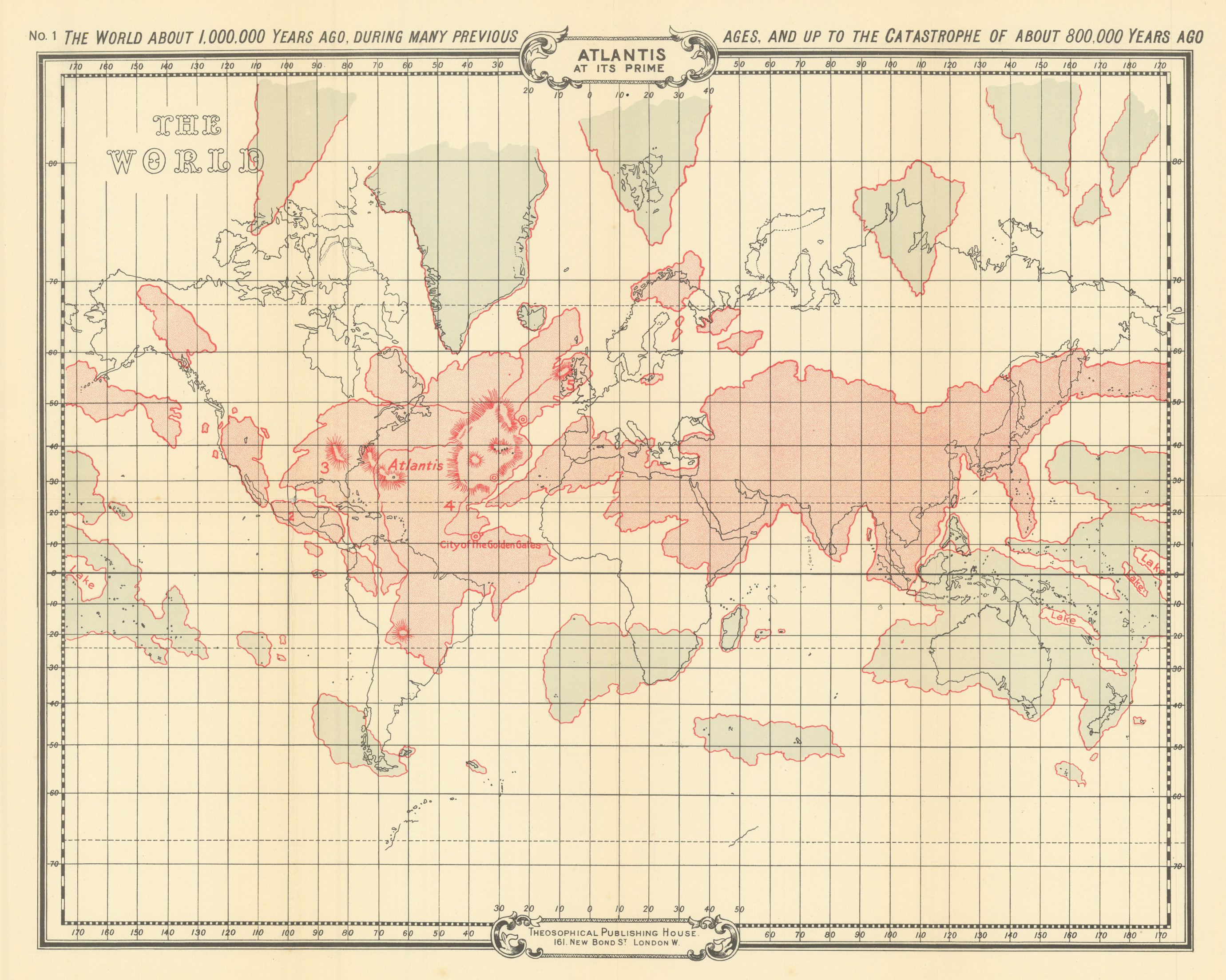
- The Rmoahal race came into existence between four and five million years ago, at which period large portions of the great southern continent of Lemuria still existed, while the continent of Atlantis had not assumed the proportions it ultimately attained (as shown in MAP 1).
- The Rmoahals were a dark race — their complexion being a sort of mahogany black, standing 10–12 feet high in their earliest existence. Being of the first sub-race, they were still quite similar to Lemurians, with whom they lived alongside, even warring against.
- The Rmoahals were incapable of developing any plan of settled government, nor did they ever reach even as high a point of civilization as the 6th and 7th Lemurian sub-races.
- The Manu* who effected the segregation actually incarnated in the race and ruled it as king. Even when he no longer took visible part in the government of the race, Adept or Divine rulers were, when the times required it, still provided for the infant community.
Narrative
Theosophical writings call the first sub-race of the Atlanteans that of the Rmoahals. The memory of this race was primarily directed toward vivid sense impressions. Colors which the eye had seen, sounds which the ear had heard, had a long after-effect in the soul. This was expressed in the fact that the Rmoahals developed feelings which their Lemurian ancestors did not yet know. For example, the attachment to what has been experienced in the past is a part of these feelings.
With the development of memory was connected that of language. As long as man did not preserve what was past, a communication of what had been experienced could not take place through the medium of language. Because in the last Lemurian period the first beginnings of memory appeared, at that time it was also possible for the faculty of naming what had been seen and heard to have its inception. Only men who have the faculty of recollection can make use of a name which has been given to something. The Atlantean period, therefore, is the one in which the development of language took place. With language a bond was established between the human soul and the things outside man. He produced a speech-word inside himself, and this speech-word belonged to the objects of the external world. A new bond is also formed among men by communications through the medium of language. It is true that all this existed in a still youthful form among the Rmoahals, but nevertheless it distinguished them profoundly from their Lemurian forefathers.
The soul powers of these first Atlanteans still possessed something of the forces of nature. These men were more closely related to the beings of nature which surrounded them than were their successors. Their soul powers were more connected with forces of nature than are those of modern man. Thus the speech-word which they produced had something of the power of nature. They not only named things, but in their words was a power over things and also over their fellow-men. The word of the Rmoahals not only had meaning, but also power. The magic power of words is something which was far truer for those men than it is for men of today. When a Rmoahals man pronounced a word, this word developed a power similar to that of the object it designated. Because of this, words at that time were curative; they could advance the growth of plants, tame the rage of animals, and perform other similar functions. All this progressively decreased in force among the later sub-races of the Atlanteans. One could say that the original fullness of power was gradually lost. The Rmoahals men felt this plenitude of power to be a gift of mighty nature, and their relationship to the latter had a religious character. For them language was something especially sacred. The misuse of certain sounds, which possessed an important power, was an impossibility. Each man felt that such misuse must cause him enormous harm. The good magic of such words would have changed into its opposite; that which would have brought blessings if used properly would bring ruin to the author if used criminally. In a kind of innocence of feeling the Rmoahals ascribed their power not so much to themselves as to the divine nature acting within them.
* The Manus were very exalted Beings. They embraced not only the planning of the types of the whole Manvantara (in Hindu cosmology, is a cyclic period of time identifying the duration, reign, or age of a Manu, the progenitor of mankind), but the superintending the formation and education of each Root Race in turn. The following quotation refers to these arrangements: "There are also Manus whose duty it is to act in a similar way for each Root Race on each Planet of the Round, the Seed Manu planning the improvement in type which each successive Root Race inaugurates and the Root Manu actually incarnating amongst the new Race as a leader and teacher to direct the development and ensure the improvement."
02Tlavtli
Overview
- The place of origin of the Tlavatli was an island off the west coast of Atlantis (see MAP 1, #2, 100° W / 20° N). They eventually migrated into Atlantis proper, chiefly across the middle of the continent, gradually however tending northwards towards the stretch of coast facing the promontory of Greenland.
- They were always a mountain-loving people, and their chief settlements were in the mountainous districts of the interior.
- Physically they were a powerful and hardy race of a red-brown color, but they were not quite so tall as the Rmoahals.
- The Tlavatli people showed some (small) signs of advance in the art of government. Their various tribes or nations were ruled by chiefs or kings who generally received their authority by acclamation of the people.
Narrative
This (ascribing their power not so much to themselves as to the divine nature acting within them) changed among the second sub-race, the so-called Tlavatli peoples. The men of this race began to feel their own personal value. Ambition, a quality unknown to the Rmoahals, made itself felt among them. Memory was in a sense transferred to the conception of communal life. He who could look back upon certain deeds demanded recognition of them from his fellow-men. He demanded that his works be preserved in memory. Based upon this memory of deeds, a group of men who belonged together elected one as leader A kind of regal rank developed. This recognition was even preserved beyond death. The memory, the remembrance of the ancestors or of those who had acquired merit in life, developed. From this there emerged among some tribes a kind of religious veneration of the deceased, an ancestor cult. This cult continued into much later times and took the most varied forms. Among the Rmoahals a man was still esteemed only to the degree to which he could command respect at a particular moment through his powers. If someone among them wanted recognition for what he had done in earlier days, he had to demonstrate by new deeds that he still possessed his old power. He had to recall the old works to memory by means of new ones. What had been done was not esteemed for its own sake. Only the second sub-race considered the personal character of a man to the point where it took his past life into account in the evaluation of this character.
03Toltec
Overview
- The Toltec race was a magnificent development (of the Manus): An improvement on the two previous sub-races, the features being straight and well marked, not unlike the ancient Greek..
- It ruled the whole continent of Atlantis for thousands of years in great material power and glory.
- So dominant and so endowed with vitality was this race that intermarriages with the following sub-races failed to modify the type, which still remained essentially Toltec; and hundreds of thousands of years later we find one of their remote family races ruling magnificently in Mexico and Peru, long ages before their degenerate descendants were conquered by the fiercer Aztec tribes from the north.
- The complexion of this race was also a red-brown, but they were redder or more copper-coloured than the Tlavatli.
- They were also tall, around 8 feet, but, like all of the Atlantean races, eventually dwindled in height more familiar to our own time (the 20th / 21st century).
- Their approximate birthplace is marked on MAP 1, #3, 90° W / 30° N.
- It was the Toltec race who developed the highest civilization and organized the most powerful empire of any of the Atlantean peoples, and it was then that the principle of hereditary succession was for the first time established.
- The race was at first divided into a number of petty independent kingdoms, constantly at war with each other, and all at war with the Lemurio-Rmoahals of the south, the latter were gradually conquered and made subject peoples — many of their tribes being reduced to slavery.
- Eventually, however, these separate kingdoms united in a great federation with a recognized emperor at its head. This was of course inaugurated by great wars, but the outcome was peace and prosperity for the race.
- However, such prominence led to an eventual downfall. See the section below titled Descent of the Toltec Race for an extended history of this sub-race.
Narrative
A further consequence of memory for the communal life of man was the fact that groups of men were formed which were held together by the remembrance of common deeds. Previously the formation of groups depended wholly upon natural forces, upon common descent. Man did not add anything through his own mind to what nature had made of him. Now a powerful personality recruited a number of people for a joint undertaking, and the memory of this joint action formed a social group.
This kind of social communal life became fully developed only among the third sub-race, the Toltec. It was therefore the men of this race who first founded what is a state. The leadership, the government of these communities, was transmitted from one generation to the next. The father now gave over to the son what previously survived only in the memory of contemporaries. The deeds of the ancestors were not to be forgotten by their whole line of descent. What an ancestor had done was esteemed by his descendants. However, one must realize that in those times men actually had the power to transmit their gifts to their descendants. Education, after all, was calculated to mold life through vivid images. The effectiveness of this education had its foundation in the personal power which emanated from the educator — He did not sharpen the power of thought, but in fact, developed those gifts which were of a more instinctive kind. Through such a system of education the capacities of the father were generally transmitted to the son.
Under such conditions personal experience acquired more and more importance among the third sub-race. When one group of men separated from another for the foundation of a new community, it carried along the remembrance of what it had experienced at the old scene. But at the same time there was something in this remembrance which the group did not find suitable for itself, in which it did not feel at ease. Therefore it then tried something new. Thus conditions improved with every one of these new foundations. It was only natural that what was better was imitated. These are the facts which explain the development of those flourishing communities in the period of the third sub-race, described in theosophic literature. The personal experiences which were acquired found support from those who were initiated into the eternal laws of spiritual development. Powerful rulers themselves were initiated, so that personal ability might have full support. Through his personal ability man slowly prepares himself for initiation. He must first develop his powers from below in order that the enlightenment from above can be given to him. In this way the initiated kings and leaders of the Atlanteans came into being. Enormous power was in their hands, and they were greatly venerated.
But in this fact also lay the reason for decline and decay. The development of memory led to the pre-eminent power of a personality. Man wanted to count for something through his power. The greater the power became, the more he wanted to exploit it for himself. The ambition which had developed turned into marked selfishness. Thus the misuse of these powers arose. When one considers the capabilities of the Atlanteans resulting from their mastery of the [etheric] life force (Vril), one will understand that this misuse inevitably had enormous consequences. A broad power over nature could be put at the service of personal egotism.
Descent of the Toltec Race
W. Scott-Elliot
It must be remembered that humanity [at this time] was still for the most part possessed of psychic attributes [altruistic clairvoyance], and by this time the most advanced had undergone the necessary training in the occult schools, and had attained various stages of initiation — some even reaching to Adeptship. Now the second of these emperors was an Adept, and for thousands of years the Divine dynasty ruled not only all the kingdoms into which Atlantis was divided but the islands on the west and the southern portion of the adjacent land lying to the east. When necessary, this dynasty was recruited from the Lodge of Initiates, but as a rule the power was handed down from father to son, all being more or less qualified, and the son in some cases receiving a further degree at the hands of his father. During all this period these Initiate rulers retained connection with the Occult Hierarchy which governs the world, submitting to its laws, and acting in harmony with its plans. This was the golden age of the Toltec race. The government was just and beneficent; the arts and sciences were cultivated — indeed the workers in these fields, guided as they were by occult knowledge, achieved tremendous results; religious belief and ritual was still comparatively pure — in fact the civilization of Atlantis had by this time reached its height.
After about 100,000 years of this golden age the degeneracy and decay of the race set in. Many of the tributary kings, and large numbers of the priests and people ceased to use their faculties and powers in accordance with the laws made by their Divine rulers, whose precepts and advice were now disregarded. Their connection with the Occult Hierarchy was broken. Personal aggrandisement, the attainment of wealth and authority, the humiliation and ruin of their enemies became more and more the objects towards which their occult powers were directed: and thus turned from their lawful use, and practised for all sorts of selfish and malevolent purposes, they inevitably led to what we must call by the name of sorcery.
Surrounded as this word is with the odium which credulity on the one hand and imposture on the other have during many centuries of superstition and ignorance gradually caused it to be associated, let us consider for a moment its real meaning, and the terrible effects which its practice is ever destined to bring on the world.
Partly through their psychic faculties, which were not yet quenched in the depths of materiality to which the race afterwards descended, and partly through their scientific attainments during this culmination of Atlantean civilization, the most intellectual and energetic members of the race gradually obtained more and more insight into the working of Nature's laws, and more and more control over some of her hidden forces. Now the desecration of this knowledge and its use for selfish ends is what constitutes sorcery. The awful effects, too, of such desecration are well enough exemplified in the terrible catastrophes that overtook the race. For when once the black practice was inaugurated it was destined to spread in ever widening circles. The higher spiritual guidance being thus withdrawn, the Kamic principle, which being the fourth, naturally reached its zenith during the Fourth Root Race, asserted itself more and more in humanity. Lust, brutality and ferocity were all on the increase, and the animal nature in man was approaching its most degraded expression. It was a moral question which from the very earliest times divided the Atlantean Race into two hostile camps, and what was begun in the Rmoahal times was terribly accentuated in the Toltec era. The battle of Armageddon is fought over and over again in every age of the world's history.
No longer submitting to the wise rule of the Initiate emperors, the followers of the "black arts" rose in rebellion and set up a rival emperor, who after much struggle and fighting drove the white emperor from his capital, the "City of the Golden Gates," and established himself on his throne.
The white emperor driven northward re-established himself in a city originally founded by the Tlavatli on the southern edge of the mountainous district, but which was now the seat of one of the tributary Toltec kings. He gladly welcomed the white emperor and placed the city at his disposal. A few more of the tributary kings also remained loyal to him, but most transferred their allegiance to the new emperor reigning at the old capital. These, however, did not long remain faithful. Constant assertions of independence were made by the tributary kings, and continual battles were fought in different parts of the empire, the practice of sorcery being largely resorted to, to supplement the powers of destruction possessed by the armies.
These events took place about 50,000 years before the first great catastrophe.
From this time onwards things went from bad to worse. The sorcerers used their powers more and more recklessly, and greater and greater numbers of people acquired and practised these terrible "black arts."
Then came the awful retribution when millions upon millions perished. The great "City of the Golden Gates" had by this time become a perfect den of iniquity. The waves swept over it and destroyed its inhabitants, and the "black" emperor and his dynasty fell to rise no more. The emperor of the north as well as the initiated priests throughout the whole continent had long been fully aware of the evil days at hand, and subsequent pages will tell of the many priest-led emigrations which preceded this catastrophe, as well as those of later date.
The continent was now terribly rent. But the actual amount of territory submerged by no means represented the damage done, for tidal waves swept over great tracts of land and left them desolate swamps. Whole provinces were rendered barren, and remained for generations in an uncultivated and desert condition.
The remaining population too had received a terrible warning. It was taken to heart, and sorcery was for a time less prevalent among them. A long period elapsed before any new powerful rule was established. We shall eventually find a Semite dynasty of sorcerers enthroned in the "City of the Golden Gates," but no Toltec power rose to eminence during the second map period. There were considerable Toltec populations still, but little of the pure blood remained on the mother continent.
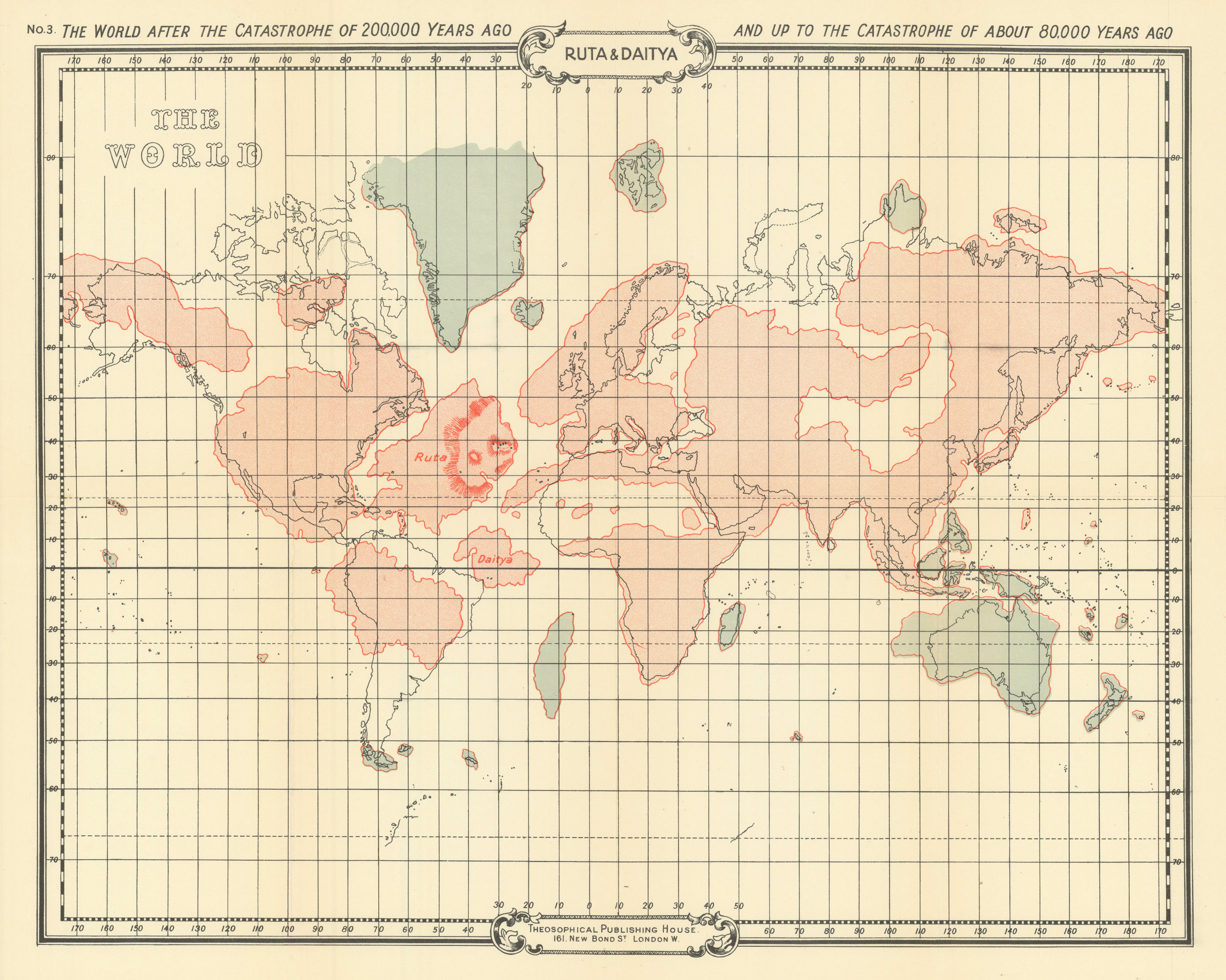
On the island of Ruta however, in the third map period, a Toltec dynasty again rose to power and ruled through its tributary kings a large portion of the island. This dynasty was addicted to the black craft, which it must be understood became more and more prevalent during all the four periods, until it culminated in the inevitable catastrophe, which to a great extent purified the earth of the monstrous evil. It must also be borne in mind that down to the very end when Poseidonis disappeared, an Intitiate emperor or king — or at least one acknowledging the "good law" — held sway in some part of the island continent, acting under the guidance of the Occult Hierarchy in controlling where possible the evil sorcerers, and in guiding and instructing the small minority who were still willing to lead pure and wholesome lives. In later days this "white" king was as a rule elected by the priests — the handful, that is, who still followed the "good law."
Little more remains to be said about the Toltecs. In Poseidonis the population of the whole island was more or less mixed. Two kingdoms and one small republic in the west divided the island between them. The northern portion was ruled by an Initiate king. In the south too the hereditary principle had given way to election by the people. Exclusive race-dynasties were at an end, but kings of Toltec blood occasionally rose to power both in the north and south, the northern kingdom being constantly encroached upon by its southern rival, and more and more of its territory annexed.
04(Primal) Turanian
Overview
- The Turanian sub-race had their origin on the eastern side of the continent, south of the mountainous district inhabited by the Tlavatli people (MAP 1, #4, 50° W / 20° N).
- They were never a thoroughly dominant race on the mother-continent, though some of their tribes and family races became fairly powerful.
- The complexion of the Turanians has been referred to as 'yellow'.
- The Turanian race developed a form of feudal system. Each chief was supreme on his own territory.
- The king was only primus inter pares (first among equals).
- The chiefs who formed the king's council occasionally murdered their king and set up one of their own number in his place. They were a turbulent and lawless race — brutal and cruel.
- The Turanians were constantly at war with their neighbors, the Toltecs, and, due to their being always bested due to much lower numbers, sought to increase their population through laws that nullified the nuclear family, placing children as property of the State, relieving familial responsibilities. Marriage having been disregarded, this experiment led only to failure.
Narrative
The broad power over nature (founded in the third sub-race) was put at the service of personal egotism in full measure by the fourth sub-race, the Primal Turanians. The members of this race, who were instructed in the mastery of the above-mentioned powers, often used them in order to satisfy their selfish wishes and desires. But used in such a manner, these powers destroy each other in their reciprocal effects. It is as if the feet were stubbornly to carry a man forward, while his torso wanted to go backward.
Such a destructive effect could only be halted through the development of a higher faculty in man. This was the faculty of thought. Logical thinking has a restraining effect on selfish personal wishes. The origin of logical thinking must be sought among the fifth sub-race, the Primal Semites. Men began to go beyond a mere remembrance of the past and to compare different experiences. The faculty of judgment developed. Wishes and appetites were regulated in accordance with this faculty of judgment. One began to calculate, to combine. One learned to work with thoughts. If previously one had abandoned oneself to every desire, now one first asked whether thought could approve this desire. While the men of the fourth sub-race rushed wildly toward the satisfaction of their appetites, those of the fifth began to listen to an inner voice. This inner voice checks the appetites, although it cannot destroy the claims of the selfish personality.
05(Primal) Semite
Overview
- There is little sufficient data on this sub-race.
- This sub-race had its origin in the mountainous country which formed the more southerly of the two north-eastern peninsulas which, as we have seen, is now represented by Scotland, Ireland, and some of the surrounding seas (MAP 1, #5, 10° W / 60° N).
- In this least desirable portion of the great continent the race grew and flourished, for centuries maintaining its independence against aggressive southern kings.
- In time, it spread abroad and colonized.
- By the time the Semites rose to power hundreds of thousands of years had passed and the 2nd map period had been reached.
- They were a turbulent, discontented race, always at war with their neighbors, especially with the then growing power of the Akkadians.
- The complexion of the Primal Semites has been referred to as comparatively 'white'.
- The original Semites had a patriarchal form of government.
- Their colonists, who generally took to the nomadic life, almost exclusively adopted this form, and developed a considerable empire in the days of the second map period, and possessed the great "City of the Golden Gates." They ultimately, however, had to give way before the growing power of the Akkadians.
Narrative
The fifth subrace transferred the impulses for action to within the human being. Man wishes to come to terms within himself as to what he must or must not do. But what thus was won within, with respect to the faculty of thought, was lost with respect to the control of external natural forces. With this combining thought mentioned above, one can master only the forces of the mineral world, not the life force. The fifth subrace therefore developed thought at the expense of control of the life force. But it was just through this that it produced the germ of the further development of mankind. New personality, self-love, even complete selfishness could grow freely; for thought alone which works wholly within, and can no longer give direct orders to nature, is not capable of producing such devastating effects as the previously misused powers. From this fifth subrace the most gifted part was selected which survived the decline of the fourth root race and formed the germ of the fifth, the Aryan race, whose mission is the complete development of the thinking faculty.
06Akkadian
Overview
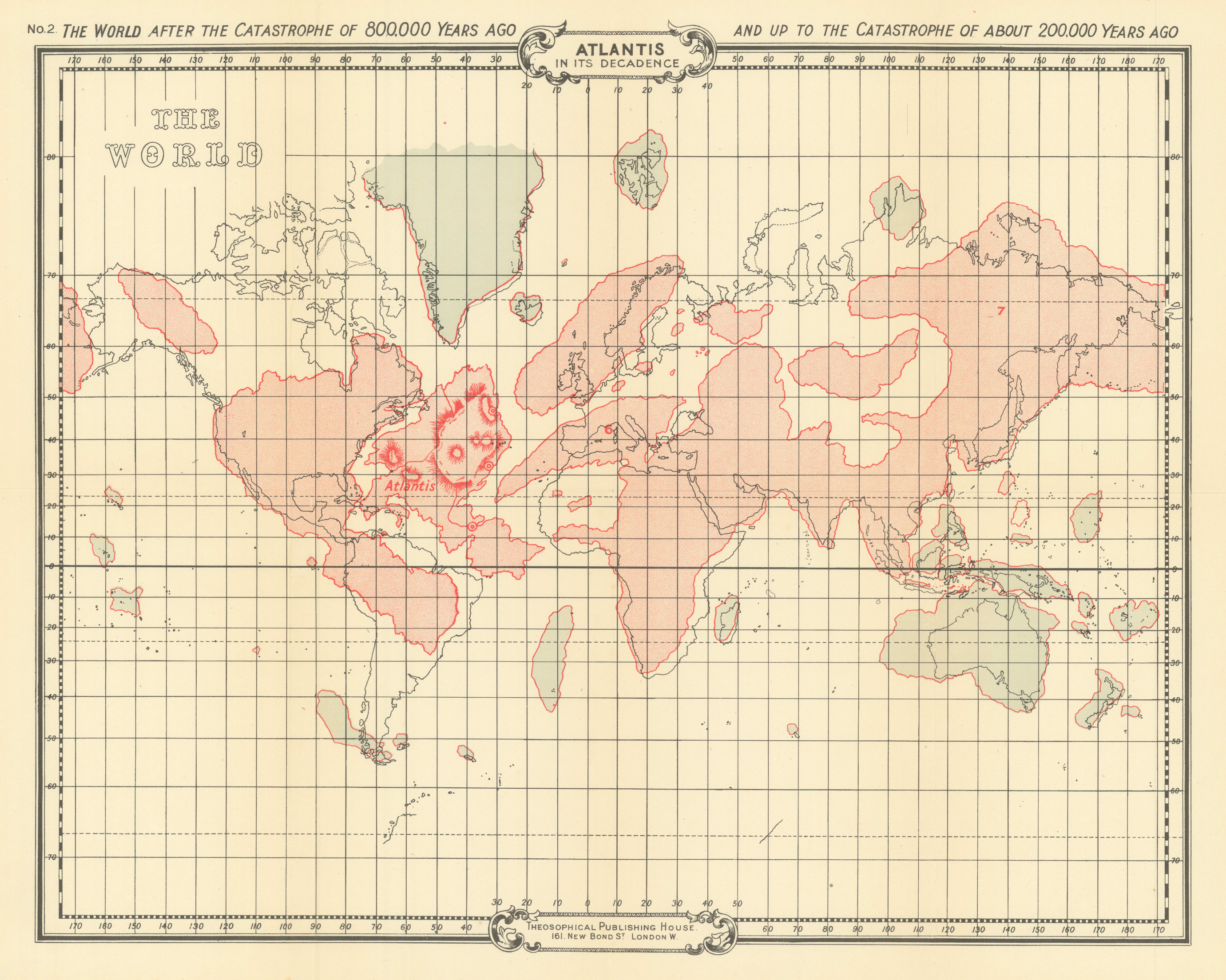
- The Akkadian sub-race came into existence after the first great catastrophe, some 800,000 years ago – MAP 2, #6, 10° W / 50° N.
- They quickly overran the now diminished continent of Atlantis.
- They fought with the Semites in many battles both on land and sea, and very considerable fleets were used on both sides.
- Approximately 100,000 years ago they completely vanquished the Semites, and from that time onwards an Akkadian dynasty was set up in the old Semite capital, whereupon ruled the country wisely for several hundred years.
- They were a great trading, sea-going, and colonizing people, and they established many centers of communication with distant lands.
- The complexion of the Akkadians has been referred to as comparatively 'white'.
- After overthrowing the Semite's power about 100,000 years ago, the Akkadians became a much more law-abiding people than their predecessors.
- They lived in settled communities as traders and sailors, and naturally produced an oligarchical form of government.
- They studied the stars with great interest, thereby making great advances both in astronomy and astrology.
Narrative
The men of the sixth subrace, the Akkadians, developed the faculty of thought even further than the fifth. They differed from the so-called Primal Semites in that they employed this faculty in a more comprehensive sense than the former.
It has been said that while the development of the faculty of thought prevented the claims of the selfish personality from having the same devastating effects as among the earlier races, these claims were not destroyed by it. The Primal Semites at first arranged their personal circumstances as their faculty of thought directed. Intelligence took the place of mere appetites and desires. The conditions of life changed. If preceding races were inclined to acknowledge as leader one whose deeds had impressed themselves deeply upon their memory, or who could look back upon a life of rich memories, this role was now conferred upon the intelligent. If previously that which lived in a clear remembrance was decisive, one now regarded as best what was most convincing to thought. Under the influence of memory one formerly held fast to a thing until one found it to be inadequate, and in that case it was quite natural that he who was in a position to remedy a want could introduce an innovation. But as a result of the faculty of thought, a fondness for innovations and changes developed. Each wanted to put into effect what his intelligence suggested to him. Turbulent conditions therefore began to prevail under the fifth subrace, and in the sixth they led to a feeling of the need to bring the obdurate thinking of the individual under general laws. The splendor of the communities of the third subrace was based on the fact that common memories brought about order and harmony. In the sixth, this order had to be brought about by thought-out laws. Thus it is in this sixth subrace that one must look for the origin of regulations of justice and law.
During the third subrace, the separation of a group of men took place only when they were forced out of their community so to speak, because they no longer felt at ease in the conditions prevailing as a result of memory. In the sixth this was considerably different. The calculating faculty of thought sought the new as such; it spurred men to enterprises and new foundations. The Akkadians were therefore an enterprising people with an inclination to colonization. It was commerce, especially, which nourished the waxing faculty of thought and judgment.
07Mongol
Overview
- The Mongolian sub-race was the only one that had absolutely no touch with the mother-continent.
- Its origin was on that of the plains of Tartary (MAP 2, #7, 130° E / 65° N).
- This sub-race was directly developed from descendants of the Turanian race, which gradually migrated over the greater part of Asia.
- This sub-race multiplied exceedingly, and even at the present day a majority of the earth's inhabitants technically belong to it, though many of its divisions are so deeply colored with the blood of earlier races as to be scarcely distinguishable from them.
- The complexion of the Mongolians has been referred to as 'yellow'.
- The Mongolian people were an improvement on their immediate ancestors of the brutal Turanian stock and became a nomadic people.
- More psychic and more religious than the Turanians from whom they sprang, the form of government towards which they gravitated required a suzerain (feudal lord) in the background who should be supreme both as a territorial ruler and as a chief high priest.
Narrative
Among the seventh subrace, the Mongols, the faculty of thought was also developed. But characteristics of the earlier sub-races, especially of the fourth, remained present in them to a much higher degree than in the fifth and sixth. They remained faithful to the feeling for memory. And thus they reached the conviction that what is oldest is also what is most sensible and can best defend itself against the faculty of thought. It is true that they also lost the mastery over the life forces, but what developed in them as the thinking faculty also possessed something of the natural might of this life force. Indeed they had lost the power over life, but they never lost their direct, naive faith in it. This force had become their god, in whose behalf they did everything they considered right. Thus they appeared to the neighboring peoples as if possessed by this secret force, and they surrendered themselves to it in blind trust. Their descendants in Asia and in some parts of Europe manifested and still manifest much of this quality.
08Maps of the Atlantean Epoch
Editor's Note: The various configurations of Atlantis, over long periods of time and through various great catastrophes, are shown in red overlaying an outline of our current (20th and 21st centuries) land masses. In green are shown land remnants of the Lemurian continent (south) and Hyperborean continent (north).
Notes from FreeManCreator regarding these maps; Comments based on RS: The notes explain certain inconsistencies with the research by Rudolf Steiner. As explained it does not make sense to use years for dating periods before approx. 20,000 BC and certainly not periods of hundred thousands of years. Furthermore, the sub-races do not seem to map to the evolutionary time axis as all seven sub-races are mapped with their origin to the first two charts. (∴ it is important to keep these things in mind while studying Scott-Elliot's information ~Ed.)
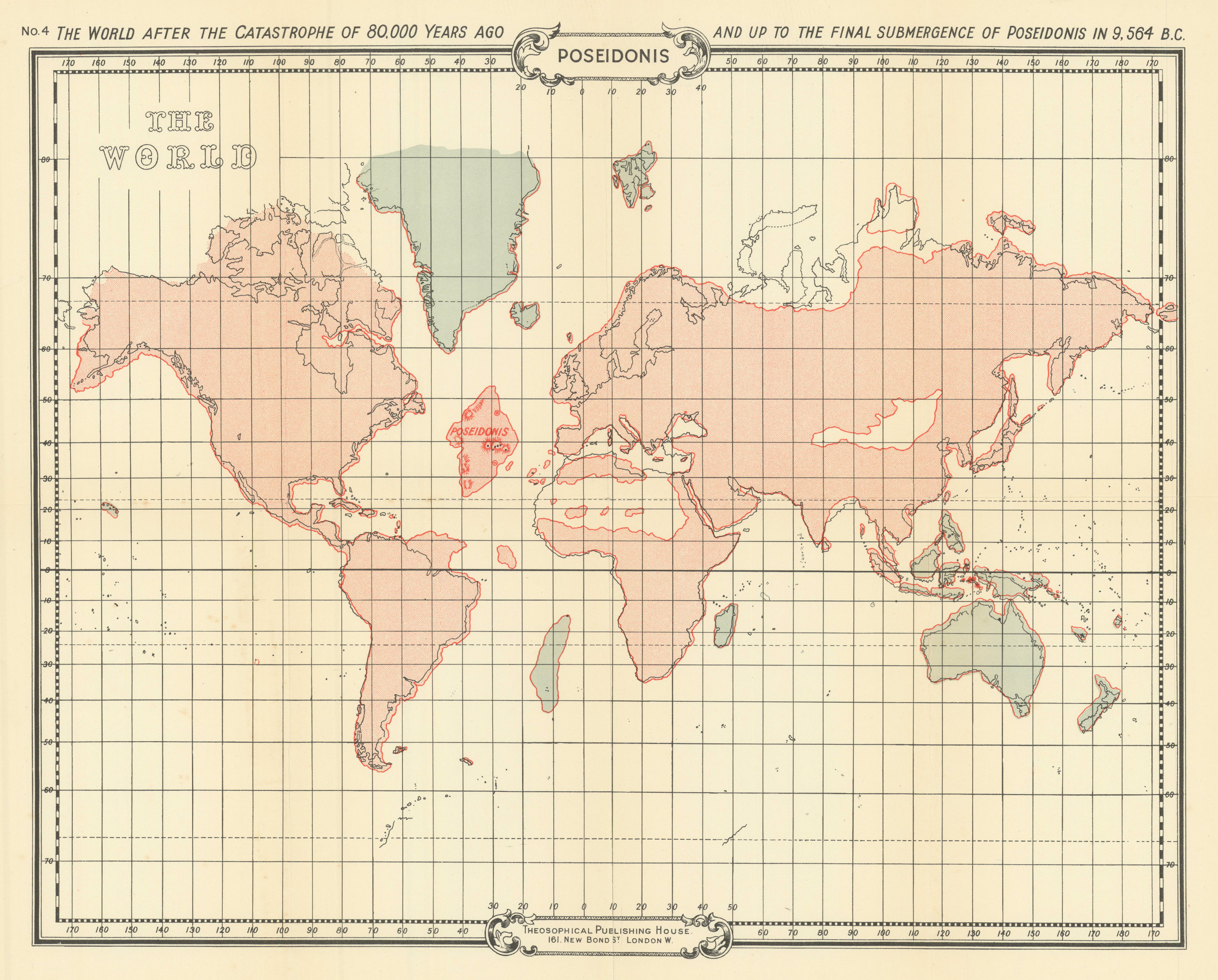
The following quotation from Le Plongeon's translation of the famous Troano MS., which may be seen in the British Museum, will appropriately bring this part of the subject to a close. The Troano MS. appears to have been written about 3,500 years ago, among the Mayas of Yucatan, and the following is its description of the catastrophe that submerged the island of Poseidonis: — "In the year 6 Kan, on the 11th Muluc in the month Zac, there occurred terrible earthquakes, which continued without interruption until the 13th Chuen. The country of the hills of mud, the land of Mu was sacrificed: being twice upheaved it suddenly disappeared during the night, the basin being continually shaken by volcanic forces. Being confined, these caused the land to sink and to rise several times and in various places. At last the surface gave way and ten countries were torn asunder and scattered. Unable to stand the force of the convulsions, they sank with their 64,000,000 of inhabitants 8060 years before the writing of this book."
The Story of Atlantis, W. SCOTT-ELLIOT
09City of the Golden Gates
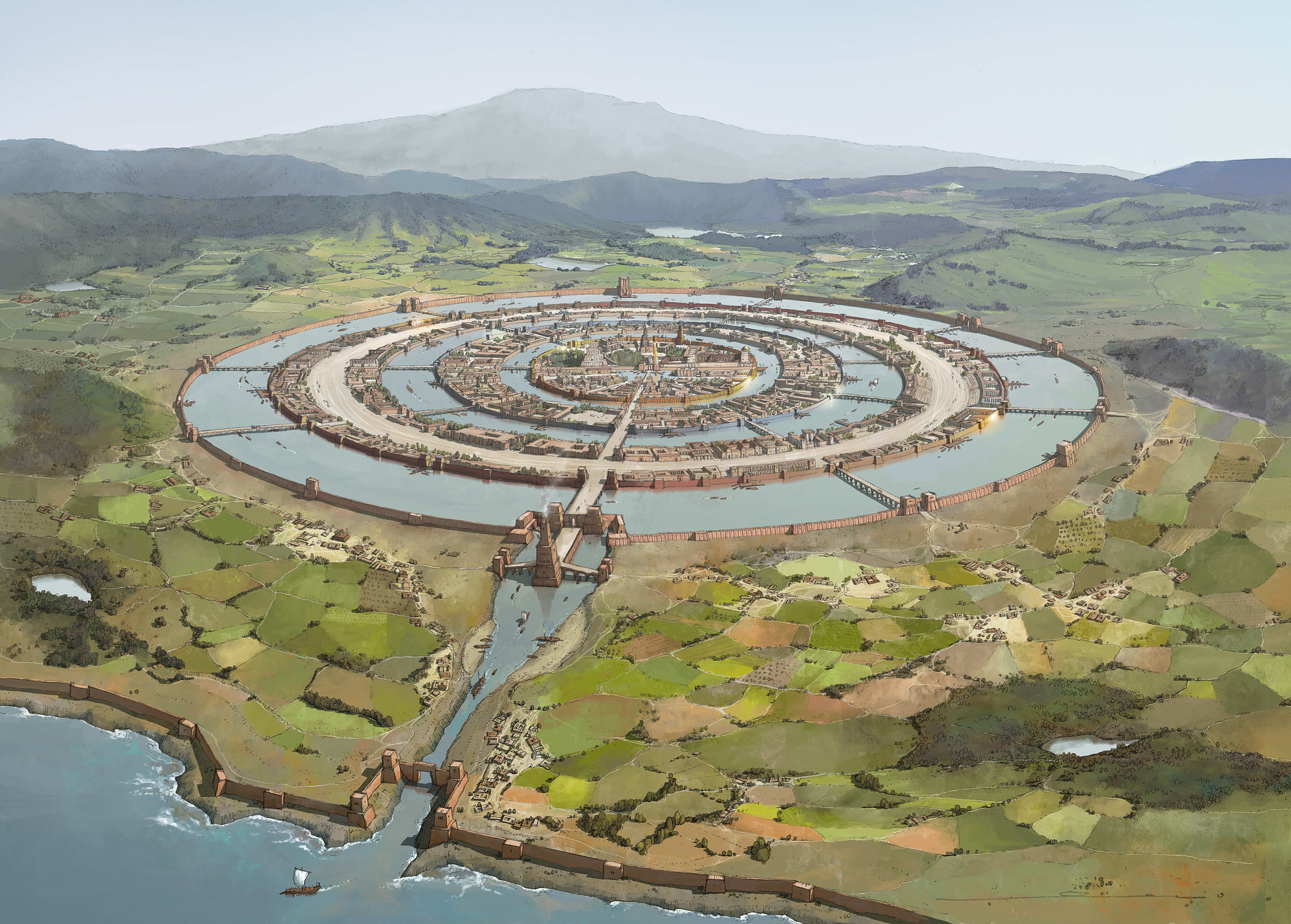
Excerpt from W. Scott-Elliot's Book
The "City of the Golden Gates" and its surroundings must be described before we come to consider the marvellous system by which its inhabitants were supplied with water. It lay, as we have seen, on the east coast of the continent close to the sea, and about 15° north of the equator. A beautifully-wooded park-like country surrounded the city. Scattered over a large area of this were the villa residences of the wealthier classes. To the west lay a range of mountains, from which the water supply of the city was drawn. The city itself was built on the slopes of a hill, which rose from the plain about 500 feet. On the summit of this hill lay the emperor's palace and gardens, in the centre of which welled up from the earth a never-ending stream of water, supplying first the palace and the fountains in the gardens, thence flowing in the four directions and falling in cascades into a canal or moat which encompassed the palace grounds, and thus separated them from the city which lay below on every side. From this canal four channels led the water through four quarters of the city to cascades which in their turn supplied another encircling canal at a lower level. There were three such canals forming concentric circles, the outermost and lowest of which was still above the level of the plain. A fourth canal at this lowest level, but on a rectangular plan, received the constantly flowing waters, and in its turn discharged them into the sea. The city extended over part of the plain, up to the edge of this great outermost moat, which surrounded and defended it with a line of waterways extending about twelve miles by ten miles square.
It will thus be seen that the city was divided into three great belts, each hemmed in by its canals. The characteristic feature of the upper belt that lay just below the palace grounds, was a circular race-course and large public gardens. Most of the houses of the court officials also lay on this belt, and here also was an institution of which we have no parallel in modern times. The term "Strangers' Home" amongst us suggests a mean appearance and sordid surroundings, but this was a palace where all strangers who might come to the city were entertained as long as they might choose to stay — being treated all the time as guests of the Government. The detached houses of the inhabitants and the various temples scattered throughout the city occupied the other two belts. In the days of the Toltec greatness there seems to have been no real poverty — even the retinue of slaves attached to most houses being well fed and clothed — but there were a number of comparatively poor houses in the lowest belt to the north, as well as outside the outermost canal towards the sea. The inhabitants of this part were mostly connected with the shipping, and their houses though detached were built closer together than in other districts.
It will be seen from the above that the inhabitants had thus a never-failing supply of pure clear water constantly coursing through the city, while the upper belts and the emperor's palace were protected by lines of moats, each one at a higher level as the centre was approached.
Now it does not require much mechanical knowledge in order to realize how stupendous must have been the works needed to provide this supply, for in the days of its greatness the "City of the Golden Gates" embraced within its four circles of moats over two million inhabitants. No such system of water supply has ever been attempted in Greek, Roman or modern times — indeed it is very doubtful whether our ablest engineers, even at the expenditure of untold wealth, could produce such a result.
A description of some of its leading features will be of interest. It was from a lake which lay among the mountains to the west of the city, at an elevation of about 2,600 feet, that the supply was drawn. The main aqueduct which was of oval section, measuring fifty feet by thirty feet, led underground to an enormous heart-shaped reservoir. This lay deep below the palace, in fact at the very base of the hill on which the palace and the city stood. From this reservoir a perpendicular shaft of about 500 feet up through the solid rock gave passage to the water which welled up in the palace grounds, and thence was distributed throughout the city. Various pipes from the central reservoir also led to different parts of the city to supply drinking water and the public fountains. Systems of sluices of course also existed to control or cut off the supply of the different districts.
From the above it will be apparent to any one possessed of some little knowledge of mechanics that the pressure in the subterranean aqueduct and the central reservoir from which the water naturally rose to the basin in the palace gardens, must have been enormous, and the resisting power of the material used in their construction consequently prodigious.
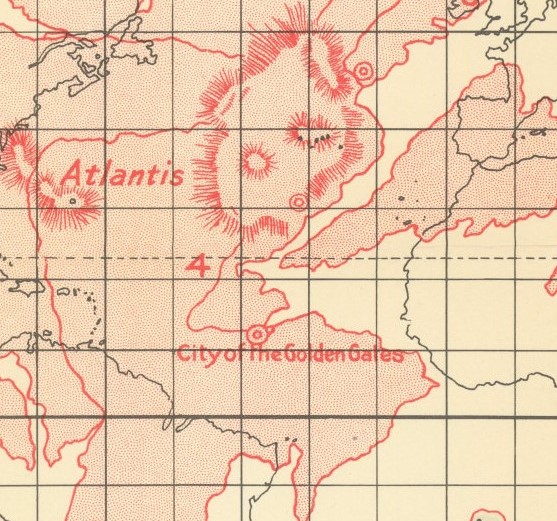
its Prime on a map from W. Scott-Elliot's book on Atlantis
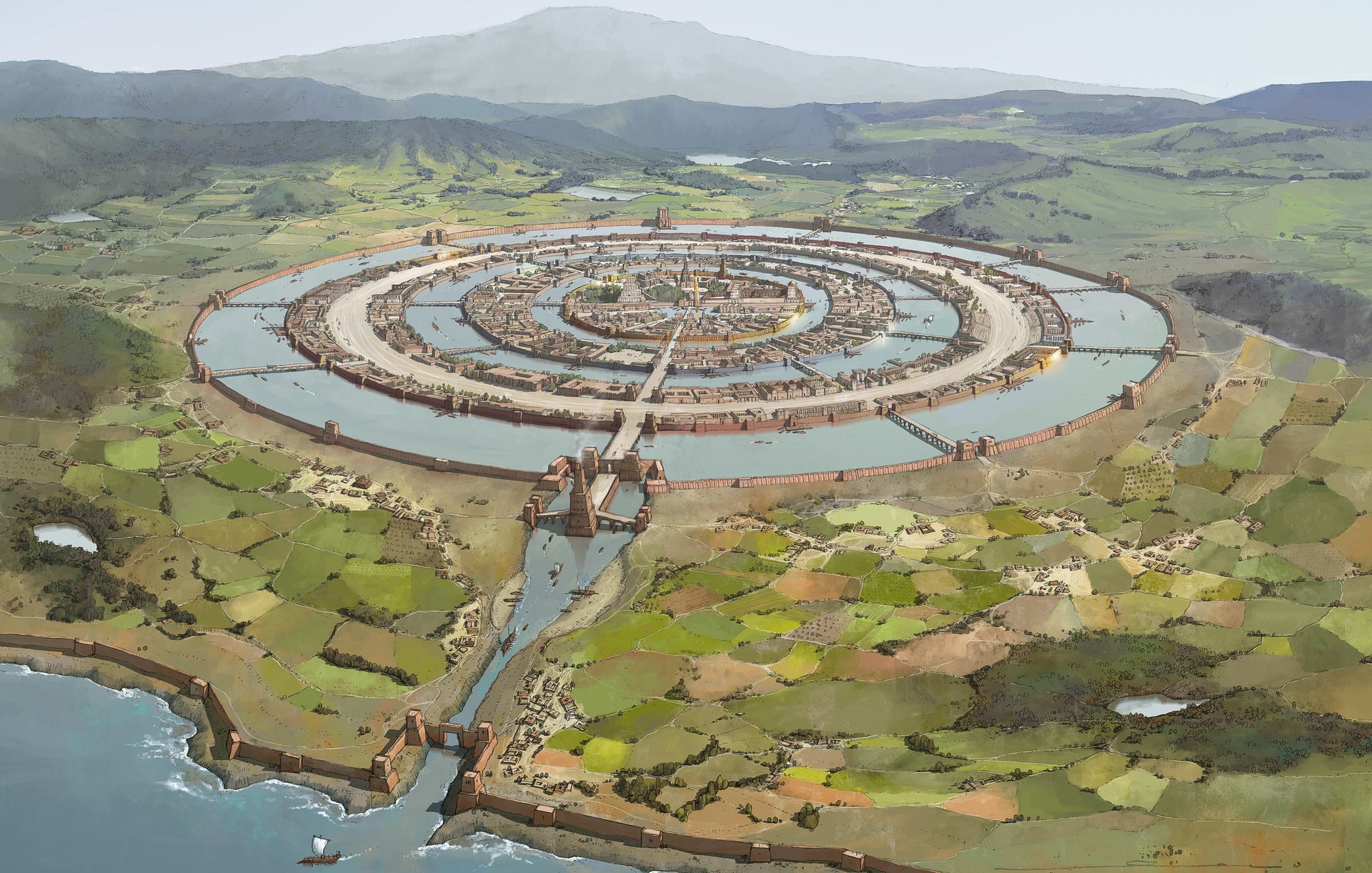
- with a radius of @12 mi.
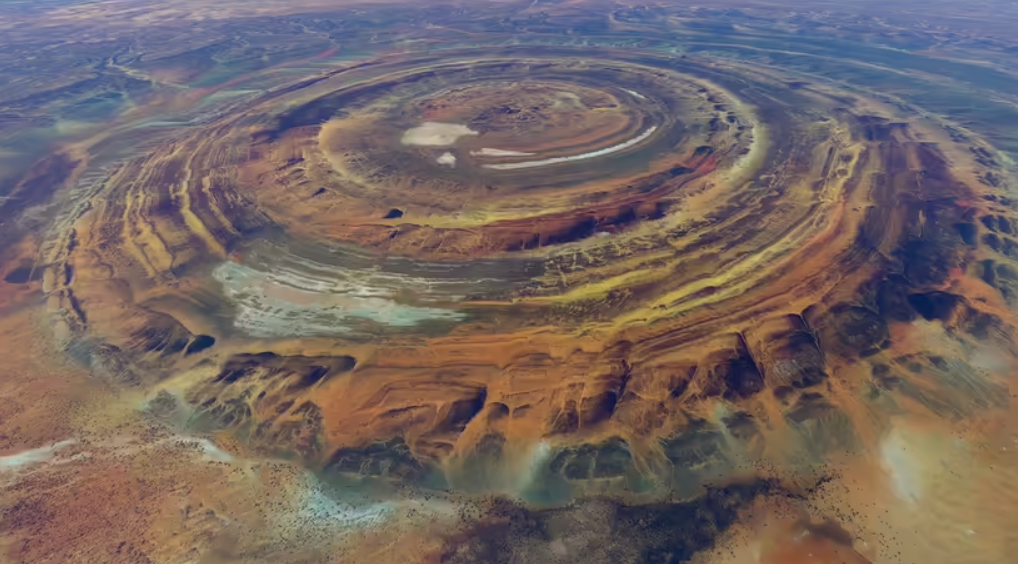
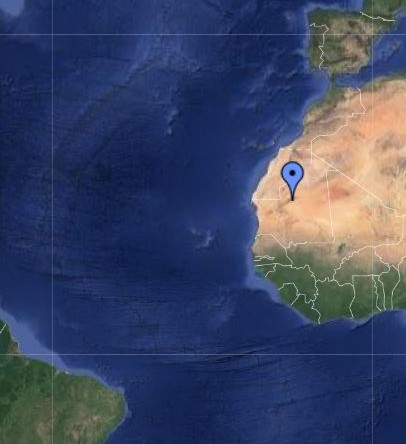
Although age estimates vary, geologists agree that the structure is at least 100 million years old. There is evidence that the Richat Structure was inhabited by early humans. Acheulean and pre-Acheulean tools found there, such as hand axes, suggest the presence of hunting and manufacturing activities. (emphasis mine)
Quote from: Encyclopedia Britannica
Note: The map above from W. Scott-Elliot's book has the caption, The world about 1,000,000 years ago, up to the catastrophe about 800,000 years ago. The next map in the series shows Atlantis at its decadence, up to the catastrophe that occurred about 200,000 years ago, which still shows the City of the Golden Gates on the map.
Q & A
Questions raised during our initial discussion of this material. Answers were researched and recorded as supplemental to the core material in this document. -ed.
-
- Question
- Answer...
-
- Question
- Answer...
-
- Question
- Answer...
-
- Question
- Answer...
-
- Question
- Answer...
-
- Question
- Answer...
Sources
Fair Use
FAIR USE NOTICE: This site contains copyrighted material the use of which has not always been specifically authorized by the copyright owner. We are making such material available in our efforts to advance understanding of spiritual truths that we believe are critical in our time in lieu of the current (21st century) socioeconomic atmosphere. We believe this constitutes a 'fair use' of any such copyrighted material as provided for in section 107 of the US Copyright Law. In accordance with Title 17 U.S.C. Section 107, the material on this site is distributed without profit to those who have expressed a prior interest in receiving the included information for research and educational purposes. For more information go to: https://www.law.cornell.edu/uscode/text/17/107. If you wish to use copyrighted material from this site for purposes of your own that go beyond 'fair use', you must obtain permission from the copyright owner.
-- ed.