Karma

From the Spiritual Science of

On Earth every human being has two teachers: firstly, him- or herself and, secondly, fate.
What Man is not able to achieve by his own diligence, practice, renunciation, pain, grief, etc., will be served up by the buffets of fate.
Life is a school, not an amusement fair.
—Franz Bardon
Karma or destiny is the law that connects the human being in any incarnate life between birth and death on Earth, and how Man experiences life after death and up to the next birth, and what follows for the next life.
The wheel of karma is the process to incorporate learnings and enable ( or force) the soul to progress in its development.
The concept of karma presents the perspective to not only view events and what happens as effects, but also to look at things as a cause with a purpose, e.g. a misfortune in this life may be the purpose to acquire an ability we neglected and missed to develop in a previous life. (1909-11-21-GA108).
The teachings of karma and reincarnation impact the responsibility of the human being in its free choices and actions, following from true awareness during incarnate life of the consequences of one's actions.
In the current age of the consciousness soul, Man – with freedom (i.e. the free will to choose and act) – assumes spiritual responsibility over this process to act as one's own teacher and learn from and during life. "What Man is not able to achieve by his own diligence, practice, renunciation, pain, grief, etc., will be served up by the buffets of fate." (Franz Bardon).

It is said that a little attention to occultism (the wisdom of hidden beings) produces great Karmic results. That is because it is impossible to give any attention to occultism without making a definite choice between what are familiarly called good and evil. The first step in occultism brings the student to the tree of knowledge. He must pluck and eat; he must choose. No longer is he capable of the indecision of ignorance. He. goes, on, either on the good or on the evil path. And to step definitely and knowingly even but one step on either path produces great Karmic results. The mass of men walk waveringly, uncertain as to the goal they aim at; their standard of life is indefinite; consequently their Karma operates in a confused manner. But when once the threshold of knowledge is reached, the confusion begins to lessen, and consequently the Karmic results increase enormously, because all are acting in the same direction on all the different planes: for the occultist cannot be half-hearted, nor can he return when he has passed the threshold. These things are as impossible as that the man should become the child again. The individuality has approached the state of responsibility by reason of growth; it cannot recede from it.
He who would escape from the bondage of Karma must raise his individuality out of the shadow into the shine; must so elevate his existence that these threads do not come in contact with soiling substances, do not become so attached as to be pulled awry. He simply lifts himself out of the region in which Karma operates. He does not leave the existence which he is experiencing because of that. The ground may be rough and dirty, or full of rich flowers whose pollen stains, and of sweet substances that cling and become attachments — but overhead there is always the free sky. He who desires to be Karma-less must look to the air for a home; and after that to the ether. He who desires to form good Karma will meet with many confusions, and in the effort to sow rich seed for his own harvesting may plant a thousand weeds, and among them the giant. Desire to sow no seed for your own harvesting; desire only to sow that seed the fruit of which shall feed the world. You are part of the world; in giving it food you feed yourself. Yet in even this thought there lurks a great danger which starts forward and faces the disciple, who has for long thought himself working for good, while in his inmost soul he has perceived only evil; that is, he has thought himself to be intending great benefit to the world while all the time he has unconsciously embraced the thought of Karma, and the great benefit he works for is for himself. A man may refuse to allow himself to think of reward. But in that very refusal is seen the fact that reward is desired. And it is useless for the disciple to strive to learn by means of checking himself. The soul must be unfettered, the desires free. But until they are fixed only on that state wherein there is neither reward nor punishment, good nor evil, it is in vain that he endeavors. He may seem to make great progress, but some day he will come face to face with his own soul, and will recognise that when he came to the tree of knowledge he chose the bitter fruit and not the sweet; and then the veil will fall utterly, and he will give up his freedom and become a slave of desire. Therefore be warned, you who are but turning toward the life of occultism. Learn now that there is no cure for desire, no cure for the love of reward, no cure for misery of longing, save in the fixing of the sight and hearing upon that which is invisible and soundless. Begin even now to practise it, and so a thousand serpents will be kept from your path. Live in the eternal.
The operations of the actual laws of Karma are not to be studied until the disciple has reached the point at which they no longer affect himself. The initiate has a right to demand the secrets of nature and to know the rules which govern human life. He obtains this right by having escaped from the limits of nature and by having freed himself from the rules which govern human life. He has become a recognised portion of the divine element, and is no longer affected by that which is temporary. He then obtains a knowledge of the laws which govern temporary conditions. Therefore you who desire to understand the laws of Karma, attempt first to free yourself from these laws; and this can only be done by fixing your attention on that which is unaffected by those laws.
—Mabel Collins, Light on the Path
Spiritual science may appear, at first, to be one conception of the world among the many others now existing. It may be argued: The riddles of existence are there; people endeavor with every possible means at their disposal, religious or scientific, to answer these riddles of existence in an effort to satisfy, as it is said, their eagerness and desire for knowledge. Spiritual science may well be considered just another philosophy of life — whether calling itself materialism, monism, animism, idealism, realism, or what you will. It may be represented as something that endeavors to satisfy the desire for knowledge on a par with other modern world-conceptions. But this is not correct. In what man acquires through spiritual science he has something of positive, continuous value in life, something that not only satisfies his thinking, his thirst for knowledge, but is a real and potent factor in life itself. To understand this we must look far afield and consider the evolutionary course of mankind from a particular point of view.
We have often looked back to the times preceding the great Atlantean flood, to the times when our forefathers, that is to say our own souls in the bodies of those forefathers, lived on the ancient continent of Atlantis between Europe, Africa and America. We have also looked still further back, to the Lemurian epoch, when the souls of men incarnated at the present time were at a much lower stage of existence. We shall now speak again of this epoch, reminding ourselves, to begin with, of the following: Man has attained the present stage of his life of feeling, his life of will, his intelligence, nay even his form, because higher spiritual Beings in the cosmos have also been at work in earth-existence. We have spoken of these Beings as the "Thrones", the "Spirits of Wisdom", the "Spirits of Movement", the "Spirits of Form", the "Spirits of Personality", and so forth.
They are the great builders and architects of existence who have led the human race onward step by step to its present stage. But we must bring clearly before our minds to-day that Spirits and Beings other than those who help human evolution forward have also intervened; there are spiritual Beings who oppose the progressive Powers. And for every epoch — Lemurian, Atlantean, Post-Atlantean — it is possible to indicate which particular spiritual Beings bring the "hindrances", which spiritual Beings are the opponents of those whose only aim is the progress of humanity.
In the Lemurian epoch — the first that concerns us to-day — it was the Luciferic Beings who intervened in man's evolution, in opposition to the Powers who at that time were striving to help him forward. In the Atlantean epoch, the Spirits opposing the progressive Powers were the Spirits of "Ahriman" or "Mephistopheles". The Ahrimanic or Mephistophelean Spirits — to give the precise names — are those known in medieval times as the Spirits of "Satan" — who must not be confused with "Lucifer".
In our own epoch, as time goes on, other spiritual Beings of whom we shall speak later, will stand as hindrances in the path of the progressive Spirits. We will ask ourselves now: What did the Luciferic Spirits actually achieve in the ancient Lemurian epoch?
These things will be considered to-day from a particular point of view. Of what domain did the Luciferic Spirits lay hold during the Lemurian epoch? The best way to understand this is to cast our minds back over the course taken by human evolution.
You know that on Old Saturn the Thrones poured out their own substance to lay the first foundation of the human physical body. On Old Sun the Spirits of Wisdom imbued man with the ether- or life-body. And on the Earth the Spirits of Form endowed him with the 'I', the ego, in order that by realizing himself as distinct from his environment he might become an independent being. But even if through the deed of the Spirits of Form he had become independent vis-à-vis the external world surrounding him on earth, he would never have become independent of the Spirits of Form themselves; he would have remained dependent on them, he would have been directed by them as on leading-strings. That this did not happen was due to something which had, in a certain sense, a beneficial effect, namely the fact that in the Lemurian epoch the Luciferic Beings set themselves in opposition to the Spirits of Form. It was these Luciferic Beings who gave man the prospect of freedom — but therewith the possibility of evil-doing, of succumbing to passion and desire in the world of sense. Where did these Luciferic Beings actually take hold? They took hold of what had been instilled into man as his innermost member at that time — the astral body. They established their footing in the human astral body and took possession of it. Had it not been for the coming of the Luciferic Beings this astral body would have remained in the sole possession of the Spirits of Form. They would have instilled into this astral body the forces which give man his human countenance, making him into an image of the Gods, namely, of the Spirits of Form. All this man would have come to be; but in his life through all eternity he would have remained dependent upon the Spirits of Form.
The Luciferic Beings had crept, as it were, into man's astral body, so that Beings of two kinds were now working in it: the Beings who bring man forward and the Beings who, while obstructing this constant impulse, had at the same time established the foundations of his independence. Had the luciferic Beings not approached, man would have remained in a state of innocence and purity in his astral body. No passions inciting him to crave for what is to be found only on earth would have arisen in him. The passions, urges and desires of man were densified, debased, as it were, by the Luciferic Beings. Had they not approached, man would have retained a perpetual longing for his heavenly home, for the realms of spirit whence he has descended. He would have taken no delight in what surrounds him on the earth; earthly impressions would have aroused no interest in him. It was through the Luciferic Spirits that he came to have this interest, to crave for the impressions of the earth. These Spirits impelled him into the earthly sphere by pervading his innermost member, his astral body. Why, then, was it that man did not fall away entirely at that time from the Spirits of Form or from the higher spiritual realms as a whole? Why was it that in his interests and desires he did not succumb wholly to the world of sense?
It was because the Spirits who lead humanity forward took counter measures; they inculcated into the being of man what would otherwise not have been his lot, namely, illness, suffering and pain. That was the necessary counterweight to the deeds of the Luciferic Spirits.
The Luciferic Spirits gave man material desires; as their countermeasures the higher Beings introduced illness and suffering as the consequences of material desires and interests, to the end that he should not utterly succumb to this world of sense. And so there is exactly as much suffering and pain in the world as there is interest only in the physical and the material. The scales are held in perfect balance; the one does not outweigh the other — so many passions and desires on the one side, so much illness and pain on the other. This was the effect of the mutual activities of the Luciferic Spirits and the Spirits of Form in the Lemurian epoch. Had the Luciferic Spirits not approached, man would not have descended into the earthly realm as soon as he actually did. His passion and craving for the world of sense also brought it about that his eyes were opened and he was able to gaze at the surrounding field of material existence earlier than would otherwise have been the case. If evolution had proceeded uninterruptedly along the course intended by the progressive Spirits, man would have had sight of the surrounding world only from the middle of the Atlantean epoch onwards. But then he would have seen it spiritually, not as he sees it to-day; he would have seen it as the direct expression of spiritual beings. Because man came prematurely into the earthly sphere, forced downwards by his earthly interests and desires, conditions were different from what they would otherwise have been in the middle of the Atlantean epoch.
The result was that the Ahrimanic Spirits — "Mephistophelean Spirits" as it is equally correct to call them — mingled in what man was able to see and apprehend; thus he fell into error, into what, for the first time, can correctly be called "conscious sin". The host of Ahrimanic Spirits has worked upon man since the middle of the Atlantean epoch onwards. To what did these Ahrimanic Spirits entice him? They enticed him into regarding everything in his environment as material, with the result that he does not see through this material world to its true, spiritual foundations. Were man to have perceived the Spiritual in every stone, in every plant, in every animal, he would never have fallen into error and therewith into evil; if the progressive Spirits alone had worked upon him he would have been protected from those illusions to which he must always fall a prey when he bases himself solely upon the manifestations of the world of sense.
How did those spiritual Beings who desire to further man's progress act in order to combat this corruption, error and illusion arising from the material world? They saw to it — the process was of course slow and very gradual — that man was actually lifted away from the material world as such; this enabled him to shoulder and work out his karma. Whereas, therefore, the beings upon whom it fell to rectify the enticement of the Luciferic beings brought into the world suffering, pain and what is connected with them, namely death, the beings whose task it was to rectify the outcome of error concerning the sense-world, made it possible for man, through his karma, eventually to blot out all the error, all the evil he has wrought in the world.
For what would have happened if he had become the prey of evil and error?
Little by little he would have become one with the evil; no progress would have been possible for him. For with every error, every lie, every illusion, we cast an obstacle in the way of progress. We should fall back in our progress to exactly the same extent to which we had cast obstacles in our path through sin and error, if we were not in a position to rectify them; in other words, we could not reach man's true goal. It would be impossible to attain this goal if the counter-forces, the forces of karma, were not in operation.
Suppose that in some life you commit a wrong. If this wrong were to become firmly fixed in your life it would mean nothing less than that you would lose the step forward which you would have taken had you not committed the wrong; with every wrong, a step would be lost — enough steps to correspond exactly with the wrongs committed. If the possibility of surmounting error had not been given, man must ultimately have been submerged by it. But the blessing of karma was bestowed.
What does this blessing mean for man? Is karma something at which to shudder, something to dread?
No, indeed! Karma is a power for which man should be thankful. For karma says to us: If you have committed a wrong, remember that "God is not mocked; whatsoever a man soweth that shall he also reap". An error demands that you shall right it; then, having expunged it from your karma you can again take a step forward!
Without karma, no progress would be possible. Karma is a blessing that has been vouchsafed to us, inasmuch as it obliges us to rectify every error, to re-achieve the steps that thrust us back.
Karma was thus the indirect consequence of the deeds of Ahriman. And now let us go further. In our days we are moving towards the epoch when other beings will draw near to man — beings who in the future before us will intrude more and more deeply into human evolution. Just as the Luciferic spirits intervened in the Lemurian and the Ahrimanic spirits in the Atlantean epoch, so our epoch too will see the intrusion of [other] beings. Let us be clear about the nature of these beings.*
* These 'other' beings, referred to as the Asuras, are outside the realm of Karma. However, due to the importance in our time of understanding these Asuras, I have included what follows in the above lecture in the notes [1]. -ed.
There are individuals who in the course of their lives have amassed a tremendous amount of knowledge and have filled their souls with science of every kind, but who must admit to themselves: I once had a violent temper and still have it today. Or again: I was phlegmatic from the beginning and have remained so. Once upon a time I had this or that habit and still have it. Admittedly there are also individuals who have changed a great deal in their own natures and characters.
Perhaps indeed there is no individual who has brought about no change whatever in his fundamental disposition.
When you look back to your childhood you will certainly have to admit that you have achieved many changes in your character since then. But at the same time, you will realise that realisation of your characteristics and learning how to change them are processes related to each other as the minute hand of a clock and the hour hand. The transformation of character and temperament proceeds slowly, as does the hour hand of a clock and observations of life are comparatively rapid, rather like the minute hand.
This is connected with the fact that
We will now pass from a study of these members of man's constitution to their connection with Karma. What takes place during the same life on Earth only slowly, that is to say the transition of something that to begin with is in the astral body into the etheric body manifests karmically from one incarnation to the other in the following way.
Someone who has tried to judge things in accordance with true morality, and who in this striving may perhaps still have been prompted by other considerations, finds the fruits of this striving in his next life as a basic quality of his etheric body, as a kind of habit, as a quality of his character. What is active in the present life in the astral body becomes in the next life an attribute of the etheric body.
A certain concept that can be explained in the light of karma, is particularly important here. It is the concept of conscience. What arises from a man's conscience is equally something that has been acquired.
So you see, that what the minute hand on the clock of life shows us becomes the hour hand in the next life. There must, however, be a certain strengthening of the moral principle and its realisation in one life and then they are consolidated for the next.
What is established in the etheric body of one life brings to maturity the attributes of the physical body of the next life. Good habits, good inclinations, good traits of character, prepare healthiness, physical proficiency, physical strength, therefore a healthy physical body, for the next life. A healthy physical body in one life indicates that the individual concerned prepared this physical body for himself in an earlier life through self-acquired habits and qualities of character.
A particularly strong connection exists between a well-developed memory in one life and the physical body in the next life.
...
Now what develops in the etheric body passes in the next life into the physical body. Good inclinations, qualities of character, and proficient habits in life come to expression in a healthy physical body in the next incarnation, whereas the opposite qualities produce a sickly organism in the next life. This is not to be understood in the sense that a particular disease stems from a particular quality, but certain predispositions for illness can always be led back to quite definite qualities of character and temperament in the previous life.
You see, therefore, that things in the world are complicated and are subject to the law of cause and effect. To give an example, here is a case based on definite results of investigation. It may at first be something of a shock but in a study group it may certainly be spoken of.
A certain individual had developed an entirely egoistic urge for acquisition, a veritable greed for external wealth. It was not a matter of a healthy striving for riches which may spring from an altruistic aim to be of help and engage in selfless activity in the world — that is something different — but it was a case of an egoistic longing for acquisition due to a particular constitution of the etheric body; the striving for acquisition was abnormal. Such an individual may very possibly be born in the next life with a physical body prone to catch infectious diseases. In numerous cases it has been established by occultism that individuals readily prone to infection from epidemics in the present life, were possessed of a pathological sense for acquisitions in the previous life.
Other examples could be specifically quoted.
Thus, there are two characteristics which have a clearly recognisable influence upon the karmic formation of the following life. There we must speak to begin with of the strong influence exerted by a loving, benevolent attitude towards one's fellow men.
There are individuals who accept everything from their fellowmen with benevolence, who deal with their environment lovingly and sympathetically. In many cases this love extends far beyond pure philanthropy. Such individuals love nature and the whole world. The more strongly this sense of all-embracing love has developed and become habit in the soul and is therefore rooted in the etheric body, the greater becomes the capacity of the individual concerned to retain the qualities of youth for a long time in a subsequent incarnation.
Therefore
Thus, we see that life can be influenced by a conscious intervention in Karma.
That is a radical expression, but it is based upon truth.
...
Much that will be discussed this Winter will become more intelligible to us when we learn of certain more intimate karmic connections, for example the difference between the karma of a beautiful and an ugly human being.
What is the karma of a beautiful human being?
Something comes into consideration there that at first seems incredible, nevertheless it is a fact. Beauty of the physical body is in many cases, not always but very often, a consequence of suffering endured in the preceding life. Suffering in the preceding life — physical and also soul-suffering — becomes beauty in a subsequent life, beauty of the external physical body.
Approximately speaking, therefore, there is a karmic process which represents the connection of illness, of suffering, with beauty. This beauty is often bought at the cost of suffering and illness.
Wisdom too is in many respects bought at the cost of pain. It is not without interest that a. certain example of outer investigation today confirms in many ways what occultists have said for thousands of years, namely, that wisdom is connected with pain and sufferings, with a life of earnestness and renunciation in the previous existence.
...
It will now be still easier for you to realise that one cannot give way to blind belief or submission to authority in connection with certain revelations of the history of spiritual life. Faced with the problem of understanding Karmic law in the case of a phenomenon such as Schopenhauer, whose whole world-conception was filled with a mood of pessimism, nobody possessed of deeper insight must believe that this pessimism represents the fundamental attitude of humanity in general. It is far rather the individual trait of Schopenhauer's soul, karmically forecast and brought about by a certain constitution of his etheric body. This pessimistic mood of his thinking can only be understood by examining the karmic aspect.
In an earlier life - and this is an absolutely real explanation - a personality of this nature had had no opportunity of doing much good. Because of his position in life and vocation this man had been obliged to commit much evil and injustice. And this evil and injustice which he was fated — not by karma but by his vocation — to bring about, returned to him in the form of a certain feeling of antipathy towards the world he now encountered. This antipathy was the recapitulation of his own deeds.
If you want to understand karma you should not adopt the fatalistic standpoint that everything is predestined. A man need not be condemned by his previous lives to carry out his present deeds. Adjustment is often made in the next life. Thus, deeds are not always the fruits of an earlier life but in certain cases find their adjustment in a future speaking of the cause of the pessimistic mood in Schopenhauer.
We must strictly differentiate between everything a man accomplishes as his own individual deeds, deeds which proceed entirely from himself, and those made obligatory by his race, family and profession.
Deeds that stem from a man's personality, that is what meets him as his outer destiny in the next incarnation.
What an individual has accomplished as the result of his vocation and family circumstances is stored in his temperament and character. Thus, the destiny of a man is determined by his personal deeds in the preceding life. Vice versa, through good, intelligent and righteous deeds, he can bring about a favorable or unfavorable destiny in the next incarnation.
An individual who comes into contact with particular personalities has himself created the conditions for this in a preceding life. He had had something to do with these individuals and has himself now led them into his environment.
...
You cannot come into contact with an individual who makes an impact upon your life if you have not yourself brought him into your orbit on the basis of earlier relationships. It may, of course, also he the case that through general conditions, through his vocation or family a man is led into contact with individuals he had never yet encountered. But then, through their mutual behavior, the foundation is laid for a meeting in the next incarnation, a meeting connected with the destinies and lives of the individuals concerned.
...
When somebody says: A man has himself brought about his suffering, he has deserved it, so I may not help him - this is so much nonsense. It is just as if one thousand marks would help you, but if I were to give them to you, I should upset your account book. That would certainly not be the case! The sum of money lent would simply be entered in the account book. It is the same with life. Compensation must be made but it need not necessarily be made by oneself. Karma does not signify self-compensation but only that compensation shall be made through a deed.
Now suppose you are a wealthy, powerful person who can help not only one but two. Then you can intervene in the karma of two human beings. Just because karma exists you can intervene in the life accounts of both these two people.
There are individuals who can help three, four, five people, indeed even hundreds. Such individuals will not say: I must not help those others because then I shall intervene in their karma. Far rather, they will help them.
Such help can be vouchsafed by a most mighty being who once appeared in the world co those who account themselves his followers. This being is Christ Jesus. The fact that the redemption was brought about by a certain form of evil, does not contravene the law of karma. The redemption through Christ Jesus is perfectly compatible with the law of karma, just as is the help given by the wealthy man to the bankrupt salesman.
...
To live in accordance with the law of karma means to infuse courage and hope into the soul.
The law of Karma must above all throw light upon our future. We must think less about the past than about the future.
It has been indicated in many ways that in compliance with the law of karma a man can produce effects far into the future by preparing in his astral body the future configuration of the etheric body and in the course of further progress the future formation of the physical body.
When you have grasped the implications of this you will realize the tremendous importance of these connections and what a deepening the idea of education, especially of that of peoples, will experience in the light of the law of karma.
If efforts are made today to induce human beings to live in conformity with the law of karma and to prepare the configuration of their future accordingly, they are at the same time preparing the future communities of peoples. After all, life in the future will consist of the reincarnated human beings of the present.
Healthy races and especially healthy leaders of the future races will come into existence if human beings live on into the future intelligently, in accordance with the law of karma. For if the single individual achieves perfection in some degree, he has an effect upon the organisms of the peoples and of races.
To truly estimate our actions in this life. So far we have only spoken of what takes place within the human being; but what he does during this life, that is to say, his attitude towards his environment and his actions, produce a result which appears in the surrounding world during his next life.
A bad habit in itself does not mean that I have done something; but if this bad habit leads to an action, this action changes the external world. In fact, everything which thus exercises an influence upon the physical world returns to us during our next life as our external destiny in the physical world. Thus the deeds of our physical body during this life become our destiny in the next. We learn this through being placed in this or in that life-situation. Whether a person is happy or unhappy in one or other condition of life depends upon his actions during his preceding life. An appropriate and instructive example for this case is that of the vehmic murder, which shows us how an external action during one life falls back upon men as their destiny during the next one.
This is a brief sketch of karmic relationships in regard to individual human beings. But we can speak of Karma not only in the case of individual persons, for Man should not consider himself as a single being. If the individual were to rise even a few miles above the earth, the result would be the same as if the finger severed itself from the body.
If we penetrate into spiritual science we are literally forced to admit through this knowledge that we should not delude ourselves to the extent of insisting that we are single beings. This applies to the physical world and even more to the spiritual world. Man belongs to the whole world and his destiny is involved with that of the entire world. Karma touches not only the individual, but also the life of whole nations.
Only those who know the law of Karma and have insight into it are called upon to play an active part in the course of history.
Let me now tell you something which contributed to he founding of the spiritual-scientific world-conception: Karma influences not only individual men, but also nations, and even humanity as a whole. Those who pursue the course of history in the spiritual life of Europe know that materialism came to the fore during those last 400 years or so. The most innocent aspect of materialism is to be found in science, for there every mistake can always be perceived and corrected. The influence of materialism is far more harmful in practical life, where everything is viewed from the angle of material interests. But materialism would never have entered practical life, had men not had a predilection for it. The influence of of materialism is most harmful of all in the sphere of religious life, that is to say, in the Church: The Church above all has been heading towards materialism for centuries. In which way? If you go back to the days of early Christianity, you would never have heard people say, for instance that the seven days creation was actually accomplished in seven days, as we so often hear to-day, nor was the “seventh” day imagined in such a way that after a hard piece of work someone sits down and rests. The materialistic age has lost all knowledge of the reality underlying this work of seven days.
It is the materialistic conception in religion which corroded most deeply the life of nations. Materialism will hold sway more and more in the religions sphere, and. particularly in this direction people will less and less realise that the spirit, not physical material things, counts most of all. It will readily be admitted that the materialistic way of thinking, feeling and willing has gradually penetrated into the whole life-conception of mankind, and finally this appears in the state of health of the succeeding generations.
In an epoch in which men have a sound conception of life, a strong central point is produced within them, enabling them to be self-contained personalities whose descendants become strong and healthy. But an epoch in which people believe only in matter, will give rise to a generation of men who have a body where everything goes its own way, where nothing is directed towards a centre, thus producing symptoms of neurosis, of nervous diseases. If materialism continues to be the ruling world conception in the future, these nervous health conditions will gradually increase.
Below provides an overview and selection of statements related to the metamorphosis of the human being between two incarnations in the spirit world during the process between death and a new birth, in context of the teachings of karma or destiny.
This merely provides a synthetic summary for reference, the lectures on the right should be read to get context and full description.
| Incarnation N | Incarnation N+1 | Incarnation N+2 | Ref. | |
|---|---|---|---|---|
| Body & Soul | Bodily Traits (become) | Qualities of the Soul | 1924-3-30-GA239 | |
| Qualities of the Soul (become) | Bodily Traits |
| Incarnation N | Incarnation N+1 | Incarnation N+2 | Ref. | |
|---|---|---|---|---|
| Love & Hate | Love (becomes) | Joy (Fullness) - Warms Others | Understanding of/interest in the World | 1924-02-24-GA235 |
| Hatred (becomes) | Hypersensitive toward Suffering | Lack of Understanding; Obtuse, makes one hard and indifferent; incapable of taking interest in anything |
| Incarnation N | Incarnation N+1 | Incarnation N+2 | Ref. | |
|---|---|---|---|---|
| Life Attitude / Seriousness | Bearing previous life/lives | Serious conception of life | 1924-02-24-GA235 | |
| Past lives not working on in him | Chatterbox, laughing all the time, lack of seriousness |
| Incarnation N | Incarnation N+1 | Incarnation N+2 | Ref. | |
|---|---|---|---|---|
| Movements | Stuck in trivial habits; habitual customs of life; unable to get a moral grasp on life | Intensely Emotional | 1924-02-24-GA235 | |
| Seriousness | ||||
| Triviality | Gluttonous, Exceedingly greedy |
| Incarnation N | Incarnation N+1 | Incarnation N+2 | Ref. | |
|---|---|---|---|---|
| Interest <-> Health/Heart | Lack of interest (in environment) | Tendency toward heart trouble | 1924-02-24-GA235 | |
| Deep & real interest | Very healthy, rarely ill |
| Incarnation N | Incarnation N+1 | Incarnation N+2 | Ref. | |
|---|---|---|---|---|
| Interest & Attention <-> Courage | No interest in anything | Cowardice, faint-hearted | 1924-02-24-GA235 | |
| Craving for Knowledge; Attentiveness | Courage | |||
| Intimate and real interest in many things; not passing by or missing anything about man, things or phenomena of the world |
| Incarnation N | Incarnation N+1 | Incarnation N+2 | Ref. | |
|---|---|---|---|---|
| Bones / Shoulders | Attentive, observant | Strongly formed bones / wide shoulders | 1924-02-24-GA235 | |
| Detached, inattentive character; forms few links with the environment | Bones remain undeveloped, slow hair growth, may have bow-legs or knock-knees |
| Incarnation N | Incarnation N+1 | Incarnation N+2 | Ref. | |
|---|---|---|---|---|
| Envy-Jealousy (Luciferic influence) | Suppressed envy -> blaming and criticism | Cannot find connection with other people; cannot begin or conclude anything | Weak soul - unstable character | 1910-11-26-GA125, 1910-12-11-GA125 |
| Mendacity, Untruthfulness (Ahrimanic influence) | Suppressed untruthfulness -> shyness | Shyness, cannot look another in the eye | Weak soul - unstable character |
| Incarnation N | Incarnation N+1 | Incarnation N+2 | Ref. | |
|---|---|---|---|---|
| Lazy/Active thinking <-> Limb Movements | Lazy thinking | Slow limb movements | Sluggish & lazy thinking | 1924-03-15-GA235 |
| Active thinker | Fast limb movements |
Source: https://rsarchive.org/Lectures/GA130/English/RSP1984/19120208p03.html
8 February 1912, Vienna
I had good reason to emphasise at the end of each of the two public lectures* that Anthroposophy must not be regarded merely as a theory or a science, nor only as knowledge in the ordinary sense. It is rather something that can be transformed in the soul into actual life, into an elixir of life. What really matters is that we shall not only acquire knowledge through Anthroposophy, but that forces shall flow into us from Anthroposophy which help us not only in ordinary physical existence but through the whole compass of life, which includes physical existence and the discarnate condition between death and a new birth. The more we feel that Anthroposophy bestows upon us forces whereby life itself is strengthened and enriched, the more truly do we understand it. When such a statement is made, people may ask: If Anthroposophy is to be a power that strengthens and infuses vigour into life, why is it necessary to absorb all this apparently theoretical knowledge? Why do we have to bother in our group meetings with all sorts of details about the preceding planetary embodiments of the earth? Why is it necessary to learn about things that happened in the remote past? Why are we also expected to familiarise ourselves with the more intimate, intangible laws of reincarnation, karma and so forth? Many people might think that Anthroposophy is just another kind of science, on a par with the many sciences existing in outer, physical life.
* Vienna 6th and 7th February 1912, on Death and Immortality in the Light of Spiritual Science, and The Essence of Eternity and the Nature of the Human Soul in the Light of Spiritual Science. These lectures were not printed. See the corresponding lectures given in Berlin, 26th October 1911 and 21st March 1912, in 'Human History in the Light of Spiritual Research' GA 61 Dornach, 1962
Now with regard to this question, which has been mentioned here because it is very likely to be asked, all considerations of convenience in life must be put aside; there must be scrupulous self-examination to find whether or not such questions are tainted by that habitual slackness in life which we know only too well; that man is fundamentally unwilling to learn, unwilling to take hold of the spiritual because this is inconvenient for him. We must ask ourselves: Does not something of this fear of inconvenience and discomfort creep into such questions? Let us admit that we really do begin by thinking that there is an easier path to Anthroposophy than all that is presented, for example, in our literature. It is often said lightheartedly that, after all, a man need only know himself, need only try to be a good and righteous human being, and then he is a sufficiently good Anthroposophist. Yes, my dear friends, but precisely this gives us the deeper knowledge that there is nothing more difficult than to be a good man in the real sense and that nothing needs so much preparation as the attainment of this ideal.
As to the question concerning self-knowledge, that can certainly not be answered in a moment, as so many people would like to think. Today, therefore, we will consider certain questions which are often expressed in the way indicated above. We will think of how Anthroposophy comes to us, seemingly, as a body of teaching, a science, although in essence it brings self-knowledge and the aspiration to become good and righteous human beings. And to this end it is important to study from different points of view how Anthroposophy can flow into life.
Let us consider one of life's vital questions. I am not referring to anything in the domain of science but to a question arising in everyday existence, namely, that of consolation for suffering, for lack of satisfaction in life.
How, for example, can Anthroposophy bring consolation to people in distress when they need it? Every individual must of course apply what can be said about such matters to his own particular case. In addressing a number of people one can only speak in a general sense.
Why do we need consolation in life? Because something may distress us, because we have to suffer and undergo painful experiences. Now it is natural for a man to feel that something in him rebels against this suffering. And he asks: 'Why have I to bear it, why has it fallen to my lot? Could not my life have been without pain, could it not have brought me contentment?' A man who puts the question in this way can only find an answer when he understands the nature of human karma, of human destiny. Why do we suffer? And I am referring not only to outer suffering but also to inner suffering due to a sense of failure to do ourselves justice or, find our proper hearings in life. That is what I mean by inner suffering. Why does life bring so much that leaves us unsatisfied?
Study of the laws of karma will make it clear to us that something underlies our sufferings, something that can be elucidated by an example drawn from ordinary life between birth and death. I have given this example more than once. Suppose a young man has lived up to the age of eighteen or so entirely on his father; his life has been happy and carefree; he has had everything he wanted. Then the father loses his fortune, becomes bankrupt, and the youth is obliged to set about learning something, to exert himself. Life brings him many sufferings and deprivations. It is readily understandable that the sufferings are not at all to his liking. But now think of him at the age of fifty. Because circumstances obliged him to learn something in his youth he has turned into a decent, self-respecting human being. He has found his feet in life and can say to himself: 'My attitude to the sufferings and deprivations was natural at the time; but now I think quite differently about them; I realise now that the sufferings would not have come to me if in those days I had possessed all the virtues — even the very limited virtues of a boy of eighteen. If no suffering had come my way I should have remained a good-for-nothing. It was the sufferings that changed the imperfections into something more perfect. It is due to the suffering that I am not the same human being I was forty years ago. What was it, then, that joined forces in me at that time? My own imperfections and my suffering joined forces. And my imperfections sought out the suffering so that they might be removed and transformed into perfections.'
This attitude can even arise from quite an ordinary view of life between birth and death. And if we think deeply about life as a whole, facing our karma in the way indicated in the lecture yesterday, we shall finally be convinced that the sufferings along our path are sought out by our imperfections. The vast majority of sufferings are, indeed, sought out by the imperfections we have brought with us from earlier incarnations. And because of these imperfections a wiser being within us seeks for the path leading to the sufferings. For it is a golden rule in life that as human beings we have perpetually within us a being who is much wiser, much cleverer than we ourselves. The 'I' of ordinary life has far less wisdom, and if faced with the alternative of seeking either pain or happiness would certainly choose the path to happiness. The wiser being operates in depths of the subconscious life to which ordinary consciousness does not extend. This wiser being diverts our gaze from the path to superficial happiness and kindles within us a magic power which, without our conscious knowledge, leads us towards the suffering. But what does this mean: without our conscious knowledge? It means that the wiser being is prevailing over the less wise one, and this wiser being invariably acts within us so that it guides our imperfections to our sufferings, allowing us to suffer because every outer and inner suffering removes some imperfection and leads to greater perfection.
We may be willing to accept such principles in theory, but that is not of much account. A great deal is achieved, however, if in certain solemn and dedicated moments of life we try strenuously to make such principles the very lifeblood of the soul. In the hurry and bustle, the work and the duties of ordinary life, this is not always possible; under these circumstances we cannot always oust the being of lesser wisdom — who is, after all, part of us. But in certain deliberately chosen moments, however short they may be, we shall be able to say to ourselves: I will turn away from the hubbub of outer life and view my sufferings in such a way that I realise how the wiser being within me has been drawn to them by a magic power, how I imposed upon myself certain pain without which I should not have overcome this or that imperfection. A feeling of the peace inherent in wisdom will then arise, bringing the realisation that even when the world seems full of suffering, there too it is full of wisdom! In this way, life is enriched through Anthroposophy. We may forget it again in the affairs of external life, but if we do not forget it altogether and repeat the exercise steadfastly, we shall find that a kind of seed has been laid in the soul and that many a feeling of sadness and depression changes into a more positive attitude, into strength and energy. And then out of such quiet moments in life we will acquire more harmonious souls and become stronger individuals.
Then we may pass on to something else ... but the Anthroposophist should make it a rule to devote himself to these other thoughts only when the attitude towards suffering has become alive within him. We may turn, then, to think about the happiness and joys of life. A man who adopts towards his destiny the attitude that he himself has willed his sufferings will have a strange experience when he comes to think about his joy and happiness. It is not as easy for him here as it is in the case of his sufferings. It is easy, after all, to find a consolation for suffering, and anyone who feels doubtful has only to persevere; but it will be difficult to find the right attitude to happiness and joy. However strongly a man may bring himself to feel that he has willed his suffering — when he applies this mood of soul to his happiness and joy he will not be able to avoid a sense of shame; he will feel thoroughly ashamed. And he can only rid himself of this feeling of shame by saying to himself: 'No, I have certainly not earned my joy and happiness through my own karma!' This alone will put matters right, for otherwise the shame may be so intense that it almost destroys him in his soul. The only salvation is not to attribute our joys to the wiser being within us. This thought will convince us that we are on the right road, because the feeling of shame passes away. It is really so: happiness and joy in life are bestowed by the wise guidance of worlds, without our assistance, as something we must receive as grace, always recognising that the purpose is to give us our place in the totality of existence. Joy and happiness should so work upon us in the secluded moments of life that we feel them as grace, grace bestowed by the supreme powers of the world who want to receive us into themselves.
While our pain and suffering bring us to ourselves, make us more fully ourselves, through joy and happiness — provided we consider them as grace — we develop the feeling of peaceful security in the arms of the divine powers of the world, and the only worthy attitude is one of thankfulness. Nobody who in quiet hours of self-contemplation ascribes happiness and joy to his own karma, will unfold the right attitude to such experiences. If he ascribes joy and happiness to his karma he is succumbing to a fallacy whereby the spiritual within him is weakened and paralysed; the slightest thought that happiness or delight have been deserved weakens and cripples us inwardly. These words may seem harsh, for many a man, when he attributes suffering to his own will and individuality, would like to be master of himself, too, in the experiences of happiness and joy. But even a cursory glance at life will indicate that by their very nature joy and happiness tend to obliterate something in us. This weakening effect of delights and joys in life is graphically described in Faust by the words: 'And so from longing to delight I reel; and even in delight I pine for longing.' (Goethe 'Faust', Part 1, Woodland and Cave) And anybody who gives any thought to the influence of joy, taken in the personal sense, will realise that there is something in joy that makes us stagger and blots out our true being.
This is not meant to be a sermon against joy or a suggestion that it would be good to torture ourselves with red-hot pincers or the like. Certainly not. To recognise something for what it really is does not mean that we must flee from it. It is not a question of running away from joy but of receiving it calmly whenever it comes to us; we must learn to feel it as grace, and the more we do so the better it will be, for we shall enter more deeply into the divine. These words are said, therefore, not in order to preach asceticism but to awaken the right mood towards happiness and joy.
If anyone were to say: joy and happiness have a weakening, deadening effect, therefore I will flee from them (which is the attitude of false asceticism and a form of self-torture) — such a man would be fleeing from the grace bestowed upon him by the gods. And in truth the self-torture practised by the ascetics, monks and nuns in olden days was a form of resistance against the gods. We must learn to regard suffering as something brought by our karma, and to feel happiness as grace that the divine can send down to us. Joy and happiness should be to us the sign of how closely the gods have drawn us to themselves; suffering and pain should be the sign of how remote we are from the goal before us as intelligent human beings. Such is the true attitude to karma, and without it we shall make no real progress in life. Whenever the world bestows upon us the good and the beautiful, we must feel that behind this world stand those powers of whom the Bible says: 'And they looked at the world and they saw that it was good.' But inasmuch as we experience pain and suffering, we must recognise what, in the course of incarnations, man has made of the world which in the beginning was good, and what he must contribute towards its betterment by educating himself to bear pain with purpose and energy.
What has been described are two ways of accepting our karma. In a certain respect our karma consists of suffering and joys; and we relate ourselves to our karma with the right attitude when we can consider it as something we really wanted, and when we can confront our sufferings and joys with the proper understanding. But a review of karma can be extended further, which we shall do today and tomorrow.
Karma does not reveal itself only in the form of experiences of suffering or joy. As our life runs its course we encounter in a way that can only be regarded as karmic — many human beings with whom, for example, we make a fleeting acquaintance, others who as relatives or close friends are connected with us for a considerable period of our life. We meet human beings who in our dealings with them bring sufferings and hindrances along our path; or again we meet others whom we can help and who can help us. The relationships are manifold. We must regard these circumstances too as having been brought about by the will of the wiser being within us — the will, for example, to meet a human being who seems to run across our path accidentally and with whom we have something to adjust or settle in life. What is it that makes the wiser being in us wish to meet this particular person? The only intelligent line of thought is that we want to come across him because we have done so before in an earlier life and our relationship had already begun then. Nor need the beginning have been in the immediately preceding life it may have been very much earlier. Because in a past life we have had dealings of some kind with this person, because we may have been in some way indebted to him, we are led to him again by the wiser being within us, as if by magic.
Here, of course, we enter a very diverse and extremely complicated domain, of which it is only possible to speak in general terms. But all the indications given here are the actual results of clairvoyant investigation. The indications will be useful to every individual because he will be able to particularise and apply what is said to his own life.
A remarkable fact comes to light. About the middle of life the ascending curve passes over into the descending curve. This is the time when the forces of youth are spent and we pass over a certain zenith to the descending curve. This point of time — which occurs in the thirties — cannot be laid down with absolute finality, but the principle holds good for everyone. It is the period of life when we live most intensely on the physical plane. In this connection we may easily be deluded. It will be clear that life before this point of time has been a process of bringing out what we have brought with us into the present incarnation. This process has been going on since childhood, although it is less marked as the years go by. We have chiseled out our life, have been nourished as it were by the forces brought from the spiritual world. These forces, however, are spent by the point of time indicated above. Observation of the descending line of life reveals that we now proceed to harvest and work over what has been learnt in the school of life, in order to carry it with us into the next incarnation. This is something we take into the spiritual world; in the earlier period we were taking something from the spiritual world. It is in the middle period that we are most deeply involved in the physical world, most engrossed in the affairs of outer life. We have passed through our apprenticeship as it were and are in direct contact with the world. We have our life in our own hands. At this period we are taken up with ourselves, concerned more closely than at any other time with our own external affairs and with our relation to the outer world. But this relation with the world is created by the intellect and the impulses of will which derive from the intellect — in other words, those elements of our being which are most alien to the spiritual worlds, to which the spiritual worlds remain closed. In the middle of life we are, as it were, farthest away from the spiritual.
A certain striking fact presents itself to occult research. Investigation of the kind of encounters and acquaintanceships with other human beings that arise in the middle of life shows, curiously, that these are the people that a man was together with at the beginning of his life, in his very earliest childhood in the previous incarnation or in a still earlier one. The fact has emerged that in the middle of life as a rule it is so, but not always — a man encounters, through circumstances of external karma, those people who in an earlier life were his parents; it is very rarely indeed that we are brought together in earliest childhood with those who were previously our parents; we meet them in the middle of life. This certainly seems strange, but it is the case, and a very great deal is gained for life if we will only try to put such a general rule to the test and adjust our thoughts accordingly. When a human being — let us say at about the age of thirty — enters into some relationship with another ... perhaps he falls in love, makes great friends, quarrels, or has some different kind of contact, a great deal will become comprehensible if, quite tentatively to begin with, he thinks about the possibility of the relationship to this person having once been that of child and parent. Conversely, this very remarkable fact comes to light. Those human beings with whom we were together in earliest childhood — parents, brothers and sisters, playmates or others around us during early childhood — they, as a rule, are people with whom we formed some kind of acquaintanceship when we were about thirty or so in a previous incarnation; in very many cases it is found that these people are our parents or brothers and sisters in the present incarnation. Curious as this may seem, just let us try to see how the principle squares with our own life, and we shall discover how much more understandable many things become. Even if the facts are otherwise, an experimental mistake will not amount to anything very serious. But if, in solitary hours, we look at life so that it is filled with meaning, we can gain a great deal. Obviously we must not try to arrange life to our liking; we must not choose the people we like and assume that they may have been our parents. Prejudices must not falsify the real facts. You will see the danger we are exposed to and the many misconceptions that may creep in. We ought to educate ourselves to remain open-minded and unbiased.
You may now ask what there is to be said about the descending curve of life. The striking fact has emerged that at the beginning of life we meet those human beings with whom we were connected in the middle period of life in a previous incarnation; further, that in the middle of the present life, we revive acquaintanceships which existed at the beginning of a preceding life. And now, what of the descending curve of life? During that period we are led to people who may also, possibly, have had something to do with us in an earlier incarnation. They may, in that earlier incarnation, have played a part in happenings of the kind that so frequently occur at a decisive point in life — let us say, trials and sufferings caused by bitter disillusionments. In the second half of life we may again be brought into contact with people who in some way or other were already connected with us; this meeting brings about a shifting of circumstances, and a lot that was set in motion in the earlier life is cleared up and settled.
These things are diverse and complex and indicate that we should not adhere rigidly to any hard and fast pattern. This much, however, may be said: the nature of the karma that has been woven with those who come across our path especially in the second half of life is such that it cannot be absolved in one life. Suppose, for example, we have caused suffering to a human being in one life; we could easily imagine that in a subsequent life we shall be led to this person by the wiser being within us, so that we may make amends for what we have done to him. The circumstances of life, however, may not enable compensation to be made for everything, but often only for a part of it. This necessitates the operation of complicated factors which enable such surviving remnants of karma to be adjusted and settled during the second half of life. This conception of karma can shed light upon our dealings and companionship with other human beings.
But there is still something else in the course of our karma to consider, something that in the two public lectures was referred to as the process of growing maturity, the acquisition of a real knowledge of life. (If the phrase does not promote arrogance it may be used.) Let us consider how we grow wiser. We can learn from our mistakes, and it is the best thing for us when this happens, because we do not often have the opportunity of applying the wisdom thus gained in one and the same life; therefore what we have learnt from the mistakes remains with us as strength for a later life. But the wisdom, the real knowledge of life that we can acquire, what is it really?
I said yesterday that we cannot carry our thoughts and ideas with us directly from one life to the other; I said that even Plato could not take his ideas straight with him into his next incarnation. What we carry over with us takes the form of will, of feeling, and in reality our thought and ideas, just like our mother tongue, comes as something new in each life. For most of the thoughts and ideas live in the mother tongue whence we acquire them. This life between birth and death supplies us with thoughts and ideas which always come from this particular earth existence. But if this is so, we shall have to say to ourselves that it depends upon our karma. However many incarnations we go through, the ideas that arise in us are always dependent upon one incarnation as distinct from the others. Whatever wisdom may be living in your thoughts and ideas have been absorbed from outside, it is dependent upon the way karma has placed you with regard to language, nationality and family. In the last resort all our thoughts and ideas about the world are dependent on our karma. Very much lies in these words, for they indicate that whatever we may know in life, whatever knowledge we may amass, is something entirely personal, and that we can never transcend the personal by means of what we acquire for ourselves in life. In ordinary life we never reach the level of the wiser being but always remain at that of the less wise. Anyone who flatters himself that he can learn more about his higher self from what he acquires in the world, is harbouring an illusion for the sake of convenience. This actually means that we can gain no knowledge of our higher self from what we acquire in life.
Very well, then, how are we to attain any knowledge of the higher self? We must ask ourselves quite frankly: What do we really know? First of all, we know what we have learnt from experience. This is all we know, and nothing else! A man who aspires to self-knowledge without realising that his soul is only a mirror in which the outer world is reflected, may persuade himself that by penetrating into his own being he can find the higher self; certainly he will find something, but it is only what has come into him from outside. Laziness of thinking has no place in this quest. We must ask ourselves what happens in those other worlds in which our higher self also lives, and this is none other than what we are told about the different incarnations of the earth, and everything else that Spiritual Science tells us. Just as we try to understand a child's soul by examining the child's surroundings, so must we ask what the environment of the higher self is. But Spiritual Science does tell us about these worlds where our higher self is, in its account of Saturn and its secrets, of the Moon and Earth evolution, of reincarnation and karma, of Devachan and Kamaloca and so on. This is the only way we can learn about our higher self, about the self which transcends the physical plane. And anyone who refuses to accept these secrets is merely pandering to his own ease. For it is a delusion to imagine you can discover the divine man in yourself. Only what is experienced in the outer world is stored inside, but the divine man in us can only be found when we search in our soul for the mirrored world beyond the physical. So that those things which can sometimes prove difficult and uncomfortable to learn are nothing else but self-knowledge. And true Anthroposophy is in reality true self-knowledge! From Spiritual Science we receive enlightenment about our own self. For where in reality is the self? Is the self within our skin? No, the self is outpoured over the world; everything that is and has been in the world is part and parcel of the self. We learn to know the self only when we learn to know the world.
These apparent theories are, in truth, the ways to self-knowledge. A man who thinks he can find the self by staring into his inner being, says to himself: You must be good, you must be unselfish! All well and good. But you will soon notice that he is getting more and more self-centred. On the other hand, struggling with the great secrets of existence, extricating oneself from the flattering self, accepting the reality of the higher worlds and the knowledge that can be obtained from them, all leads to true self-knowledge. When we think deeply about Saturn, Sun and Moon, we lose ourselves in cosmic thought. 'In thy thinking cosmic thoughts are living,' (Benedictus' words in Rudolf Steiner's second mystery play 'The Soul's Probation', Scene 1) says a soul who thinks Anthroposophical thoughts; he adds, however, 'Lose thyself in cosmic thoughts!' The soul creating out of Anthroposophy says: 'In thy feeling cosmic powers are weaving,' but he adds: 'Experience thyself through cosmic powers!' not through powers which flatter. This experience will not come to a man who closes his eyes, saying: 'I want to be a good human being.' It will only come to the man who opens his eyes and his spiritual eyes also, and sees the powers of yonder world mightily at work, realising that he is embedded in these cosmic powers. And the soul that draws strength from Anthroposophy says: 'In thy willing cosmic beings are working,' adding: 'Create thyself anew from Beings of Will!' And this will really happen if we grasp self-knowledge in this way. Then we shall really succeed in creating ourselves anew out of world being.
Dry and abstract as this may seem, in reality it is no mere theory but something that thrives and grows like a seed sown in the earth. Forces shoot out in every direction and become plant or tree. So it is indeed. The feelings that come to us through Spiritual Science give us the power to create ourselves anew. 'Create thyself anew from Beings of Will!' Thus does Anthroposophy become the elixir of life and our view of spirit worlds opens up. We shall draw strength from these worlds, and when we have drawn these forces into our being, then we shall know ourselves in all our depths. Only when we imbue ourselves with world knowledge can we take control of ourselves and advance step by step away from the less-wise being within us, who is cut off by the Guardian of the Threshold, to the wiser being, penetrating through all that is hidden from those who do not as yet have the will to be strong. For this is just what can be gained by means of Anthroposophy.
Source: https://rsarchive.org/Lectures/GA130/English/RSP1984/19120209p02.html
9 February 1912, Vienna
There was one point in the lecture yesterday about which I should not like misunderstanding to arise, but a conversation I had today indicated that this might be possible. It is, of course, difficult to formulate in words these matters connected with the more intimate workings of karma, and one point or another may well not be quite clear at the first time of hearing. In the lecture yesterday it was said that we have to regard our sufferings as having been sought out by the wiser being within us in order that certain imperfections may be overcome, and that by bearing these sufferings calmly we may make progress along our path. That, however, was not the point on which misunderstanding might have occurred. It was the other point, namely, that happiness and joy must not be regarded as due to our own merit or individual karma, but deemed a kind of grace whereby we are interwoven with the all-prevailing spirit. Please do not think that the emphasis here lies in the fact that joy comes to us as a mark of favour from the divine-spiritual powers; the emphasis lies in the fact that these experiences are made possible through grace. That is what our attitude must be if we are to reach a true understanding of karma. Happiness and joy are acts of grace. A man who imagines that the happiness and joy in his karma indicate a desire on the part of the gods to single him out and place him above the others will achieve just the opposite. We must never imagine that happiness is allotted to us as a mark of favour or distinction but rather as a reason for feeling that we have been recipients of the grace outpoured by the divine spiritual beings. It is this realisation of grace which makes progress possible; the other attitude would throw us back in our development. Nobody should ever believe that joy comes to him because of special karmic privileges; he should far rather believe that it comes to him because he has no privileges. Joy and happiness should move us to deeds of compassion and mercy, which we shall perform more effectively than if we are suffering the pangs of sorrow. What brings us forward is the realisation that we must make ourselves worthy of grace. There is no justification for the very prevalent view that one whose life abounds in happiness has deserved it. This is the very attitude that must be avoided. Please take this as an indication so that no misunderstanding may arise.
Today we will extend and widen the scope of our studies of karma, and talk about karma and our experiences in the world, so that Spiritual Science may become a real life force within us. Observation of life and its happenings will reveal, to begin with, experiences of two kinds. On the one hand we might say to ourselves: 'Yes, a misfortune has befallen me, but thinking about it, I can see that it would not have come my way if I had not been careless or negligent.' This realisation, however, will not always be within the power of ordinary consciousness; many a time we shall find it impossible to see any connection between the misfortune and the circumstances of our present life. With regard to much that befalls us, ordinary consciousness can only conclude that it was pure chance, unconnected with anything else. It will also be possible to make this distinction concerning undertakings which may either be successful or the reverse. In many cases we shall realise that failure was inevitable because of laziness, inattentiveness, or something of the kind, on our part; but in many others we shall be quite unable to discover any connection. It is a useful exercise to take stock of our own experiences and distinguish between things which have failed through no fault of our own, and others which succeed contrary to our expectations. We will try to get to the bottom of these matters, and of events which, on the face of them, seem to be due to pure chance, without any apparent cause, and also things we have done that are seemingly unrelated to our actual faculties. We will now make a close study of all these things.
We will proceed in rather a curious way. As an experiment, we will imagine that we ourselves have willed whatever may have happened to us. Suppose a loose tile from the roof of a house happened to crash down on us. We will picture, purely by way of experiment, that this did not happen by chance, and we will deliberately imagine that we ourselves climbed on that roof, loosened the tile and then ran down so quickly that we arrived just in time to be hit by it! Or, let us say, we caught a chill without any apparent cause; how would it be though, if we had given it to ourselves? Like the unfortunate lady who, being discontented with her lot, exposed herself to a chill, and died of it! In this way, therefore, we will imagine that things otherwise attributable to chance have been deliberately and carefully planned by ourselves. And we will also apply the same procedure to matters which are obviously dependent upon the faculties and qualities we happen to possess. Say some arrangement does not work out as planned. If we miss a train, for example, we shall not blame external circumstances but picture to ourselves that it was due to our own slackness. If we think of it in this way, as an experiment, we shall gradually succeed in creating a kind of being in our imagination, a very extraordinary being, who was responsible for all these things — for a stone having crashed upon us, for some illness, and so forth. We shall realise, of course, that this being is not ourselves; we simply picture such a being vividly and distinctly. And then, after a time, we will have a strange experience with regard to this being. We shall realise that though it is a creature we have only conjured up, yet we cannot free ourselves from him nor from the thought of him, and strange to say he does not stay as he is; he becomes alive and transforms himself within us. And then, when he has gone through this transformation, we get the impression that he really is there within us. And then we become more and more certain that we ourselves have had something to do with the things thus built up in imagination. There is no suggestion whatever that we once actually did them; but such thoughts do, nevertheless, correspond in a certain way with something we have done. We shall tell ourselves: 'I have done this and that, and I am now having to suffer the consequences.' This is a very good exercise for unfolding in the life of feeling a kind of memory of earlier incarnations. The soul seems to feel: I myself was there and prepared these things myself.
You will readily understand that it is not easy to awaken the memory of previous incarnations. For just think what mental effort is required to recall something only recently forgotten; genuine mental effort is required. Experiences which occurred in earlier incarnations have sunk into the depths of forgetfulness and much has to be done if they are to be remembered. One such exercise has just been described. In addition to what was said in the public lectures, let it be said here that a man will notice a kind of memory arising in his feeling: in former times you prepared this for yourself!
The principles indicated should not be ignored, for if we follow them we shall find that more and more light will be shed upon life, so that we grow stronger and stronger. Once the feeling has arisen that we ourselves were there and carried out the deeds ourselves we shall have quite a different attitude to events confronting us in the future; our whole life of feeling will be transformed. Whereas formerly we may have experienced fear and all the other similar feelings when something happened to us, we now have a kind of inner memory. And now when something happens, our feeling tells us that it is for a purpose; and that it is a memory of an earlier life. Life becomes much more tranquil and intelligible, and that is what men need, not only those who are sustained by a longing for Anthroposophy, but those too who are outside. It is no excuse to say: How can earlier incarnations matter if we cannot remember them! The right attitude towards earthly existence will certainly awaken memory, only it is a memory belonging to the heart, to the life of feeling, that must be developed, not the kind of memory that is composed of thoughts and concepts.
I considered it important during this particular visit to bring home to you how much can be given practical application, and how Anthroposophy can become actual experience in those who pursue it actively.
Now in addition to what accrued in earlier incarnations other factors are also of importance in a man's karma. We have a life between death and a new birth too, and this is by no means uneventful, it is filled with happenings and experiences. And the consequences of these experiences in the spiritual world appear in our earthly life, but in a peculiar form which often makes us inclined to attribute such occurrences to chance. Nevertheless they can be traced to significant experiences in the spiritual world.
I want to speak to you therefore of something which may seem remote from the first part of the lecture. But you will see that it is important for every human being and that what appear to be chance happenings may be deeply indicative of mysterious connecting threads in life.
I am now going to speak of an historical fact that is not preserved in history books but is in the Akashic Record. To begin with I have to draw your attention to the fact that the souls of all of us here now have been incarnated many times in earthly bodies, among the most diverse conditions of life, in ancient India, Persia, Egypt and Greece; again and again we have experienced different environments and conditions of existence, and there is purpose and meaning in the fact that we pass through one incarnation after another. Our present life could not be as it is if we had not lived through these other conditions. An extraordinary experience fell to the lot of men living in the twelfth and thirteenth centuries of our era, for very exceptional conditions broke in upon humanity at that time — roughly speaking not quite seven hundred years ago. Conditions were such that the souls of men were completely shut off from the spiritual world; spiritual darkness prevailed, and it was impossible even for highly developed individuals to achieve direct contact with the spiritual world. In the thirteenth century even those who in earlier incarnations had been initiates were unable to look into the spiritual world. The gates of the spiritual world were closed for a certain period during that century, and although men who in former times had received initiation were able to call up memories of their earlier incarnations, in the thirteenth century they could not themselves gaze into the spiritual worlds. It was necessary for men to live through that condition of darkness, to find the gates to the spiritual world closed against them. Men of high spiritual development were, of course, also in incarnation at that time, but they too were obliged to experience the condition of darkness. When about the middle of the thirteenth century the darkness lifted, strange happenings occurred at a certain place in Europe. The name of this place cannot now be given, but sometime it may be possible to communicate it in a group lecture. Twelve men in Europe of great and outstanding wisdom, whose spiritual development had taken an unusual course, emerged from the condition of twilight that had obscured clairvoyant vision. Of these twelve wise men, seven, to begin with, have to be distinguished from the others. These seven men had retained the memory of their earlier initiations and this memory, together with the knowledge still surviving, was such that the seven men recapitulated in themselves conditions they had once lived through in the period following the Atlantean catastrophe — the ancient Indian epoch of culture. The teachings given by the seven holy Rishis of India had come to life again in the souls of these seven wise men of Europe; seven rays of the ancient wisdom of the sacred Atlantean culture shone forth in the hearts of these seven men who through the operations of world karma had gathered at a certain place in Europe in the thirteenth century and had found one another again. To these seven came four others. In the soul of the first of these four the wisdom belonging to the ancient Indian culture shone forth — he was the eighth among the twelve. The wisdom of the ancient Persian culture lived in the soul of the ninth; the wisdom of the third period — that of Egyptian-Chaldaean culture — lived in the soul of the tenth, and the wisdom of Greco-Roman culture in the soul of the eleventh. The wisdom of the culture as it was in that particular age — contemporary wisdom — lived in the soul of the twelfth. In these twelve men who came together to perform a special mission, the twelve different streams in the spiritual development of mankind were represented. The fact that all possible religions and all possible philosophies belong to twelve basic types is in itself a mystery. Buddhism, Brahmanism, Vedanta philosophy, materialism, or whatever it may be — all of them can be traced to the twelve basic types; it is just a matter of being quite exact. And so all the different streams of man's spiritual life — the religions, the philosophies and world conceptions that are spread over the earth — were united in that council of the twelve.(all possible religions and all possible philosophies belong to twelve basic types: see Rudolf Steiner's 'Human and Cosmic Thought', 4 lectures Berlin, January 1914)
After the period of darkness had passed and spiritual achievement was possible again, a thirteenth came in remarkable circumstances to the twelve. I am telling you now of one of those events which take place secretly in the evolution of mankind once and once only. They cannot occur a second time and are mentioned not as an indication that efforts should be made to repeat them but for quite other reasons. When the darkness had lifted and it was possible to develop clairvoyant vision again, the coming of the thirteenth was announced in a mysterious way to the twelve wise men. They knew that the time had come when a child with significant and remarkable incarnations behind him was to be born. Above all they knew that one of his incarnations had been at the time of the Mystery of Golgotha. It was known, therefore, that one who had been a contemporary of the events in Palestine was returning. And the birth of the child in these unusual circumstances during the thirteenth century could not have been said to be that of a person of renown. In speaking of previous lives there is a deplorable and only too widespread tendency to refer back to important historical personages. I have come across all kinds of people who believe that they were incarnated as some historical personage or figure in the Gospels. Quite recently a lady informed me that she had been Mary Magdelene, and I could only reply that she was the twenty-fourth Mary Magdelene I had met in my life. In these matters the greatest care must be taken to prevent fantastic notions arising.
History tells us very little about the incarnations of the thirteenth. He was born many times with great and profound qualities of heart. It was known that this individuality was to be born again as a child and that he was destined for a very special mission. This knowledge was revealed to the twelve seers who took the child entirely into their charge and were able to arrange that from the very beginning he was shut off from the outside world. He was removed from his family and cared for by these twelve men. Guided by their clairvoyance they reared the child with every care in such a way that all the forces acquired from previous incarnations were able to unfold in him. A kind of intuitive perception of this occurrence has arisen in men who know something of the history of spiritual life. Goethe's poem The Mysteries has been recited to us many times. Out of a deep, intuitive perception Goethe speaks in that poem of the council of the twelve, and he has been able to convey to us the mood of heart and feeling in which they lived. The thirteenth is not brother Mark but the child of whom I have been telling you, and who almost immediately after his birth was taken into the care of the twelve and brought up by them until the age of early manhood. The child developed in a strange and remarkable way. The twelve were not in any sense fanatics; they were full of inner composure, enlightenment and peace of heart. How does a fanatic behave? He wants to convert people as quickly as possible; while they, as a rule, do not want to be converted. Everybody is expected immediately to believe what the fanatic wants them to believe and he is angry when this does not happen. In our day, when someone sets out to expound a particular subject, people simply do not believe that his aim may be not to voice his own views but something quite different, that is, the thoughts and opinions of the one of whom he is writing. For many years I was held to be a follower of Nietzsche because I once wrote an absolutely objective book about him ('Friedrich Nietzsche, Fighter for Freedom', Rudolf Steiner Publications, New Jersey, 1960). People simply cannot understand that the aim of a writer may be to give an objective exposition. They think that everyone must be a fanatic on the subject of which he happens to be speaking.
The twelve in the thirteenth century were far from being fanatics, and they were very sparing with oral teaching. But because they lived in communion with the boy, twelve rays of light as it were went out from them into him and were resolved in his soul into one great harmony. It would not have been possible to give him any kind of academic examination; nevertheless there lived within him, transmuted into feeling and sensitive perception, all that the twelve representatives of the twelve different types of religion poured into his soul. His whole soul reflected the harmony of the twelve different forms of belief spread over the earth.
In this way the soul of the boy had to bear a great deal, and consequently it worked in a strange way upon the body. And it is precisely for this reason that the process of which I am telling you now may not be repeated: it could only be enacted at that particular time. Strange to say, as the harmony within the boy's soul increased, his body became more delicate — more and more delicate, until at a certain age it was transparent in every limb. The boy ate less and less until he finally took no nourishment at all. Then he lay for days in a condition of complete torpor: the soul had left the body, and returned into it again after a few days. The youth was now inwardly quite changed. The twelve different rays of human outlook were united in one single radiance, and he gave utterance to the greatest, most wonderful secrets; he did not repeat what the first, or the second, or the third had said, but gave forth in a new and wonderful synthesis all that they would have said had they spoken in unison; all the knowledge they possessed was gathered into one whole, and when he uttered it, it was as though this new wisdom had just come to birth in him. It was as though a higher spirit were speaking in him. Something entirely and essentially new was thus imparted to the twelve wise men. Wisdom in abundance was imparted to them; and to each, individually, greater illumination concerning what had been known to him hitherto.
I have been describing to you the first school of Christian Rosenkreutz, for the thirteenth is the individuality known to us by that name. In that incarnation he died after only a brief earthly existence; in the fourteenth century he was born again and lived then for more than a hundred years. All those things again appeared in him that had developed in him in the thirteenth century. Then his life had been brief, but in the fourteenth century it was very long. During the first half of this later incarnation he went on great journeys in search of the different centres of culture in Europe, Africa and Asia, in order to gather knowledge of what had come to life in him during the previous century; then he returned to Europe. A few of those who had brought him up in the thirteenth century were again in incarnation and were joined by others. This was the time of the inauguration of the rosicrucian stream of spiritual life. And Christian Rosenkreutz himself incarnated again and again.
To this very day he is at work — during the brief intervals, too, when he is not actually in incarnation; through his higher bodies he then works spiritually into human beings, without the need of spatial contact. We must try to picture the mysterious way in which his influence operates.
And I want to begin here by giving an example. Those who participate consciously in the occult life of the spirit had a strange experience from the eighties on into the nineties of the previous century; they became aware of certain influences emanating from a remarkable personality (I am only mentioning one case among many). There was, however, something not quite harmonious about these influences. Anyone who is sensitive to influences from contemporaries living a great distance away, would, at that time, have been aware of something raying out from a certain personality, which was not altogether harmonious. When the new century dawned, however, these influences became harmonious. What had happened? I will tell you the reason for this.
On the 12th August 1900 Soloviev had died — a man far too little appreciated or understood. The influences of his ether body radiated far and wide, but although Soloviev was a great philosopher, in his case the development of the soul was in advance of that of the head, the intellect; he was a great and splendid thinker, but his conscious philosophy was of far less significance than that which he bore in his soul. Up to the time of his death the head was a hindering factor and so, as an occult influence, he had an inharmonious effect. But when he was dead and the ether body, separated from the brain, rayed out in the ether world, he was liberated from the restrictions caused by his thinking, and the rays of his influence shone out with wonderful brilliance and power.
People may ask: How can such knowledge really concern us? This very question is an illusion, for the human being is through and through a product of the spiritual processes around him; and when certain occultists become aware of the reality of these processes, that is because they actually see them. But spiritual processes operate too in those others who do not see. Everything in the spiritual world is interconnected. Whatever influence may radiate from a highly developed Frenchman or Russian is felt not only on their own native soil, but their thought and influence has an effect over the whole earth. Everything that happens in the spiritual world has an influence on us, and only when we realise that the soul lives in the spiritual world just as the lung within the air, shall we have the right attitude.
The forces in the ether bodies of highly developed individualities stream out and have a potent effect upon other human beings. So too, the ether body of Christian Rosenkreutz works far and wide in the world. And reference must be made here to a fact that is of the greatest significance to many people; it is something that transpires in the spiritual world between death and a new birth and is not to be ascribed to chance.
Christian Rosenkreutz has always made use of the short intervals of time between his incarnations to call into his particular stream of spiritual life those souls whom he knows to be ripe; between his deaths and births he has concerned himself as it were with choosing those who are ready to enter his stream. But human beings themselves, by learning to be attentive, must be able to recognise by what means Christian Rosenkreutz gives them a sign showing them that they may count themselves among his chosen. This sign has been given in the lives of very many human beings of the present time, but they pay no heed to it. Yet among the apparently chance happenings in a man's life, there is for many people one in particular that is to be regarded as an indication that between death and a new birth Christian Rosenkreutz has found him mature and ready; the sign is given by Christian Rosenkreutz on the physical plane, however. This event may be called the mark of Christian Rosenkreutz. Let us suppose a man is lying in bed — in other places I have mentioned different forms of such a happening, but all of them have occurred — for some unaccountable reason he suddenly wakes up and, as though guided by instinct, looks at a wall that is usually quite dark. The room is dimly lit, the wall is dark, when suddenly he sees written on the wall: 'Get up at once!' It all seems very strange, but he gets up and leaves the house, and hardly has he done so when the ceiling over his bed collapses; although nobody else would have been in danger of getting hurt, he himself would inevitably have been killed. The most thorough investigation proves that nobody on the physical plane warned him to get up. If he had remained lying there he would certainly have been killed.
Such an experience may be thought to be an hallucination or something of the kind; but deeper investigation will reveal that these particular experiences — and they come to hundreds of people — are not accidental. A beckoning call has come from Christian Rosenkreutz. The karma of the one called in this way always indicates that Christian Rosenkreutz bestows the life he may claim. I say explicitly: such occurrences occur in the lives of many people at the present time, and it is only a question of being alert. The occurrence does not always take such a dramatic form as the example quoted, but numbers of human beings nowadays have had such experiences. Now when I say something more than once during a lecture, I do so quite deliberately, because I find that strange conclusions are apt to be drawn from things that are half or totally forgotten. I am saying this because nobody need be discouraged who has had no such experience; this might not be the case, for if he searches he will certainly find something of the kind in his life. Naturally I can only single out a typical example. Here then we have in our life a fact of which we may say that its cause does not lie in the period of actual incarnation; we may have met Christian Rosenkreutz in the spiritual world. I have laid particular stress on this outstanding event of the call. Other events, too, could be mentioned, events connected directly with the spiritual world that occur during the life between death and a new birth; but in our spiritual context this particular event should be of special significance for us as it is so intimately connected with our spiritual movement.
Such a happening surely indicates that we must develop quite a different attitude if we want to have a clear vision of what actually plays into life. Most human beings rush hectically through life and are not thoughtful and attentive; many people say that one should not brood but engage in a life of action. But how much better it would be if precipitate deeds were left undone and people were to brood a little their deeds, then, would be far more mature! If only the beckoning call were heeded with composure and attentiveness. Often it only seems as if we were brooding. It is precisely through quiet composure that strength comes to us — and then we shall follow when karma calls, understanding, too, when it is calling. These are the things I wanted to call your attention to today, for they do indeed make life more intelligible.
I have told you of the strange event in the thirteenth century, purely in the form of historical narrative, in order to indicate those things which men must heed if they are to find their proper place in life and understand the beckoning call of Christian Rosenkreutz. To make this possible the preparation by the twelve and the coming of the thirteenth were necessary. And the event in the thirteenth century was necessary in order that in our own time and hereafter such a beckoning or other sign may be understood and obeyed.
Christian Rosenkreutz has created this sign in order to rouse the attention of men to the needs of the times, to indicate to them that they belong to him and may dedicate their lives to him in the service of the progress of humanity.
Of the Beings who intervened during the Lemurian epoch we must say: They entrenched themselves in the astral body of man, drew his interests, impulses and desires down into the earthly sphere. Where — to speak more precisely — did these Luciferic Beings entrench themselves?
You can only understand this by taking as a basis what is set forth in my book Theosophy. There it is shown that the following members of man's being must be distinguished: first, his physical body; then his ether or life-body and his astral body — or as I have called it in that book, the sentient body, or soul-body.
These are the three members with which man was endowed before his earthly existence. The foundation of the physical body was laid on Old Saturn, the ether-body on the Old Sun, the soul or sentient body on the Old Moon. On the Earth was added the sentient soul — which is actually a transformation, an elaboration carried out unconsciously, of the sentient body. Lucifer anchored himself in the sentient soul; and there he remains. Through the unconscious transformation of the ether-body, the intellectual soul came into being, a more detailed description of which is contained in the book entitled The Education of the Child. It was in this second soul-member, the intellectual soul — the transformed part of the ether-body — that Ahriman established his footing. From there he lures man to false conceptions and judgments of material things, leads him to error, to sin, to lying — to everything that originates in the intellectual or mind soul. In every illusion that matter is the sole reality, we must perceive the whispered promptings of Ahriman, of Mephistopheles. Thirdly, there is the consciousness soul (spiritual soul), arising from an unconscious transformation of the physical body. You will remember how this transformation came about. Towards the end of the Atlantean epoch, the etheric body corresponding to the head came right into the physical head and gradually brought about selfconsciousness in the physical body. Fundamentally speaking, man is still working at this unconscious transformation of the physical body, at the development of the consciousness soul. And in the age now, approaching, those spiritual Beings known as the Asuras will creep into the consciousness soul and therewith into the human 'I' or ego — for the 'I' lights up in the consciousness soul. The Asuras will generate evil with a far mightier force than was wielded by the Satanic powers in the Atlantean epoch or by the Luciferic Spirits in the Lemurian epoch.
The Asuras are retarded Beings of the Hierarchy of the Archai (Spirits of Personality). They are Beings who instead of furthering man's progress to independence, lure him into gross egoism. In the negative sense they now bear the name originally pertaining to the entire Hierarchy.
In the course of the Earth-period man will cast away all the evil brought to him by the Luciferic Spirits together with the blessing of freedom. The evil brought by the Ahrimanic Spirits can be shed in the course of karma. But the evil brought by the Asuric powers cannot be expunged in this way. Whereas the good Spirits instituted pain and suffering, illness and death in order that despite the possibility of evil, man's evolution may still advance, whereas the good Spirits made possible the working of karma to the end that the Ahrimanic powers might be resisted and the evil made good, it will not be so easy to counter the Asuric powers as earth-existence takes its course. For these Asuric Spirits will prompt what has been seized hold of by them, namely the very core of man's being, the consciousness soul together with the 'I', to unite with earthly materiality. Fragment after fragment will be torn out of the 'I', and in the same measure in which the Asuric Spirits establish themselves in the consciousness soul, man must leave parts of his existence behind on the earth. What thus becomes the prey of the Asuric powers will be irretrievably lost. Not that the whole man need become their victim — but parts of his spirit will be torn away by the Asuric powers. These Asuric powers are heralded to-day by the prevailing tendency to live wholly in the material world and to be oblivious of the realty of spiritual beings and spiritual worlds. True, the Asuric powers corrupt man to-day in a way that is more theoretical than actual. To-day they deceive him by various means into thinking that his 'I' is a product of the physical world only; they hue him to a kind of theoretic materialism. But as time goes on — and the premonitory signs of this are the dissolute, sensuous passions that are becoming increasingly prevalent on earth — they will blind man's vision of the spiritual Beings and spiritual Powers. Man will know nothing nor desire to know anything of a spiritual world. More and more he will not only teach that the highest moral ideals of humanity are merely sublimations of animal impulses, that human thinking is but a transformation of a faculty also possessed by the animals, that man is akin to the animal in respect of his form and moreover in his whole being descends from the animal — but he will take this view in all earnestness and order his life in accordance with it.
Man does not as yet entirely base his life on the principle that his true being descends from the animal. But this view of existence will inevitably arise, with the result that men will also live like animals, will sink into animal impulses, animal passions. And in many things that need not be further characterized here, many things that in the great cities come to expression in orgies of dissolute sensuality, we can already perceive the lurid, hellish glare of the Spirits we call the Asuras.
Once again let us look back. We have said that suffering and pain, nay even death, were brought by the Spirits who are intent upon man's progress. The words of the Bible are unambiguous: "In travail shalt thou bear thy children!" Death has come into the world. Death was decreed for man by the Powers opposing the Luciferic Spirits. From whom came the gift of karma itself, who made karma possible for man? — To understand what is here being said you must discard all earthly, pedantic notions of time. Earthly notions of time give rise to the belief that what has once happened here or there will have an effect only upon what comes afterwards. But in the spiritual world it is the case that what comes to pass reveals itself in its effect, beforehand; in its effect it is already there, in advance. Whence comes the blessing of karma? Whence has there arisen in our earth-evolution this blessing of karma? From a Power none other than Christ.
Although Christ appeared only later, He was always present in the spiritual sphere of the earth Already in the ancient Oracles of Atlantis, the priests of those Oracles spoke of the "Spirit of the Sun", of Christ. In the old Indian epoch of civilization the Holy Rishis spoke of "Vishva Karman"; Zarathustra in ancient Persia spoke of "Ahura Mazdao", Hermes of "Osiris"; and Moses spoke of the Power which, being eternal, brings about the harmonization of the temporal and natural, the Power living in the "Ehjeh asher Ehjeh" (I am the I AM) as the harbinger of Christ. All spoke of the Christ; but where was He to be found in those ancient times? In the realm to which the eye of spirit alone can penetrate, in the spiritual world. In the spiritual world He was always to be found, working in and from the spiritual world. It is He Who even before man appeared on earth, sent down the possibility of karma. Then He came Himself to the earth, and we know what this has meant for man. We have described what was wrought by Him in the earthly sphere, we have spoken of the significance of the Event of Golgotha and of its effect also upon those who at that time were in the spiritual world, not incarnate in earthly bodies. We know that at the moment on Golgotha when the Blood flowed from the wounds, the Christ-Spirit appeared in the underworld, flooding the whole world of spirit with radiance and light; we have said that the appearance of Christ on the earth is the event of supreme importance also for the world through which man passes between death and a new birth.*
* Lecture 13, Cycle VIII: The Gospel of St. John in relation to the other three Gospels, especially to the Gospel of St. Luke. "At the moment when the Blood flowed from the wounds on Golgotha, the earth — which in the course of evolution had grown ever darker — began to send rays out into cosmic space, began to be radiant."
The impulse going forth from Christ is in the fullest sense reality. We need but ask ourselves what would have become of the earth had Christ not appeared. Precisely from the opposite picture — an earth without Christ — you can apprehend the significance of Christ's coming. Let us suppose that Christ had not come, that the Mystery of Golgotha had not taken place.
Before Christ's Coming, the condition in the spiritual world of human souls who were the most progressed, who had acquired the deepest interest for earthly life, was truly expressed by the saying of the Greeks: Better it is to be a beggar in the upper world than a king in the realm of the Shades. For before the Event of Golgotha the souls in the spiritual world felt completely isolated, enveloped in darkness. The spiritual world in all its gleaming clarity was not transparent to those who entered it through the portal of death. Each one felt isolated, thrust back into himself as though a wall were between himself and every other soul. And this feeling of isolation would have become more and more intense. Man would have hardened within the ego, would have been thrown back into himself, nor could he have found any bridge to the others. And egoism, already intense, would have increased beyond all telling with every new incarnation.
Earth-existence would more and more have made men into utter egoists. There would have been no prospect of brotherhood on the earth or of inner harmony among souls; for with every journey through the spiritual world, stronger influence would have penetrated the ego. That is what would have happened to an earth without Christ. That the way from soul to soul will be found again, that it has been made possible for the mighty force of brotherhood to pour over all humanity — this is due to Christ's Coming, to the Event of Golgotha. Therefore Christ is the Power who has enabled man to turn earth-existence ultimately to good account, in other words to give karma its true configuration — for karma must be worked out on the earth. That man finds in himself the force to profit by his karma in physical existence, that advancing evolution is possible for him — all this he owes to the working of the Christ Event, to the presence of Christ in the earthly realm.
And so we see many diverse forces and beings working together in the evolution of humanity. Had Christ not come upon the earth, man would have been engulfed in error, because having hardened within himself he would have become as it were a globe on its own, knowing nothing of other beings, entirely self-enclosed, driven into that condition by error and sin.
Christ is verily the Light which leads out of error and sin, the Light which enables man to find the way upwards. And now let us ask ourselves: What was it that was lost to man in that he descended from the spiritual world, was ensnared in desires and passions under the influence of Lucifer, and then, under Ahriman's influence, in error, illusion and lying in the earthly world? — He lost direct vision of the spiritual world, he lost understanding of the spiritual world.
What, then, must he regain? He must regain full understanding of the spiritual world. As a self-conscious being, man can grasp the import of Christ's Deed only by realizing with full clarity of understanding, the significance of Christ. The Christ-Power is there in very truth — not brought by man, for the Christ-Power was brought to the earth by none other than Christ Himself. Karma has come into humanity through Christ. But now, with self-consciousness, man must learn to know Christ in His real nature and His connection with the whole universe. Only so can man work in the true sense as an 'I'. What then, does he actually achieve when, after Christ's appearance, he does not merely rest satisfied with letting Christ's power work upon him unconsciously, with saying: I am content with the knowledge that Christ came to the earth; He will redeem me and ensure my progress! — but when he says: I am resolved to know what Christ is in all reality, how He descended; I am resolved to participate through my own spirit in Christ's Deed! — what does man achieve thereby?
Recall to your minds that because the Luciferic Spirits slipped into his astral body, man has come down into the world of sense, thereby falling prey to the evil but also acquiring the possibility of self-conscious freedom. Lucifer is in very truth present in the being of man, has drawn him down to the earth, has ensnared him in earthly existence; inasmuch as the passions and desires contained in the astral body had first been led by Lucifer into the earthly realm, Ahriman too was able to invade the astral body — in the intellectual soul. Christ appeared, and with Him the force which can bear man upwards again into the spiritual world. But now, if he so wills, man can come to know Christ, he can gather all wisdom to this end. What does he achieve thereby? Something of untold moment! When a man knows Christ, when he absorbs the wisdom which begets insight into what Christ truly is, then he redeems himself and the Luciferic Beings through this knowledge of Christ. Were man merely to say: I am content with the fact that Christ appeared and to allow myself to be redeemed by Him unconsciously — then he would contribute nothing to the redemption of the Luciferic Beings. These Luciferic Beings who have brought man freedom, also make it possible for him, if he so wills, to turn it to account in order to understand Christ. Then the Luciferic Spirits are cleansed and purified in the fire of Christianity and the wrong done to the earth by them is changed into blessing. Freedom has been attained; but it will also be carried into the spiritual sphere as a blessing. That man is capable of this, that he is capable of understanding Christ, that Lucifer, resurrected in a new form, can unite with Christ as the good Spirit — this, as prophecy still, was told by Christ Himself to those around Him, when He said: "Ye shall be illumined by the new Spirit, by the Holy Spirit!" This "Holy Spirit" is none other than the Spirit through whom man can apprehend what Christ has wrought. Christ desired not merely to work, but also to be apprehended, to be understood. Therefore the sending of the Spirit by whom men are inspired, the sending of the "Holy spirit", is implicit in Christianity.
In the spiritual sense, Whitsuntide belongs inseparably to Easter. This "Holy Spirit" is none other than the Lucifer-Spirit, resurrected now in higher, purer glory — the Spirit of independent understanding, wisdom-inwoven. Christ Himself foretold that this Spirit would come to men after Him, and in the light of this Spirit their labors must proceed. What is it that works onward in the light of this Spirit? The world-stream of spiritual science, if rightly conceived! What is this spiritual science? It is the wisdom of the Spirit, the wisdom that lifts into the full light of consciousness that in Christianity which would otherwise remain in the unconscious.
The torch of the resurrected Lucifer, of the Lucifer now transformed into the good, blazons the way for Christ. Lucifer is the bearer of the Light — Christ is the Light! As the word itself denotes, Lucifer is the "Bearer of the Light". That is what the spiritual scientific movement should be, that is implicit in it. Those who know that the progress of mankind depends upon living apprehension of the mighty Event of Golgotha are they who as the "Masters of Wisdom and of the Harmony of Feelings" are united in the great Guiding Lodge of mankind. And as once the "tongues of fire" hovered down as a living symbol upon the company of the apostles, so does the "Holy Spirit" announced by Christ Himself reign as the Light over the Lodge of the Twelve. The Thirteenth is the Leader of the Lodge of the Twelve. The "Holy Spirit" is the mighty Teacher of those we name the "Masters of Wisdom and of the Harmony of Feelings". It is through them that his voice and his wisdom flow down to mankind in this or that stream upon the earth. The treasures of wisdom gathered together by the spiritual scientific movement in order to understand the universe and the Spirits therein, how through the "Holy Spirit" into the Lodge of the Twelve; and that is what will ultimately lead mankind step by step to free, self-conscious understanding of Christ and of the Event of Golgotha Thus to 'cultivate' spiritual science means to understand that the Spirit has been sent into the world by Christ; the pursuit of spiritual science is implicit in true Christianity. This will become more and more evident to men; and then they will realize that in spiritual science they have a potent asset in their lives. Men owe to spiritual science the consciousness which dawns in them by degrees, that Christ is the Spirit Who fills the world with light. And the consequence will be that here on this earthly globe, in the physical world itself, men will make progress in their moral life, in their life of will, in their intellectual life. Through physical life itself the world will be spiritualized in ever-increasing measure. Men will grow in goodness, strength and wisdom and will gaze with ever deepening vision into the foundations and origins of existence. They will bear with them into the super-sensible life the fruits acquired in this physical life, and ever and again bring these fruits back from the super-sensible life into a new incarnation.
Thus the earth will more and more become the expression of its Spirit, of the Christ-Spirit. Spiritual science will be understood in the light of the world's foundations, apprehended as a real and active power. In various respects to-day mankind is near to losing the Spirit altogether. In the recent public lecture (Berlin, 18th February, 1909) it was said that men suffer to-day under the fear of heredity. The fear of the burden of heredity is the direct offspring of our materialistic age. But is it enough if a man simply says to himself that he need not have this fear? — By no means does that suffice. A man who does not concern himself with the spiritual world, who does not instill into his soul what can flow from spiritual science, is subject to the forces of physical heredity. Only by steeping his whole being in what spiritual science can communicate to him does he gain mastery over the forces of heredity, regards it as a factor of no essential significance and becomes the victor of everything that the powers of hindrance place in his way in the external world. It is not by arguing or philosophizing it away, or by contending: Spirit exists! — that man brings the life of the senses under his command, but by permeating himself with the Spirit, by absorbing the Spirit, by having the will to acquire intimate knowledge of the Spirit. Then spiritual science will make men healthier even in the physical world; for spiritual science is itself a therapy that brings vigor and health. And the essential power of spiritual science will become still more evident to us when we consider what becomes of the human being when he passes through the gate of death. The modern mind finds great difficulty here.
Man thinks to himself: Why need I trouble about what happens in the spiritual world? When I die I go into the spiritual world in any case and then I shall see and hear what goes on there! In endless variations one hears this easy-going way of talking: Why should I trouble about the spiritual before I die? When the time comes I shall see what there is to see. My relationship to the spiritual world will not be altered in the slightest, no matter whether I do or do not concern myself with it. — But indeed this is not so! A man who thinks in such a way will enter a world of darkness and gloom, unable to make very much of what is said in my book Theosophy about the spiritual worlds. For it is only by allying himself in spirit and soul with the spiritual world during life in the physical world that man can acquire the faculty of perception in the spiritual world; the preparation must be made in his life here on earth. The spiritual world is there in very truth — the faculty of being able to see in that world must be acquired on the earth; otherwise there is blindness in the spiritual world. Spiritual science is therefore the power which alone makes it possible for man to enter the spiritual world with consciousness. Had Christ not appeared in the physical world, man would have gone under in that world, could not have found entry to the spiritual world. But Christ lifts him into the spiritual world in such a way that he can see and be conscious there. This depends upon his knowledge of how to unite his being with the Spirit sent by Christ; failing that knowledge, he remains unconscious. Man has to win his immortality through his own efforts, for an unconscious immortality is no immortality. A beautiful saying of Meister Eckhardt is: "What does it profit a man to be a king if he knows it not," — What he meant was: Of what use is the spiritual world to a man if he does not know what the spiritual worlds are in reality? The capacity for seeing the spiritual world can be acquired only in the physical world. Those who ask: Why was it necessary for man to descend at all into the physical world? do well to take this to heart. — Man descended in order to acquire vision of the spiritual world. He would have remained blind to the spiritual world had he not descended and attained the self-conscious manhood which enables him to return to the spiritual world now lying in radiance and light before his soul.
Spiritual science is therefore not merely a "conception of the world" in the accepted sense but something without which — even in the immortal part of his being — man can know nothing about the worlds of immortality. Spiritual science is an active power, permeating the soul as reality. And in that you are present here in the pursuit of spiritual science, you are not only gathering knowledge but you are growing into something you would otherwise not have become. That is the difference between spiritual science and other world-conceptions. The latter are rooted in knowledge; spiritual science is rooted in being.
Rightly conceived, these things will make us say to ourselves: With this illumination, an inner, fundamental connection is revealed between Christ, the Spirit, and spiritual science. In face of this connection all the superficial statements made to-day to the effect that a Western trend is being set up in opposition to an Eastern trend of occultism fall to the ground. There can be no question of any such opposition. There are not two occultisms, there is only one occultism; and there is no opposition between eastern and western Theosophy. There is only one truth. And what is our reply to be when we are asked: If eastern occultism is the same as western occultism, why is it that in eastern occultism, Christ is not acknowledged? The right reply is that it is not for us to give the answer; that obligation does not rest upon us, for we fully acknowledge eastern occultism. If asked whether we acknowledge what eastern occultism says about Brahma, about the Buddha, we shall answer: Most certainly we acknowledge it. We understand what is meant when we are told that the Buddha attained his exalted rank in this or that way. We deny no single one of the eastern truths; in so far as they are positive truths we acknowledge them all. But shall this prevent us from acknowledging as well, what goes yet further? No indeed! We acknowledge what is said by eastern occultism, but that does not prevent us from acknowledging, too, the western truths.
When people allege that it is an inferior way of thinking on the part of orientalists to say that the Buddha died from eating too much pork — as these learned gentlemen assert — and it is explained that this actually has a deep meaning, namely that the Buddha imparted to those immediately around him too much of the esoteric wisdom, so that this over-abundance caused the onset of a kind of karma — then we agree that it is so; we say: certainly there lie behind it the deeper esoteric truths as stated by you who are eastern esotericists! — But when the statement that the Apocalypse was revealed to St. John on Patmos amid thunder and lightning is held to be unintelligible, then our answer will be: everyone who is aware of what is really meant, knows that it is a truth! We do not refute what is said about the Buddha but we cannot agree when the validity of the other statement (concerning the Apocalypse) is denied. We do not contest the assertion that the astral body of the Buddha was preserved and was later incorporated in Shankaracharya. But that does not prevent us from teaching that the astral body of Jesus of Nazareth was preserved and in multiple replicas was incorporated in various individuals dedicated to Christianity, like St. Francis of Assisi or St. Elizabeth of Thüringen (Elizabeth of Hungary, known for her piety and humility). We deny no single truth of oriental esotericism. Therefore when we are asked: Why is anything refuted? Why is there opposition? — it is not incumbent upon us to answer. It would be incumbent upon us to answer if the opposition came from our side. But it does not! The duty to answer rests upon one who denies, not upon one who agrees. That is obvious enough. In the coming weeks (Lecture-Course on the "Spiritual Hierarchies") you will be able to hear of the connection between spiritual science and the Event of Golgotha and you will realize that the whole vocation, the whole mission of the spiritual scientific movement in the world is raised to a higher sphere inasmuch as spiritual science puts into effect the inspiration, the power proclaimed as the Spirit by Christ Himself.
So we see how Powers work together in the world, how everything that appears to oppose the progress of mankind subsequently turns out to be a blessing. We realize, too, that in the Post-Atlantean epoch — from age to age — the Spirit who has brought man freedom will appear again in a new form; Luciferus, the sovereign Bearer of Light, will be redeemed. For everything in the great World Plan is good and the evil endures only for a season. Therefore he alone believes in eternity of the evil who confounds the temporal with the eternal; he who does not rise from the temporal to the eternal can never understand the evil.
If we rightly conceive of the laws of reincarnation and karma, we cannot find a contradiction in what is stated above. Only those qualities of the human being which belong to his physical and ether body can be directly passed on by heredity. The ether body is the bearer of all life phenomena (the forces of growth and reproduction). Everything connected with this can be directly passed on by heredity. What is bound to the so-called soul-body can be passed on by heredity to a much lesser degree. This constitutes a certain disposition in the sensations. Whether we possess a vivid sense of sight, a well-developed sense of hearing, and so forth, may depend upon whether our ancestors have acquired such faculties and have passed them on to us by heredity. But nobody can pass on to his offsprings what is connected with the actual spiritual being of man, that is, for instance, the acuteness and accuracy of his life of thought, the reliability of his memory, the moral sense, the acquired capacities of knowledge and art.
These are qualities which remain enclosed within his individuality and which appear in his next incarnation as capacities, talents, character, and so forth.—The environment, however, into which the reincarnating human being enters is not accidental, but it is necessarily connected with his karma. Let us assume a human being has acquired in his previous life the capacity for a morally strong character. It is his karma that this capacity should unfold in his next incarnation. This would not be possible if he did not incarnate in a body which possesses a quite definite constitution. This bodily constitution, however, must be inherited from the forebears. The incarnating individuality strives, through a power of attraction inherent in it, toward those parents who are capable of giving it the suitable body. This is caused by the fact that, already before reincarnating, this individuality connects itself with the forces of the astral world which strive toward definite physical conditions. Thus the human being is born into that family which is able to transmit to him by heredity the bodily conditions which correspond to his karmic potentialities. It then looks, if we go back to the example of moral courage, as if the latter itself had been inherited from the parents. The truth is that man, through his individual being, has searched out that family which makes the unfoldment of moral courage possible for him. In addition to this it may be possible that the individualities of the children and the parents have already been connected in previous lives and for that very reason have found one another again. The karmic laws are so complicated that we may never base a judgment upon outer appearances. Only a person to whose spiritual sense-organs the higher worlds are at least partially manifest may attempt to form such a judgment. Whoever is able to observe the soul organism and the spirit, in addition to the physical body, is in a position to discriminate between what has been passed on to the human being by his forebears and what is his own possession, acquired in previous lives. For ordinary vision these things are not clearly distinguishable, and it may easily appear as if something were merely inherited which in reality is karmicly determined.—It is a thoroughly wise expression which states that children are “given” to their parents. In respect of the spirit this is absolutely the case. And children with certain spiritual qualities are given to them for the very reason that they, the parents, are capable of giving the children the opportunity to unfold these spiritual qualities.
The laws of karma are so complicated that we should not be surprised when to the human intellect some fact appears at first as being contradictory to the general validity of this law. We must realize that this intellect is schooled by our physical world, and that, in general, it is accustomed to admit only what it has learned in this world. The laws of karma, however, belong to higher worlds. Therefore, if we try to understand an event which meets the human being as being brought about by karma in the same way in which justice is applied in the purely earthly-physical life, then we must of necessity run up against contradictions. We must realize that a common experience which several people undergo in the physical world may, in the higher world, mean something completely different for each individual person among them. Naturally, the opposite may also be true: common interrelations may become effective in common earthly experiences. Only one gifted with clear vision in the higher worlds can give information about particular cases. If the karmic interrelations of five hundred people become effective in the common death of these people in a theater fire, the following instances may be possible:
First: Not a single one of the five hundred people need be karmicly linked to the other victims. The common disaster is related in the same way to the karmas of each single person as the shadow-image of fifty people on a wall is related to the worlds of thought and feeling of these persons. These people had nothing in common an hour ago; nor will they have anything in common an hour hence. What they experienced when they met at the same place will have a special effect for each one of them. Their association is expressed in the above-mentioned common shadow-image. Whoever were to attempt to conclude from this shadow-image that a common bond united these people would be decidedly in error.
Second: It is possible that the common experience of the five hundred people has nothing whatsoever to do with their karmic past, but that, just through this common experience, something is prepared which will unite them karmicly in the future. Perhaps these five hundred people will, in future ages, carry out a common undertaking, and through the disaster have been united for the sake of higher worlds. The experienced spiritual-scientist is thoroughly acquainted with the fact that many societies, formed today, owe their origin to the circumstance of a common disaster experienced in a more distant past by the people who join together today.
Third: The case in question may actually be the effect of former common guilt of the persons concerned. There are, however, still countless other possibilities. For instance, a combination of all three possibilities described might occur.
It is not unjustifiable to speak of “chance” in the physical world. And however true it is to say: there is no “chance” if we take into consideration all the worlds, yet it would be unjustifiable to eradicate the word “chance” if we are merely speaking of the interlinking of things in the physical world. Chance in the physical world is brought about through the fact that things take place in this world within sensible space. They must, in as far as they occur within this space, also obey the laws of this space. Within this space, things may outwardly meet which have inwardly nothing to do with each other. The causes which let a brick fall from a roof, injuring me as I pass by, do not necessarily have anything to do with my karma which stems from my past. Many people commit here the error of imagining karmic relations in too simple a fashion. They presume, for instance, that if a brick has injured a person, he must have deserved this injury karmicly. But this is not necessarily so. In the life of every human being events constantly take place which have nothing at all to do with his merits or his guilt in the past. Such events find their karmic adjustment in the future. If something happens to me today without being my fault, I shall be compensated for it in the future. One thing is certain: nothing remains without karmic adjustment. However, whether an experience of the human being is the effect of his karmic past or the cause of his karmic future will have to be determined in every individual instance. And this cannot be decided by the intellect accustomed to dealing with the physical world, but solely by occult experience and observation.
How the human being can act in the physical world depends entirely upon the physical instrumentality of his body. Higher ideas, for instance, can come to expression in this world only if there is a fully developed brain. Just as the pianist must wait until the piano builder has made a piano on which he can express his musical ideas, so does the soul have to wait with its faculties acquired in the previous life until the forces of the physical world have built up the bodily organs to the point where they can express these faculties. The nature forces have to go their way, the soul, also, has to go its way. To be sure, from the very beginning of human life a cooperation exists between soul and body forces. The soul works in the flexible and supple body of the child until it is made ready to become a bearer of the forces acquired in former life periods. For it is absolutely necessary that the reborn human being adjust himself to the new life conditions.
Were he simply to appear in a new life with all he has acquired previously, he would not fit into the surrounding world. For he has acquired his faculties and forces under quite different circumstances in completely different surroundings. Were he simply to enter the world in his former state he would be a stranger in it. The period of childhood is gone through in order to bring about harmony between the old and the new conditions. How would one of the cleverest ancient Romans appear in our present world, were he simply born into our world with his acquired powers? A power can only be employed when it is in harmony with the surrounding world. For instance, if a genius is born, the power of genius lies in the innermost being of this man which may be called the causal-body. The lower spirit-body and the body of feeling and sensation are adaptable, and in a certain sense not completely determined. These two parts of the human being are now elaborated. In this work the causal-body acts from within and the surroundings from without. With the completion of this work, these two parts may become the instruments of the acquired forces.—The thought that we have to be born as a child is, therefore, neither illogical nor unbearable. On the contrary, it would be unbearable were we born as a fully developed man into a world in which we are a stranger.
This might be the case, but not necessarily so. Such similarities occur, but are by no means the rule. It is easy in this field to arrive at false conceptions because we form thoughts concerning the laws of reincarnation which cling too much to externalities. Someone loves the south, for instance, and therefore believes he must have been a southerner in a former incarnation. Such inclinations, however, do not reach up to the causal-body. They have a direct significance only for the one life. Whatever sends its effects over from one incarnation into another must be deeply seated in the central being of man. Let us assume, for instance, that someone is a musician in his present life. The spiritual harmonies and rhythms which express themselves in tones reach into the causal-body. The tones themselves belong to the outer physical life. They sit in the parts of the human being which come into existence and pass away. The lower ego or spirit-body, which is, at one time, the proper vehicle for tones may, in a subsequent life, be the vehicle for the perception of number and space relations. And the musician may now become a mathematician. Just through this fact the human being develops, in the course of his incarnations, into an all-comprehensive being by passing through the most manifold life activities. As has been stated, there are exceptions to this rule. And these are explicable by the great laws of the spiritual world.
A case like this ought not to be dealt with by speculation and hypotheses, but only by means of spiritual-scientific experience. Therefore, the question here will be answered by quoting an example which has really occurred.
In a previous life a certain person had been doomed to an existence of mental torpor because of an undeveloped brain. During the time between his death and a new birth he was able to work over in himself all the depressing experiences of such a life, such as his having been pushed around, subjected to the unkindness of people, and he was reborn as a veritable genius of benevolence. Such a case shows clearly how wrong we can be if we refer everything in life karmicly back to the past. We cannot say in every instance: this destiny is the result of this or that guilt in the past. It is very well possible that an event has no relation whatsoever to the past but is only the cause for a karmic compensation in the future. An idiot need not have deserved his destiny through his deeds in the past. But the karmic consequence of his destiny for the future will not fail to appear. Just as a businessman's balance account is determined by the figures of his ledger, while he is free to have new receipts and expenses, so new deeds and blows of destiny may enter the life of a human being in spite of his book of life showing a definite balance at every given moment. Therefore, karma must not be conceived of as an immutable fate: it is absolutely compatible with the freedom, the will of man. Karma does not demand surrender to an unalterable fate; on the contrary, it affords us the certainty that no deed, no experience of the human being remains without effect or runs its course outside of the laws of the world. It affords us the certainty that every deed or experience is joined to just and compensating law. Moreover, if there were no karma, arbitrariness would rule in the world. As it is, I may know that every one of my actions, every one of my experiences is inserted in a lawful interrelationship. My deed is free; its effect follows definite laws. It is the free deed of a businessman when he makes a good deal; its result, however, shows up in the balance sheet of his ledger in accordance with definite laws.
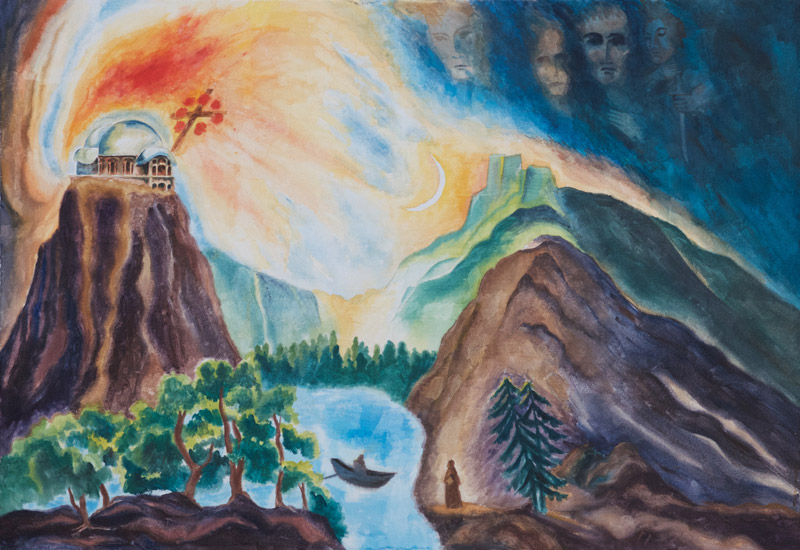
FAIR USE NOTICE: This site contains copyrighted material the use of which has not always been specifically authorized by the copyright owner. We are making such material available in our efforts to advance understanding of spiritual truths that we believe are critical in our time in lieu of the current (21st century) socioeconomic atmosphere. We believe this constitutes a 'fair use' of any such copyrighted material as provided for in section 107 of the US Copyright Law. In accordance with Title 17 U.S.C. Section 107, the material on this site is distributed without profit to those who have expressed a prior interest in receiving the included information for research and educational purposes. For more information go to: https://www.law.cornell.edu/uscode/text/17/107. If you wish to use copyrighted material from this site for purposes of your own that go beyond 'fair use', you must obtain permission from the copyright owner.
-- ed.